

Large amounts of personal information about medical professionals are available on people search sites. A new analysis by Incogni’s researchers shows how much data about doctors appears online and how easily it can be found. The findings should concern healthcare leaders who support staff safety, workforce protection, and clinical operations.
Doctors have searchable profiles
Researchers examined 786 medical doctors working in major U.S. hospitals. 97% of them appeared on at least one people search site. 72% were likely exposed on several sites. Only 3% could not be matched with enough data to create a profile.
Profiles appeared across a wide set of platforms. Some doctors showed up on ten. When information spreads across several sites, it becomes difficult for individuals to track what is exposed and where it is being reused.
Although the dataset focuses on doctors, separate research cited in the document shows that nurses face high levels of workplace violence. More than half reported incidents within the last year. Healthcare staff across different roles have also raised concerns about online harassment and unwanted contact.
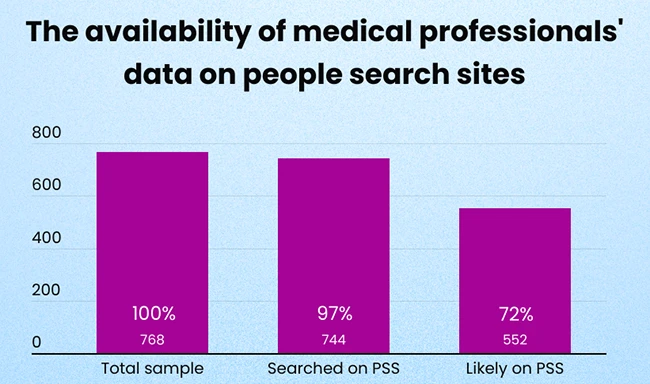
The availability of personal data for doctors mirrors the kinds of exposure nurses already face. When a home address, phone number, or list of relatives can be found within seconds, the risk of harm grows.
Exposure levels vary across groups and states
71% of female doctors and 76% of male doctors were likely exposed.
Age creates a larger gap. 66% of Millennials in the sample had data on at least one site. The percentage rises for Gen X and rises again for Baby Boomers and older doctors. Longer careers and larger public records create more material for data brokers to collect, which makes older workers easier to match.
Nevada and New Mexico had the highest exposure levels. Illinois, Alaska, and Oklahoma had some of the lowest.
These differences may result from state laws, licensing database structures, and how public records are collected or shared. Staff safety can depend on where a hospital operates, not only on the internal steps the organization takes.
Common data types found on search sites
People search sites collect:
- Contact information such as phone numbers and email addresses
- Current and previous home addresses
- Relatives and known associates
- Age and birth month
- Criminal or civil records when available
- Property and asset data
Some sites also link to social profiles, education histories, or photos. Much of this information can be viewed without payment, and some requires only a small fee.
“It’s concerning to learn how easily medical workers’ addresses, phone numbers, and family details can be found on the Internet. These professionals spend their days trying to help people, and should not have to worry about being targeted by disgruntled families or troubled patients,” said Darius Belejevas, Head of Incogni.
Open and lightly restricted details create a ready starting point for scammers, stalkers, and harassers. For healthcare workers who deal with distressed or confrontational patients, the availability of home and family information increases risk.
Data brokers drive the visibility problem
Data brokers gather information from public records, commercial databases, and third party sources, then combine these details into profiles that appear on people search sites. People search platforms sit at the end of that chain and make the information easy to query.
Doctors and nurses leave traces across various systems, including licensure databases, hospital staff directories, publication records, and local reporting on medical activity. Once this information enters broker networks, it is aggregated and repackaged into profiles that anyone can locate.
This visibility feeds into safety issues already present in healthcare settings, including harassment, stalking, intimidation, and targeted fraud. The chance of misuse rises when profiles become detailed.
Consequences for healthcare organizations
The findings raise concerns for hospitals and large healthcare systems responsible for staff safety. When personal information is easy to locate, several problems become likely for staff:
- Targeted harassment outside the workplace
- Fraud attempts that rely on personal details
- Unwanted contact with staff members
- Increased vulnerability for workers involved in sensitive medical fields
Hospitals already manage serious safety challenges. Staff in emergency medicine, obstetrics, oncology, and other fields can face hostility from patients or the public. The availability of home addresses and phone numbers adds difficulty to these situations.
