
LIVE NEWS
  • Calls for Global Digital Estate Standard as Fraud Risk Grows
  • An ode to craftsmanship in software development
  • Global economy must stop pandering to ‘frivolous desires of ultra-rich’, says UN expert | Environment
  • Some Middle East Flights Resume but Confusion Reigns From Iran Strikes
  • Clinton Deposition Videos Released in Epstein Investigation
  • Elevance stock tumbles as CMS may halt Medicare enrollment
  • Wild spaces for butterflies to be created in Glasgow
  • You can now adjust how your caller card looks for calls on Android phones
Prime Reports
  • Home
  • Popular Now
  • Crypto
  • Cybersecurity
  • Economy
  • Geopolitics
  • Global Markets
  • Politics
  • See More
    • Artificial Intelligence
    • Climate Risks
    • Defense
    • Healthcare Innovation
    • Science
    • Technology
    • World
Prime Reports
  • Home
  • Popular Now
  • Crypto
  • Cybersecurity
  • Economy
  • Geopolitics
  • Global Markets
  • Politics
  • Artificial Intelligence
  • Climate Risks
  • Defense
  • Healthcare Innovation
  • Science
  • Technology
  • World
Home»Science»3I/ATLAS photos: NASA, ESA reveal new images of interstellar comet ahead of close encounter with Earth
Science

3I/ATLAS photos: NASA, ESA reveal new images of interstellar comet ahead of close encounter with Earth

primereportsBy primereportsDecember 6, 2025No Comments5 Mins Read
Share Facebook Twitter Pinterest LinkedIn Tumblr Reddit Telegram Email
3I/ATLAS photos: NASA, ESA reveal new images of interstellar comet ahead of close encounter with Earth
Share
Facebook Twitter LinkedIn Pinterest Email


The celebrity comet 3I/ATLAS is showing itself out of our solar system for good — but not before the cosmic paparazzi at Earth’s space agencies snap some of the clearest photos of it yet.

Discovered in late June and confirmed to be the third known interstellar object in July, 3I/ATLAS has spent the past several months zooming through the inner solar system at an estimated 130,000 mph (210,000 km/h). The massive, jet-spewing snowball made its closest approaches to Mars and the sun in October. It is due for its closest encounter with Earth on Dec. 19, when it will be about 170 million miles (270 million kilometers) away — nearly twice the distance between our planet and the sun.

As the comet careens toward this astronomical milestone, spacecraft managed by NASA and the European Space Agency (ESA) are snagging as many close-up observations as possible. This week, both agencies shared new images of the comet — proving that its recent flyby of the sun has left it very bright and active as it spews large amounts of sublimated gas and dust into space.


You may like

Hubble doubles down

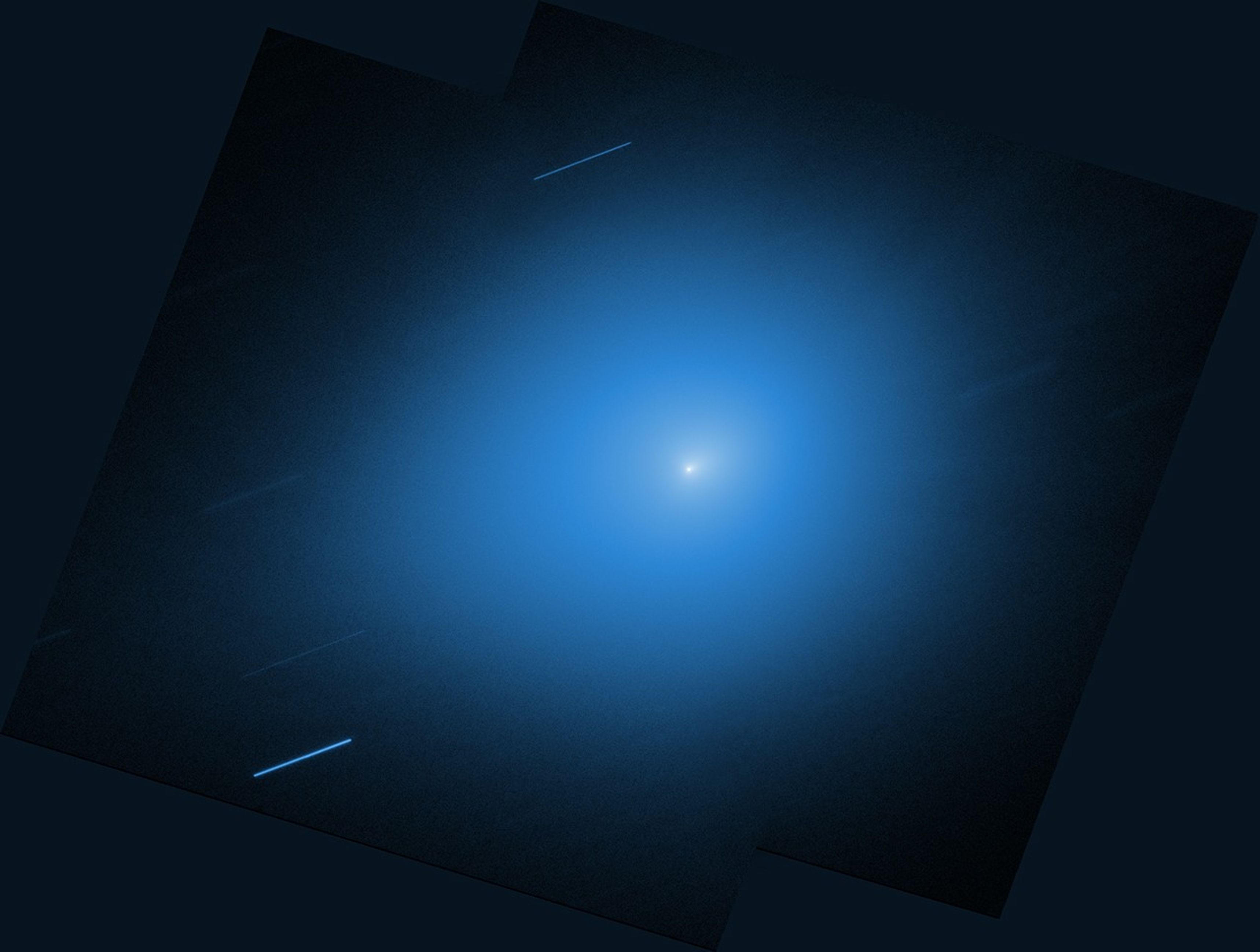
The second Hubble Space Telescope view of comet 3I/ATLAS

The second Hubble Space Telescope view of comet 3I/ATLAS (Image credit: NASA / Hubble)

On Thursday (Dec. 4), NASA shared the latest image of 3I/ATLAS taken by the Hubble Space Telescope. The glowing white dot at the center of the image shows the comet’s nucleus (its main body) and coma, the bright atmosphere of gas and dust that wraps around the comet before getting funneled into its tail. In the background, stars are stretched into long streaks as Hubble’s camera stays fixed on the fast-moving comet.

Comets typically brighten as they approach the sun, when the ice within them heats up and sublimates. Solar radiation pushes this gas into a tail that stretches away from the sun. Meanwhile, the warmest, sun-facing side of the comet may erupt with jets of gas and dust angled toward our star. Both of these features are faintly visible in the new Hubble image.

NASA snapped this image on Nov. 30, when Hubble was about 178 million miles (286 million km) from the comet. This is considerably closer than when Hubble first imaged the comet in late July. Although that first view showed little more than a blue blur, it nevertheless allowed scientists to constrain 3I/ATLAS’ size to somewhere between 1,400 feet (440 meters) and 3.5 miles (5.6 km) wide — likely the largest interstellar object seen to date.

New data from this image, including details of the coma’s composition, has yet to be released but is likely on the way.

Get the world’s most fascinating discoveries delivered straight to your inbox.

ESA juices up

A grainy image of comet 3I/ATLAS, taken from the ESA's Jupiter Icy Moons Explorer (Juice).

A new image of comet 3I/ATLAS, taken from the ESA’s Jupiter Icy Moons Explorer (Juice). (Image credit: ESA/Juice/NavCam)

Also on Thursday, ESA shared its latest view of the comet, taken by the Jupiter Icy Moons Explorer (Juice) orbiter on its way to study Jupiter’s moons for signs of life. Juice snapped the image Nov. 2, just days after 3I/ATLAS’ close approach to the sun.

Located even closer to its target than Hubble (only 41 million miles, or 66 million km, away), Juice shows us a comet brimming with activity.

“Not only do we clearly see the glowing halo of gas surrounding the comet known as its coma, we also see a hint of two tails,” an ESA spokesperson wrote in a statement. “The comet’s ‘plasma tail’ — made up of electrically charged gas, stretches out towards the top of the frame. We may also be able to see a fainter ‘dust tail’ — made up of tiny solid particles — stretching to the lower left of the frame.”

Earth gets ready

A collection of comet 3I/ATLAS images released by NASA.

Recent views of 3I/ATLAS taken by six NASA spacecraft scattered around the solar system (Image credit: NASA/Goddard/LASP/CU Boulder/JPL-Caltech/University of Arizona/Southwest Research Institute/Lowell Observatory/Qicheng Zhang/ASU/MSSS)

Juice observed 3I/ATLAS with five scientific instruments on two days. But besides this teaser image, we don’t yet know what those instruments saw; the full data set won’t reach Earth until late February 2026, according to ESA. That’s because Juice is currently using its main antenna as a heat shield to protect it during its close pass of the sun, and relying on its smaller, less efficient antenna to beam its observations back to us.

While there’s little we can learn from NASA’s and ESA’s new images without the full complement of scientific data, it’s a good reminder that human space exploration pays off in unexpected ways. Hubble and Juice number among a dozen spacecraft that have observed 3I/ATLAS from around the solar system, including Mars rovers, solar orbiters, asteroid trackers and space telescopes that were never intended to track comets.

And there’s more to come: As 3I/ATLAS draws closer to Earth, the James Webb Space Telescope will take another look at it, while countless scientific observatories and amateur astronomers will have their chance to watch it as well. When you’re dealing with a mysterious intruder from parts unknown, every observation matters.

Share. Facebook Twitter Pinterest LinkedIn Tumblr Email
Previous ArticleDell 16 Premium, Nikon ZR, Ooni Volt 2 and more
Next Article New STRATCOM Commander Correll Takes Over from Cotton
primereports
  • Website

Related Posts

Science

Wild spaces for butterflies to be created in Glasgow

March 2, 2026
Science

Rapamycin can add years to your life, or none at all – it’s a lottery

February 25, 2026
Science

2,800-year-old mass grave of women and children discovered in Serbia reveals ‘brutal, deliberate and efficient’ violence

February 24, 2026
Add A Comment
Leave A Reply Cancel Reply

Top Posts

Global Resources Outlook 2024 | UNEP

December 6, 20255 Views

The D Brief: DHS shutdown likely; US troops leave al-Tanf; CNO’s plea to industry; Crowded robot-boat market; And a bit more.

February 14, 20264 Views

German Chancellor Merz faces difficult mission to Israel – DW – 12/06/2025

December 6, 20254 Views
Stay In Touch
  • Facebook
  • YouTube
  • TikTok
  • WhatsApp
  • Twitter
  • Instagram
Latest Reviews

Subscribe to Updates

Get the latest tech news from FooBar about tech, design and biz.

PrimeReports.org
Independent global news, analysis & insights.

PrimeReports.org brings you in-depth coverage of geopolitics, markets, technology and risk – with context that helps you understand what really matters.

Editorially independent · Opinions are those of the authors and not investment advice.
Facebook X (Twitter) LinkedIn YouTube
Key Sections
  • World
  • Geopolitics
  • Artificial Intelligence
  • Popular Now
  • Cybersecurity
  • Crypto
All Categories
  • Artificial Intelligence
  • Climate Risks
  • Crypto
  • Cybersecurity
  • Defense
  • Economy
  • Geopolitics
  • Global Markets
  • Healthcare Innovation
  • Politics
  • Popular Now
  • Science
  • Technology
  • World
  • About Us
  • Contact Us
  • Privacy Policy
  • Terms & Conditions
  • Disclaimer
  • Cookie Policy
  • DMCA / Copyright Notice
  • Editorial Policy

Sign up for Prime Reports Briefing – essential stories and analysis in your inbox.

By subscribing you agree to our Privacy Policy. You can opt out anytime.
Latest Stories
  • Calls for Global Digital Estate Standard as Fraud Risk Grows
  • An ode to craftsmanship in software development
  • Global economy must stop pandering to ‘frivolous desires of ultra-rich’, says UN expert | Environment
© 2026 PrimeReports.org. All rights reserved.
Privacy Terms Contact

Type above and press Enter to search. Press Esc to cancel.