

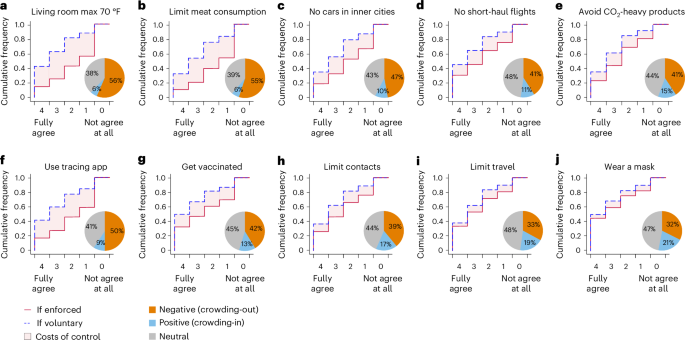
More control aversion for climate than for Covid policies
We find substantial control aversion for climate policies, at levels exceeding that for vaccination mandates and other enforced Covid measures. The pie charts in Fig. 1 show that control-averse responses are frequent across all policies (orange slices). There are also some who exhibit crowding-in, responding positively to enforcement (blue slices), possibly conditional cooperators as we hypothesized above.
Figure 1 also shows cumulative distributions of agreement under enforced (red) versus voluntary (blue) policies. Across all domains, most respondents agree with adopting the behaviour if the policy is voluntary (blue step functions, Likert levels 3 and 4). Respondents agree less if the policy is enforced (red step functions), especially for those targeting climate. Across all ten policies, enforcement provokes opposition (levels 0 and 1) from a minimum of one-fifth (Covid masks) to a maximum of three-fifths (restricting meat) of the sample.

a–e, Responses to climate policies: limiting living room at maximum 70° F or 21° C (a), limiting meat consumption (b), no cars in inner cities (c), no short-haul flights (d) and avoiding CO2 heavy products (e). f–j, Responses to Covid policies: using tracing app (f), getting vaccinated (g), limiting contacts (h), limiting travels (i) and wearing a mask (j). Pie charts show the shares of types of responses to enforced versus voluntary policies. Responses to enforcement are negative (reflecting control aversion or crowding-out) if agreement is lower in case of enforced rather than voluntary policies and analogously for positive responses (crowding-in). The underlying choice distributions are provided in Supplementary Fig. 1. Cumulative distributions show agreement in case of enforced (red) versus voluntary (blue) policies. For example, the cumulative distributions in a show the percentage of respondents who fully agree (agreement level 4) with limiting room temperature if it is enforced or voluntary, that is, 15% or 43%, respectively. The sum of those expressing agreement levels 3 and 4 amounts to 25% or 63%, respectively, in the enforced or voluntary cases. Strongest opposition (agreement level 0) was expressed by 43% or 11%, respectively, if enforced or voluntary (the final step on the right in the upper left graph). The light red area between the two-step functions shows the cost of control. To control for their possible impact on the climate questions, 40% of our sample were not asked the Covid questions. Accordingly, for the climate policies in a–e, sample sizes are n = 3,272, n = 3,262, n = 3,268, n = 3,269 and n = 3,263, respectively; and for the Covid policies in f–j, sample sizes are n = 1,953, n = 1,951, n = 1,948, n = 1,949 and n = 1,949, respectively.
The area between the blue and red step functions is what we term the ‘cost of control’ on citizens’ attitudes, namely the average difference in agreement between the voluntary and enforced cases. The measure captures both the frequencies of types of responses to control (as indicated by the pies in Fig. 1) as well as the different strength of their responses in the two cases (the step functions).
Averaging across the two sets of policy domains, the cost of control is 52% greater for climate than for Covid policies (95% CI: 0.40, 0.65; Supplementary Equations (1) and (2)). The persistence of our panel-based measures of control aversion covering 2 years of exposure to Covid policies12,13, provides no evidence that the costs of control would be substantially reduced by peoples’ mere exposure to mandated climate policies.
We exploit our available data in the two domains, climate and Covid, to better understand the nature of control aversion as a psychological trait. Thus, we analyse control aversion across the ten different policies using principal components analysis. As shown in Supplementary Fig. 3, the first three principal components appear to capture, respectively, (1) generic control aversion as a psychological trait, irrespective of the particular policy, (2) differential responses to Covid and climate policies and (3) a component we interpret as the degree of personal invasiveness of the policy (changing diet or room temperature, getting vaccinated or a tracing app may be perceived as invasive, unlike less invasive policies such as, say, mask wearing).
On this basis, we consider control aversion to be a generic psychological trait with domain-specific aspects, some of which are susceptible to policy design. We will also provide evidence that in the policy-specific domain, the extent of control aversion is not fixed and can be substantially mitigated or even reversed by people’s attitudes and beliefs.
Belief in policy effectiveness may crowd-in agreement
Figure 1 shows that the level of agreement with adopting the targeted behaviour is substantial and differs little across voluntary policies. However, negative responses to enforcement differ markedly, control aversion being particularly pronounced for the policies we term invasive (Supplementary Figs. 2 and 3).
In regression models (exemplified by cars in Fig. 2a) we find similar patterns for all policies. Not surprisingly, trust in public institutions and climate concern increase agreement and also for some policies mitigate control aversion. However, the associated effect sizes along with the sociodemographics are modest (Supplementary Fig. 4 shows the full regressions for all climate policies).

a,b, Linear regressions for attitudes and beliefs (a) and political party inclination (b) for the example of not using cars in inner cities predicting agreement in case of voluntary (blue) and enforced (red) policies (left) and predicting control aversion (right). Parties in b are ordered according to their seating in the German parliament corresponding to their political orientation from left (The Left, at the top) to right (AfD, at the bottom). Shown are the estimated normalized coefficients and the 95% CIs. The full set of regressions including sociodemographic controls (not shown here) for all the five climate policies is provided in Supplementary Figs. 4 and 5 as well as Supplementary Tables 2 and 3. The sample sizes for a are n = 3,067 if voluntary, n = 3,066 if enforced and n = 3,063 for control aversion. The sample sizes for b are n = 2,463 if voluntary, n = 2,463 if enforced and n = 2,459 for control aversion. c,d, Belief in the effectiveness of a policy (c) and not feeling restricted in one’s freedom (d) may reduce control aversion. Average difference in agreement in case of voluntary versus enforced implementation of a policy (in Likert scale units) depending on participants’ beliefs in policy effectiveness (c) and perceived restriction of freedom in the mandated case (d). A positive average reflects average control aversion (crowding-out) on the sample level, whereas a negative average reflects crowding-in. Perceived freedom restriction and belief in policy effectiveness were measured on a five-point Likert scale (as explained in Supplementary Table 1). Data are represented as mean values with 95% CI. The underlying distributions are shown in Extended Data Fig. 1. The sample sizes depend on the number of respondents on the two extremes of the effectiveness and freedom restriction scales. In c, sample sizes for climate policies are (in the order of the bars from left to right): n = 434, n = 518, n = 479, n = 614, n = 381, n = 772, n = 223, n = 1,329, n = 254 and n = 775; and for Covid policies, sample sizes (in the order of the bars from left to right) are: n = 546, n = 180, n = 253, n = 889, n = 191, n = 547, n = 193, n = 588, n = 191 and n = 923. In d, sample sizes for climate policies are (in the order of the bars from left to right): n = 946, n = 690, n = 962, n = 496, n = 800, n = 736, n = 457, n = 1,397, n = 473 and n = 636; and for Covid policies, sample sizes (in the order of the bars from left to right) are: n = 386, n = 729, n = 415, n = 836, n = 494, n = 273, n = 390, n = 422, n = 298 and n = 716.
An individual’s self-assessed measure of altruism is associated with both greater agreement in the case of voluntary policies and heightened control aversion. This is in line with the mechanism underlying the crowding-out phenomenon: pre-existing pro-social motivations are diminished by control, and for entirely self-interested subjects, there is nothing for control to crowd out14.
As expected from cross-national and other evidence15,16, an important predictor of agreement in both the voluntary and enforced cases is the belief that the targeted behaviour is an effective way to address the climate challenge (Fig. 2a and Supplementary Fig. 4). In most cases, belief in policy effectiveness also strongly mitigates control aversion. This is consistent with the psychologist M. Lepper and his coauthors’ reference to the “detrimental effects of unnecessarily close… supervision or the imposition of unneeded temporal deadlines” or other “superfluous constraints” (see page 62 of ref. 17). In Lepper’s framework, an ineffective policy would be more likely to crowd out positive motivations because it would be seen as ‘unnecessary’, ‘superfluous’ or ‘unneeded’.
Figure 2c illustrates the substantial reduction of control aversion associated with a strong belief in policy effectiveness. Among those convinced that mask wearing and travel limitations are effective, enforcement actually crowds-in agreement, average agreement being greater for enforced than for the voluntary implementation.
From our panel survey data on Covid measures following the same respondents over the course of the pandemic, we also know that the degree of agreement changes when beliefs and attitudes change12,18. This has important implications for policy design, even though we cannot establish that the differences in agreement associated with the belief in effectiveness in Fig. 2c represent causal effects. For example, an avid driver who is concerned about climate but also strongly opposed to restrictions on the use of cars in city centres may be more comfortable believing that car bans are not an effective way to address climate change. Here the causal effect would run from disagreement with the targeted behaviour to a belief in the ineffectiveness of the policy.
Nonetheless, changing peoples’ beliefs about policy effectiveness could support agreement with the targeted green behaviour. If a person came to believe that, say, banning cars from cities was effective in mitigating climate change, dropping one’s opposition to the car ban would reduce cognitive dissonance19.
However, the climate policies we identified as invasive (reducing meat consumption and room temperature) are distinctive in this respect: control aversion in these cases appears to be immune to respondents’ belief in policy effectiveness, trust in public institutions or concern about climate change. It appears that aversion to violations of one’s perceived personal space20 (here affecting a person’s body) may have a lexical priority that is not readily ameliorated by policy design, suggesting that responses were based on feelings rather than cognitive assessments21.
Control ‘restricts my freedom’
The psychological basis of control aversion is termed reactance, introduced by J. W. Brehm22 and described as an “an unpleasant motivational arousal that emerges when people experience a threat to or loss of their free behaviours”23. For all five of the climate policies, the respondents’ perception that an enforced policy ‘restricts my freedom’ is the most important predictor of control aversion (Fig. 2a and Supplementary Fig. 4).
Figure 2d shows that those who believe that the enforced version of the policy ‘does not restrict my freedom at all’ are much less control averse. (Again, we cannot establish this relationship as causal.) Similar to the belief in effectiveness, for those who do not perceive wearing masks and travel limitations as freedom restrictions, enforcement crowds in agreement.
The climate policy for which respondents were least likely to feel that enforcement restricts their freedom (Supplementary Table 1)—limiting short-haul flights—is also the policy for which there are the fewest control-averse types (as evident from Fig. 1).
While an important predictor of control aversion, the perception that an enforced policy restricts freedom is not as common as one may think. Although differences among the policies are substantial, for none of the ten climate and Covid policies is there a majority that has this sentiment (between 25% and 48%, for the cases of short-haul flights and meat, respectively, either weakly or strongly feel that mandates would restrict their freedom). A challenge for climate policy design is not only that they tend to be perceived as more freedom restricting, but also that it is more difficult to frame adopting a green lifestyle as freedom-enhancing compared with Covid policies (for example, successful mask and vaccination mandates restore freedom of travel and in-person interactions).
Consistent with the importance of the sense that control ‘restricts freedom’ as a contributor to control aversion, the heightened and robust control aversion for limiting meat consumption and home heating may also reflect that suitable alternatives are lacking, which has been shown to have important effects on climate policies in other settings24. The availability and attractiveness of green alternatives (for example, plant-based food and heat pumps) may thus be critical in supporting higher levels of agreement and mitigating control aversion by reducing perceived freedom restrictions. For example, decent train connections in Europe may be a reason why ‘limiting short-haul flights’ is seen less as restricting freedom and evokes less control aversion among Germans than other policies.
We also find that control aversion as well as agreement in the voluntary and enforced cases of policy implementation are associated with political party affiliation (as shown in Fig. 2b and Supplementary Figure 5). Respondents leaning towards the more left-wing parties express higher agreement, while in particular supporters of the German right-wing populist party AfD agree less with the behaviours targeted by the climate policies. Left-minded respondents are less control averse and right-wing supporters are more control averse—except for policies we term privacy intrusive, where political party support has no explanatory power.
We conjectured that there might be two framings that might mitigate or even reverse crowding-out: conditional cooperation and moral values. First, following our above reasoning about conditional cooperators, knowing that free-riders would be punished should make people feel more comfortable contributing. Second, derived from the theory of the expressive function of law25,26, we framed limiting our carbon footprint as a shared moral imperative for which we hypothesized that prohibition would affirm society’s values rather than limit one’s freedom. These framings (compared to a neutral or no frame, as shown in Supplementary Table 4) had virtually no effect on respondents’ agreement levels and failed to mitigate crowding-out.
Does our evidence suggest that mandates to alter individual behaviour should be abandoned by policy-makers? This is not an implication of our results. We illustrate this using a model of policy design as an equilibrium selection problem.
Mandates designed to escape a carbon trap
Imagine a policy-maker who intervenes in a dynamic process seeking to displace a society from a carbon trap to a green equilibrium, despite the presence of control aversion.
Consider a ban on cars in city centres, except for electric cars. Assume that in the absence of the ban, e-vehicles (EVs) will remain a small fraction of all vehicles, but consistent with our results, introducing the ban will crowd out green attitudes, reducing the value that people place on driving an EV as a climate mitigating action. We show that in this setting, even a temporary ban nonetheless can induce a dynamic of EV adoption, leading most people to give up conventional cars. Here the policy designer uses a mandate (temporary car ban) to induce a shift from a self-sustaining carbon trap to a self-sustaining green equilibrium (termed equilibrium selection).
To represent this process, we extend a model of EV adoption developed by the second author as a member of the CORE team27. In the model, there are two kinds of vehicle—powered by either conventional carbon-based internal combustion (c-vehicles) or electric batteries (EVs). The costs of owning and operating an EV are lower the more other EV-users there are, for two reasons.
First, if there are few EVs, then building charging stations will not be profitable, so they will be rare and far between. Second, economies of scale in the EV production imply that the more are being produced, the lower the price at which they can be sold for a profit. We assume that the costs of owning and operating a c-vehicle, by contrast, do not depend on the number of other c-vehicles on the road. These assumptions are illustrated in Fig. 3a, were cc and ce(et) are the costs of operating a conventional and an electric vehicle, respectively, and et is the fraction of all vehicles that are electric in period t.

a, Costs of operating EVs and c-vehicles. b, Adoption dynamic curves (ADCs) without and with a car ban. In b, the solid blue line is the initial ADC. An equilibrium is any point where the ADC crosses the ray from the origin (fraction of EVs unchanged). There is a green EV equilibrium (G) and the status quo brown carbon-based equilibrium (B). The arrowheads on the blue solid ADC show the out-of-equilibrium dynamics of the system. Both the carbon-based (B) and the EV-based (G) equilibria are stable, while T, a tipping point, is an unstable equilibrium. The dashed ADCs show the effects of substantial (red) and less substantial (blue) crowding-out due to control aversion in reaction to the car ban.
In the model, people value an EV as a climate mitigating action. We capture this green value by vi, defined as the additional cost of an EV that makes individual i indifferent between the two modes of transport.
We assume that v is normally distributed with parameters such that some people prefer EVs even if few are being produced and consequently the cost disadvantage is substantial. Correspondingly, we assume that a few are sufficiently pro-carbon that they will not purchase an EV, even if all other households had done so, as a result incurring higher costs than those driving EVs.
In any period, a fraction of people buy a new vehicle, with person i purchasing an EV if ce(et) − vi < cc. Figure 3b shows an adoption dynamics curve (ADC) indicating how many will be driving electric vehicles next period (t + 1), for every level of EV owners as a fraction of all drivers this period (t). The convex and then concave (S-shaped) nature of the ADC results from the normal distribution of green values, v, combined with economies of scale in the production of EVs (Fig. 3a). Similar ADCs, but instead based on conformist preferences, are the foundation of models of the social multiplier of policy interventions18,28.
The imposition of a ban on c-vehicles in cities has two countervailing effects. First, it undermines individuals’ green values vi, resulting in a control-averse response to the ban (which we have documented), shifting the ADC down. Second, the ban increases the cost of operating a c-vehicle (which would need to be supplemented by taxis or public transport), shifting the ADC up.
In a worst-case scenario as illustrated by the red dashed line in Fig. 3b, the crowding-out effect dominates the effect of increased cost for c-vehicle owners to such an extent that it shifts the ADC so far down that there is no green equilibrium that would be self-sustaining in the absence of a permanent mandate.
The case represented by the blue dashed curve—moderate crowding-out—is more optimistic: a car ban that led the fraction of individuals buying EVs to exceed Z′ (corresponding to the new tipping point T′) would induce further voluntary adoptions of EVs. This would then allow the ban to be rescinded, possibly restoring the initial ADC (solid blue line) if the reactance resulting from the ban does not persist once the ban is rescinded and resulting in a convergence to the green equilibrium G. Knowing the underlying dynamics of EV adoption, the policy designer could thus intervene with a temporary ban to select the green equilibrium, which, once attained, is sustainable in the absence of the ban.
Thus, the fact that bans or mandates induce control-averse responses does not imply a rejection of such policies. The possibility that policies may crowd out pre-existing green values substantially complicates the policy designer’s problem and requires an overhaul of the conventional approach to policy as formalized in the economic field of mechanism design.
Climate policy as a mechanism design problem
Mechanism design is the economics analogue to engineering. Having identified a goal (for example, reducing greenhouse gas emissions), the mechanism designer derives mechanisms (rules of the game) to be implemented by policies such that, given citizens’ values and beliefs, acting independently they will behave in a way that implements the mechanism designer’s goal.
We extend the conventional assumptions of mechanism design in two ways: recognizing the plasticity of green values as well as the fact that successful green policies must be politically sustainable.
First, as opposed to the conventional view taking actors’ values and beliefs as given, we recognize that they may be adversely affected by the mechanisms introduced (as our evidence that green values may be crowded out shows). These effects may include negative spillovers, whereby a control-averse response to a particular policy (for example, ban on cars) is extended to climate policies more generally, undermining support for related interventions29. An example is control-averse responses to mask and vaccination mandates during the pandemic, which appear to have spilled over to generalized hostility towards health professionals and eventually towards governments and the entire scientific community.
These negative spillovers are also possible in the cases we have studied, because the degradation of green values due to control aversion may not be specific to particular policies (consistent with our principal component analysis above). Thus, the adverse side-effects of enforced policies targeting individual lifestyles potentially spill over and undermine support for other needed interventions.
Second, we abandon the static view where the policies under consideration will be set in place by some fictive mechanism designer. Instead, we conceive policies as the result of a democratic political process and a successful policy must be sustainable given this process. We will illustrate our extensions of mechanism design by the example of our empirical data—crowding-out in response to mandates or restrictions. However, our extension of conventional mechanism design applies more generally, including the use of monetary incentives or penalties.
Figure 4 presents both the conventional mechanism design approach and our proposed extensions that recognize the importance and plasticity of citizens’ values and beliefs along with the requirement that policies must be sustainable. The green labels illustrate an application of one of our empirical results, namely the likely control-averse reaction to a ban on cars in cities. The black labels represent the general case.

This representation is an extension to environmental policy of a model of the general problem of optimal policy design with endogenous preferences5,6. Labels in black represent the main concept, labels in green illustrate an environmental policy, the purple dashed arrow shows what is neglected in the conventional approach and is the focus of this article; other effects are represented in grey.
In the standard economic approach, the policy-maker implements a set of incentives (including penalties for violating prohibitions) to alter the expected economic costs and/or benefits of some targeted pro-social or pro-environmental action, as represented by the two causal arrows in the upper part of Fig. 4.
However, as our evidence shows, policies affect not only the material benefits of taking an action, but also the citizen’s values (negatively or positively, represented by minus and plus signs on the dashed purple arrow). In the standard approach, the policy designer does not take account of the purple dashed arrow in the lower part of the figure, either because the citizens’ values motivating the targeted green action in the absence of the policy are assumed to not exist or, if they do, are assumed not to be affected by the policy.
Our evidence of a negative effect of a car ban on citizens’ desire to limit their own car use is illustrated by the purple dashed arrow, which by our evidence, has a negative sign—unless (as we have seen) citizens’ belief in the effectiveness of the ban were sufficient to mitigate or even reverse this control-averse response, or if the ban is not perceived as restricting freedom.
Also shown in Fig. 4 are possible adverse effects of incentives on citizens’ values that spill over to other environmental actions. For example, a control-averse reaction to a car ban may degrade citizens’ pro-environmental policy preferences and support for the political movements advocating them. This may compromise citizens’ future advocacy in support of or opposition to the car ban itself, represented by the lower arrow from citizens’ political action to policy.
The importance of green values and their plasticity with respect to policies suggests that a valuable addition to the environmental policy-maker’s toolbox are approaches to not only avoid crowding-out, but also to cultivate green values. Exploring this crowding-in opportunity requires going beyond the usual framework for the study of institutions and policy design.
