

HUNTSVILLE, Ala. — Drones are profoundly changing the Army’s approach to aviation and combined arms training, Maj. Gen. Clair A. Gill, commanding general of the U.S. Army Aviation Center of Excellence, told Military Times in an interview.
During the Army’s first annual Best Drone Warfighter Competition in Huntsville, Alabama, the Fort Rucker-based aviation chief shared his insights about the impact of drones on military doctrine.
“The application of drone technology is only limited by your creativity,” he said. “It’s this constantly evolving game of technology and craftsmanship to create the desired effect that you want on the other end.”
While Army aviators are no strangers to unmanned systems, drones being fielded today are immensely different from those developed over the last two decades, many of which tended to be larger and required more manpower to operate, Gill said.
“In the last five to 10 years I would say we have seen a complete shift in what drone technology is and how it can be used,” Gill said. The net result, he added, is that drones are “no longer just the purview of Army aviation.”
“I would argue now with the proliferation of small drones and how cheap and effective they can be that Army aviation is just one minor user now. … Everybody is going to have drones in the airspace to some degree.
“It’s going to change everything. The nature of war is the same. It’s always an endeavor of human conflict. But the character of war is just fundamentally different.”
Lessons from Ukraine
Drones have been used successfully as a force multiplier in a variety of global conflicts, from Nagorno-Karabakh in Azerbaijan to the Middle East and Ukraine.
While the U.S. Army is adapting its approaches based on observing other forces around the world, Gill stressed that there is no “one-size-fits-all” approach to drone warfare.
The U.S. Army must develop drone combat doctrine in line with its unique capabilities, he said.
“We’re not the Ukrainian army, nor are we the Russian army,” he said. “We just fundamentally operate differently.”
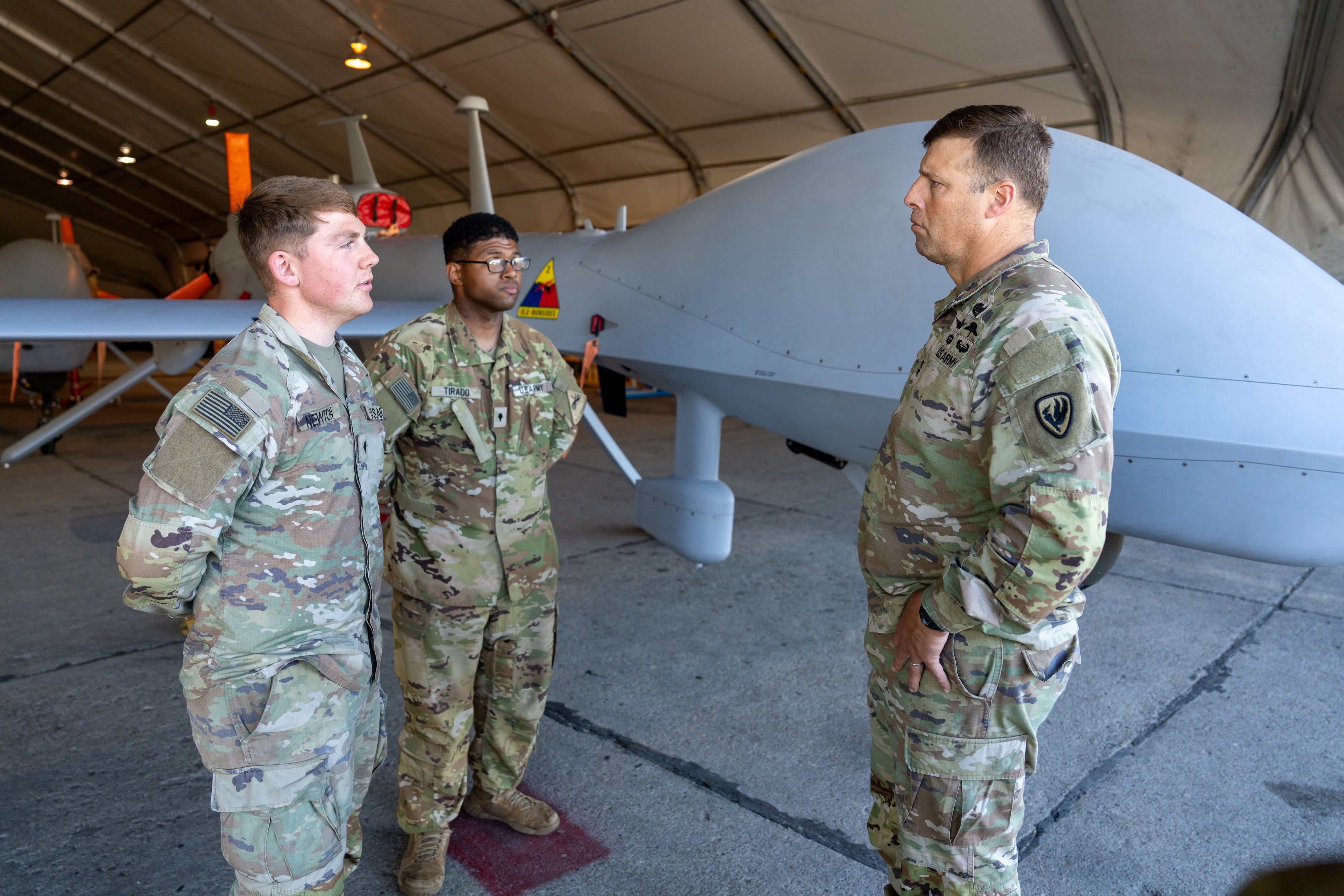
Gill told Military Times that observers from the Army Aviation Center of Excellence are currently embedded with Ukraine’s Security Assistance Group, or SAG-U, to study lessons from the conflict.
However, fighting methods from Ukraine should not be broadly applied to American forces, he noted, due to differences in U.S. tactics and capabilities.
“We would be fools not to pay attention and not to take a lot of lessons from them, which we’re doing, but we can’t take the wrong lessons,” Gill said. “Just because it didn’t work in Russia-Ukraine doesn’t mean it might not work for us.”
Project Victor
The tactical element of the Army’s drone competition gave soldiers the chance to test drone aviation abilities while leveraging field skills on a hunter-killer mission, during which each team was afforded a single reconnaissance FPV drone and up to five “killer” drones.
“That really is the application of the technology,” Gill said. “They have to be able to use the technology in the context of what it is that we do, not just fly the drone.”
The tactical challenge gave leadership an opportunity to observe with the aim of refining training, doctrine and approaches to drone combat operations.
Gill explained that restructuring within Army commands has allowed analysis teams to be established at each Army Center of Excellence, including those dedicated to aviation, maneuver and fires.
“We’ve restructured our subordinate teams and we have something called a Transformation Integration Directorate, TID, and within them they have a Transformation Lesson Learned Manager, a TLLM,” he explained.
These managers are responsible for evaluating all observations and establishing what lessons are useful to the Army before uploading them into a new database system called Project Victor.
Powered by generative AI technology, the system will give soldiers broad access to whitepapers, studies and useful information about operating drones in the field.
“That should be a database where any soldier can just go in,” he said. “That should be up and running by this summer.”
Enduring need for human pilots
Despite the nearly unlimited applications of drones in war, Gill emphasized that they will never replace the ability of humans and do not compensate for the skills of trained Army aviators.
“Ultimately, to put an assault force onto an objective, you need manned aviation,” he said.
Gill cited the recent operation to capture Venezuelan leader Nicolás Maduro as an example of the finesse Army aviators bring to the table.
“That was a very exquisite demonstration with some our best aviators and some of our best aircraft,” he said. “We continue to crank out the world’s best rotary aviators.”
The enduring need for human expertise was borne out in the tactical lane of the competition itself, as some teams experienced difficulty using the drones and soldiers tapped into combat training fundamentals for success.
“A lot of people seem to think that because we’re moving so quickly in the unmanned space that it means we’re moving away from the manned space,” Gill said.
“We need to have both.”
Zita Ballinger Fletcher previously served as editor of Military History Quarterly and Vietnam magazines and as the historian of the U.S. Drug Enforcement Administration. She holds an M.A. with distinction in military history.
