

BERLIN — With North Korean soldiers and equipment playing a key role at Russia’s front line in Ukraine, some experts worry Moscow may be ready to return the favor by providing highly sensitive information on nuclear submarines to its newfound ally in Pyongyang.
Russia could trade away what Peter Roberts, associate fellow at the University of Exeter’s Centre for Public Understanding of Defence and Security, described as the “crown jewels of military knowledge,” if Moscow runs out of things to offer Pyongyang in exchange for Kim Jong Un’s support.
Roberts was speaking as an expert before the U.K. Parliament during a Feb. 10 hearing on undersea activity.
North Korea’s role in Russia’s war against Ukraine has become vital for the Kremlin. According to South Korean intelligence, the North has suffered 6,000 casualties fighting for Russia. It is also supplying millions of artillery shells, ballistic missiles, and various types of vehicles and gear.
“It used to be that to get North Korean weapons or North Korean soldiers to fight in Ukraine for [Putin] … he would trade away ballistic missile technology and knowledge. Well, he has done that − it has sort of gone,” Roberts told British lawmakers. “You are now starting to see what is potentially the leaching and offering of submarine expertise to states like North Korea and Iran in exchange for key capabilities, whether that is mass drone manufacturing or engineers being put to the frontline in Ukraine.”
This would represent a significant step in the military ties between the two countries and signal a level of desperation among Russian policy elites. According to Roberts, “previously, nuclear submarine operating knowledge was something you never shared. It was kept within a strictly confined group of people. These were the crown jewels of military knowledge.”
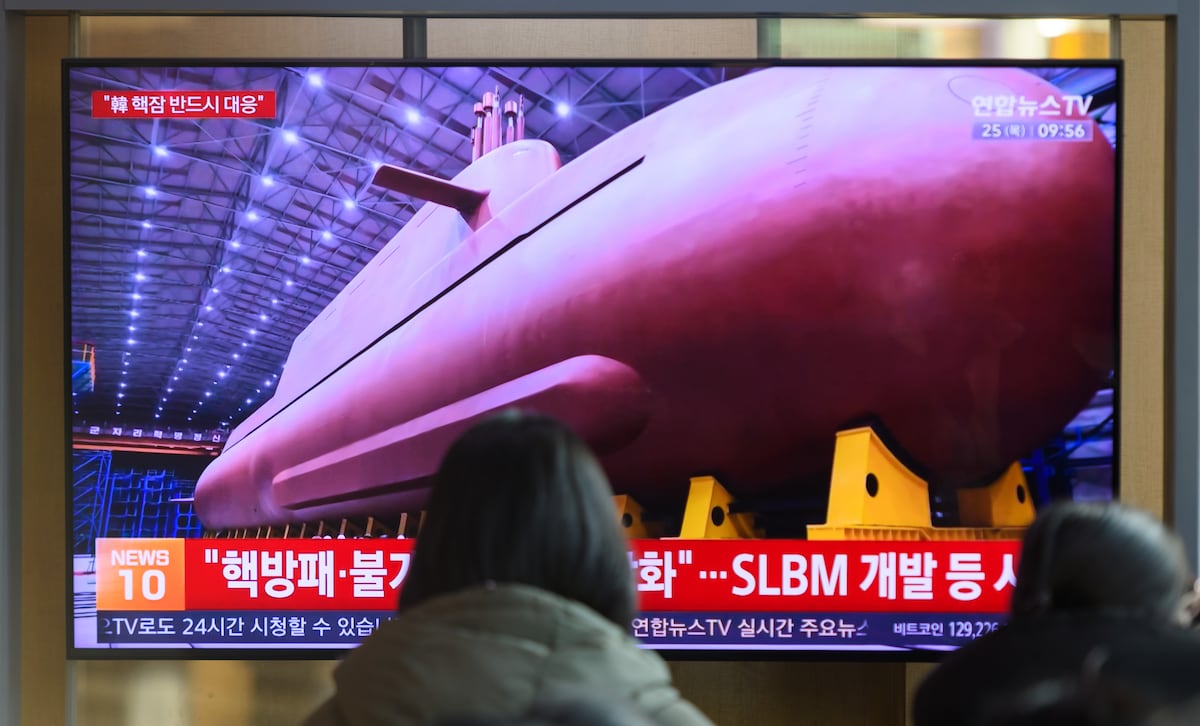
On Dec. 25, 2025, North Korean state media broadcast images of Kim Jong Un inspecting an “8,700-ton nuclear-powered strategic guided missile submarine” at the Sinpo shipyard — the most detailed look yet at a program Kim has prioritized since at least 2021. Seoul-based analysts noted that the fully assembled exterior suggested reactor installation was likely complete, with one former South Korean submarine officer estimating the vessel could be ready for sea trials within months.
“They’ve definitely been pursuing this for some time,” John Ford, a research associate at the California-based James Martin Center for Nonproliferation Studies, said of North Korean ambitions to develop a submarine component to its nuclear deterrence.
In an interview with Defense News, he said the regime is building what he called a “jank triad” − far from advanced, but sufficient to make any enemy think twice about whether to attack a country with a nuclear second strike capability that may work “well enough.”
In nuclear deterrence parlance, a country has completed a triad when it can launch nuclear weapons from land, air and sea.
North Korea has on several occasions shocked observers when it attained complex technological goals on its own that analysts thought would take many more years to figure out, such as producing a nuclear bomb, miniaturizing it, placing it atop a missile, and making progress toward a functioning re-entry vehicle.
“For subs, there’s a lot that can go wrong,” said Ford. “You’re basically taking all that previous stuff, and then you’re amplifying it − now it needs to be underwater.”
“The actual skill of operating underwater is something that they just don’t have. And unless Russian navy submariners are doing ride-alongs and training them, which I don’t think would be happening − even then, it would take a really long time,” said Ford.
But there are signs that North Korea’s leadership is getting its fair share out of the support for Putin’s war efforts. For one, Russian experts have been making repeated trips to the DPRK, though, due to the secrecy of both countries, few details are known about what they do there.
And in September 2025, South Korea’s military said it had obtained intelligence suggesting Russia supplied North Korea with two to three nuclear submarine propulsion modules − reportedly salvaged from decommissioned Russian submarines − including a reactor, turbine, and cooling system. Seoul said at the time it was working to verify the information.
However, Ford said he remains “very skeptical” that Russia has handed over the most sensitive elements of its submarine expertise
“Nuclear weapons designs: impossible,” Ford said. “Propulsion? More possible, but still very unlikely.”
Countries, as a rule, don’t trade their most closely held military knowledge, Ford noted. Russia has particular reasons for caution: intelligence transferred to North Korea could leak to Seoul via human intelligence networks, meaning Moscow would effectively be giving South Korea a window into its own reactor designs.
And even if Russia shared some information on how nuclear submarine propulsion works, North Korea would still need to bridge the gap between theoretical knowledge and practical implementation, something Ford notes took the Soviet Union and the U.S. decades to master during the Cold War.
There are also institutional barriers. “The people in Russia who are responsible for holding and maintaining this information will object to it being shared,” Ford said − although Putin ultimately has the authority to override them.
There is a difference between handing over the blueprints and providing more iterative tech support, such as answering questions or confirming whether components are correctly placed, as Ford says happened in previous proliferation cases, such as tacit U.S. assistance while France was developing its own nuclear weapons.
And Russia likely has more leverage in the relationship than popular reporting suggests. The primary compensation North Korea is receiving from Russia remains cash, Ford argues, which Pyongyang − isolated by some of the harshest UN sanctions ever imposed − has long been chronically short on. The government channels it into domestic development, from manufacturing capacity to infrastructure. Technical assistance from Russia, if it exists, is secondary and likely more constrained than the most alarmist assessments imply, said Ford.
What is not in dispute is the regime’s ambition. Kim has made the nuclear submarine a stated political priority, visited the Sinpo shipyard repeatedly, and invoked the language of a “nuclear shield.” At the country’s Yongbyon nuclear research center, Center for Nonproliferation Studies analysts have flagged new construction that may be a submarine reactor testbed.
Linus Höller is Defense News’ Europe correspondent and OSINT investigator. He reports on the arms deals, sanctions, and geopolitics shaping Europe and the world. He holds a master’s degrees in WMD nonproliferation, terrorism studies, and international relations, and works in four languages: English, German, Russian, and Spanish.
