

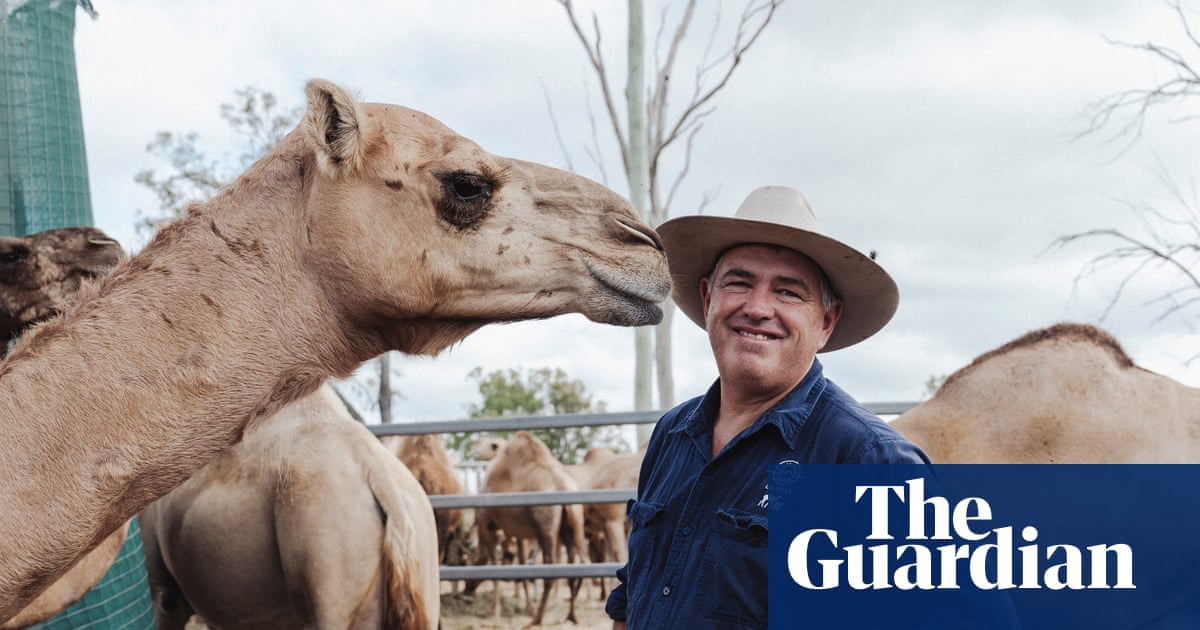
Caroline’s sultry and soulful eyes are hooded and heavy-lashed.
“She’s straight out of central,” Paul Martin whispers, gazing at his star performer with admiration.
Martin is not speaking of central casting – the camel farmer is referring to the Central Desert region of Australia, where at least half a million of Caroline’s kin roam wild.
Now far from feral, Caroline quietly chews cud as suction cups on her teats gurgle away, hoses connected to 8-litre glass bottles filling up with pure white milk.
Behind Caroline is Mildred, the second in a line of 10 in this open-air dairy shed, an hour’s drive from the metropolis of Brisbane and thousands of kilometres from Australia’s arid heart. Instead of red dunes and vast spinifex plains, these camels are surrounded by lush pasture and a horizon of jagged and wooded peaks.
After a decade of supplying the domestic camel milk market from this 130-hectare (320 acre) farm in south-east Queensland’s Scenic Rim – one of the first commercial camel dairies in Australia – Martin wants to start supplying the stuff to the US. He hopes to export 60,000 litres this year – the first shipment in what he believes could one day become a major new commodity for a country that, it was once said, was built off the sheep’s back and is now among the world’s biggest beef exporters.
And camels like Caroline could hold the key to farms such as Martin’s in building that market. Because she is producing more than double the milk of the average wild-caught camel, Caroline’s bloodline could help build more productive herds in decades to come.
“This is where the cow dairies started 200 years ago,” Martin says of the genetic selection. “People might look back at this in 20 years’ time, when all the camels are doing eight litres [of volume].”
Unlike cows, however, camels can “hold their milk”, he says – or refuse to release it. So like all true divas, that means camels like Caroline have to be coaxed, not coerced into their new roles in the dairy. Instead of pulling at nose rings and shouting to train these big wild-caught beasts, Martin and his milkers spend a lot of time thinking about camel psychology. He talks of endorphin release, reward feeding, herd structure and keeping calves close by the milking shed.
“Once you do that with these animals, they’re like a grass-eating labrador,” Martin says. “They could sit on your lap … if they weren’t so heavy”.
Exporting any milk across the Pacific Ocean, let alone one so niche to the western diet, might seem like wishful thinking. But Martin takes a glass-half-full approach – and Australia, he argues, is uniquely positioned to build a new industry.
Camel milk, he says, is naturally homogenised, giving it a unique ability to freeze, thaw and reconstitute well, meaning it can be shipped in bulk. The milk is more similar to that of humans than cows – it lacks the protein beta-lactoglobulin, the major allergen in cow’s milk.
For this reason, people with allergies and a range of conditions from diabetes to eczema were among the early non-traditional drinkers of camel milk. This protein profile has also seen it marketed as a “superfood”, leading to an interest from people exploring wellness diets and gut health.
But camel dairies are not only supplying emerging customer bases, but ancient ones. Camel milk has been a staple in east African and Arab cultures for millennia – and many among those migrant communities have not lost their taste for it.
“We’ve had the same sort of broadacre approach to food as the US, so our health issues are pretty similar,” Martin says. “They have the same dynamics of Somali and Arab communities as well – but they just have a lot more people”.
What Australia has that the US does not, though, is a lot of feral camels.
“That’s where Australia has a unique advantage: we have the massive nucleus of a herd there,” he says. “If we don’t cull them all, that is.”
Culling, however, was exactly what the Australian government undertook on a mass scale between 2010 and 2013, during which the population of camels halved to about 300,000.
Policy director at the Invasive Species Council, Dr Carol Booth, says culling is the only realistic way to control these feral animals which “inflict enormous damage” to desert ecosystems, Indigenous cultural sites, remote communities and pastoral properties.
Feral camels, she says, befoul precious desert water holes, devour and trample huge amounts of vegetation, destabilise dunes and cause erosion and outcompete native wildlife.
“People keep coming up with these ideas, which sound great from a commonsense perspective,” Booth says.
“But if the claim is that commercial use [of camels] will help solve [those problems], I would say: that’s biological bunkum.”
Just preventing the feral camel population from growing would require a harvest of about 40,000 camels a year, she says, a muster which would be commercially impossible across the 3.3m sq km swathe of remote Australia over which camels roam.
Feral camel management, she says, should instead be based on “biology and a realistic assessment on what is feasible”.
Such an assessment was done in a government review of that three-year cull, which found the cost of and logistics of mustering in swathes of remote Australia “prohibitive”.
But the Australian feral camel management project’s final report also found a “strong preference” among traditional owners for population control via commercial use. And commercial use of camels, it found, could “contribute” to feral camel control in “targeted areas”.
Ultimately, the report recommended the camel industry reduce its reliance on feral harvest and build captive herds.
One of those captive herds holds a special place in the heart of Faysel Ahmed Selat, president of the Queensland African Communities Council.
Ahmed Selat was born in Somalia to a family that owned and revered camels.
There, people drink camel milk daily, he says, drinking milk fresh from the animal and using it as a medicine. Somalis ferment the milk and use it in traditional dishes like ugali; camels are eaten and ridden.
But to Somalis, camels are more than a source of protein and transport. The camel, Ahmed Selat says, is a symbol of “[Somali] culture, its history, its survival and its resilience”.
“Our people went through a lot of hard times, as you can see – there’s so many Somali refugees across the world,” he says.
“The camel is a very tough animal, and I believe we learned a lot from the camel.
“Somali culture and camels are inseparable.”
Ahmed Selat fled Somalia at the age of seven and after years in refugee camps, settled in Brisbane’s southern suburbs. Now he visits Martin’s farm every few weeks with friends to stock up on milk and spend time with the camels.
“It really makes me feel like I am at home,” he says.
Of course, the differences are pronounced. Somalis traditionally drink spiced black coffee, he says, and splash camel milk into their tea. Camel meat in Somalia is stewed, grilled or roasted.
Meanwhile, the tin and timber visitor centre on Martin’s farm serves camel milk cappuccinos and camel pies, and sells everything from camel vodka to sausages.
While it is a far cry from the wares of Mogadishu, Ahmed Selat says it is “really good” to see camel milk being incorporated into western coffee culture.
“Creativity is important,” he says. “And using traditional [meat and milk] in modern dishes can help bridge cultures and create new markets.
“We see, in Australia and Somalia, an opportunity to connect the cultures and diversify diets and build sustainable industry.”
