

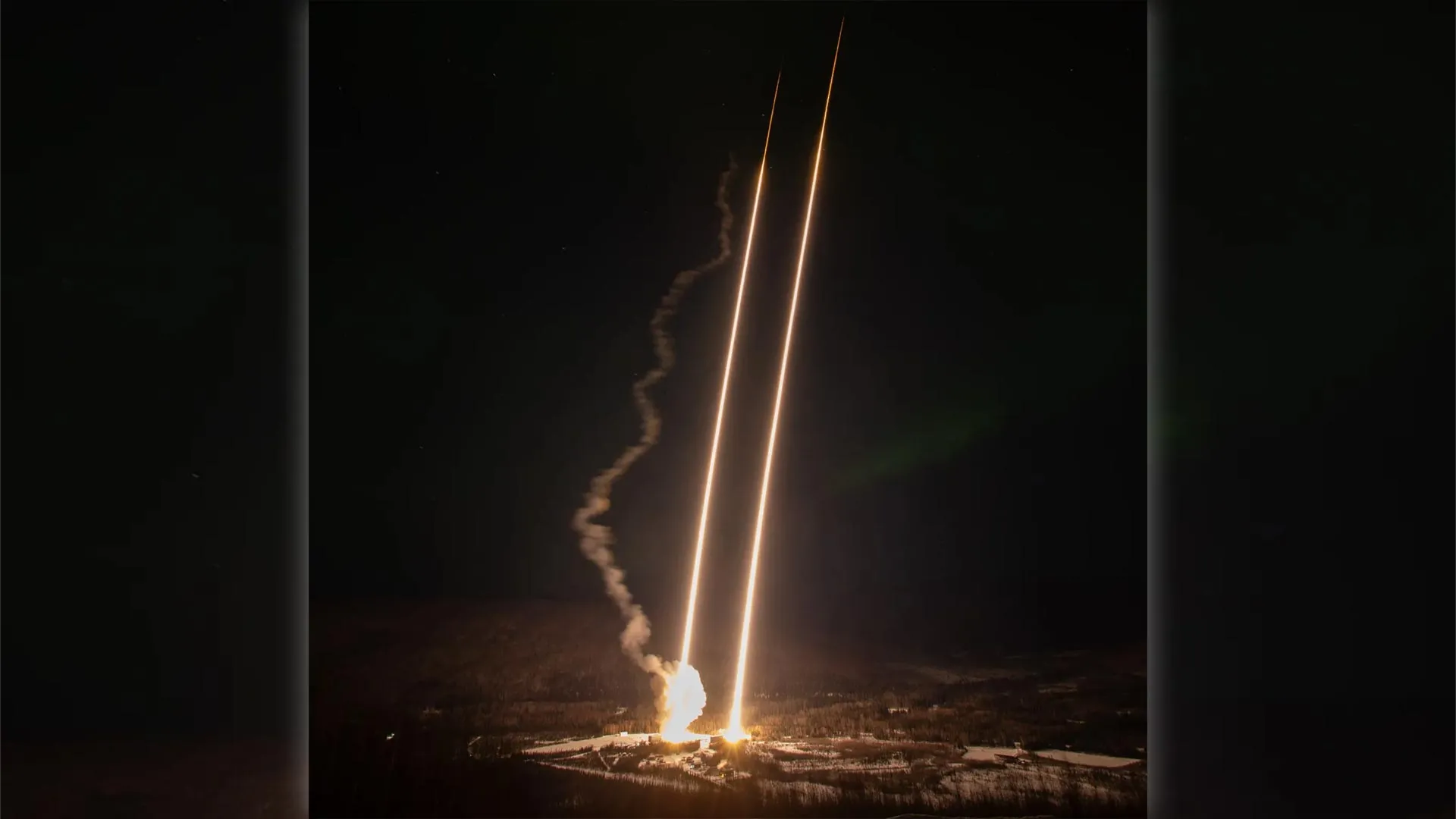
NASA has successfully launched two sounding rocket missions from Alaska to investigate the powerful electrical forces behind the northern lights. The Black and Diffuse Auroral Science Surveyor and the Geophysical Non-Equilibrium Ionospheric System Science mission, known as GNEISS (pronounced “nice”), both lifted off from the Poker Flat Research Range near Fairbanks.
The Black and Diffuse Auroral Science Surveyor launched Feb. 9 at 3:29 a.m. AKST (7:29 a.m. EST) and climbed to about 224 miles (360 kilometers). Principal investigator Marilia Samara reported that all instruments, including technology demonstrations, performed as planned and that the mission returned high-quality data.
The two-rocket GNEISS mission followed with a dramatic back-to-back launch on Feb. 10 at 1:19:00 a.m. and 1:19:30 a.m. AKST (5:19:00 a.m. and 5:19:30 a.m. EST). The rockets reached peak altitudes of approximately 198.3 miles (319.06 kilometers) and 198.8 miles (319.94 kilometers), respectively. Principal investigator Kristina Lynch said ground stations, subpayloads, and instrument booms all operated as expected, and the team is pleased with both the launch and the data collected so far.
How the Northern Lights Form an Electrical Circuit
When the aurora lights up the night sky, it is powered by electrons streaming down from space into Earth’s upper atmosphere. These charged particles energize atmospheric gases, causing them to glow. It is similar to electricity traveling through a wire to power a lightbulb.
But the process does not end where the glow appears. Electricity moves in loops. Just as a lightbulb is part of a complete circuit, the aurora is only one stop along a larger electrical pathway. If electrons are flowing into the atmosphere, they must also return to space to complete the circuit.
The incoming particle beams are relatively focused, like current flowing through a cord. The return flow, however, is far more scattered. After igniting the aurora, electrons spread out in many directions. Their motion is shaped by collisions, shifting winds, pressure differences, and changing electric and magnetic fields. Eventually, they make their way back to space, but only after weaving through the constantly changing upper atmosphere.
GNEISS Creates a 3D Scan of Auroral Electricity
To truly understand how auroras work, scientists need to see how this returning current closes the circuit. That means mapping the many possible routes electricity takes through the sky, which is extremely challenging.
“We’re not just interested in where the rocket flies,” said Kristina Lynch, principal investigator for GNEISS and a professor at Dartmouth College in New Hampshire. “We want to know how the current spreads downward through the atmosphere.”
Lynch designed GNEISS to answer that question. Using two rockets and a coordinated network of ground receivers, the mission builds a three-dimensional picture of the aurora’s electrical environment.
“It’s essentially like doing a CT scan of the plasma beneath the aurora,” Lynch said.
The two rockets launched side by side into the same aurora, each traveling along a slightly different path. Once inside, each rocket released four subpayloads to take measurements at multiple points within the glowing region.
As they flew overhead, the rockets transmitted radio signals through the surrounding plasma to receivers on the ground. The plasma changed those signals as they passed through it, much like body tissues alter X rays during a medical CT scan. By analyzing those changes, scientists can determine plasma density and identify where electrical currents are able to flow. The result is a large-scale CT style scan of the aurora.
Why Mapping Auroral Currents Matters for Space Weather
Understanding these electrical currents is not just about solving a physics puzzle. Auroral currents control how energy from space is distributed through Earth’s upper atmosphere. When currents spread out, they heat the atmosphere, stir up winds, and create turbulence that can affect satellites traveling through that region.
Researchers have long relied on ground-based instruments to study auroras. NASA’s EZIE satellite mission, launched in March 2025, measures auroral electrical currents from orbit. By combining satellite observations, ground imagery, and direct measurements from sounding rockets, scientists can examine the system from multiple angles at once.
“If we can put the in situ measurements together with the ground-based imagery, then we can learn to read the aurora,” Lynch said.
Investigating Black Auroras and Current Reversals
The GNEISS rockets were not alone during this launch campaign. The Black and Diffuse Auroral Science Surveyor focused on unusual dark regions within auroras known as black auroras. These blank spots may mark areas where electrical currents suddenly reverse direction.
The mission marked its second attempt at flight after a 2025 effort was postponed due to weather and scientific conditions. With this successful launch, researchers now have new data to examine how these mysterious dark patches fit into the broader auroral circuit.
Auroras form where space and Earth’s atmosphere interact. Electric currents, streams of charged particles, and countless collisions combine to create these glowing displays. Sounding rockets provide a rare opportunity to fly directly through them, placing instruments exactly where the action unfolds. Through brief but precisely timed missions, NASA is turning fleeting flashes of light into deeper insight about how space weather shapes our planet’s upper atmosphere.
