

Spot Bitcoin ETFs gave the market a clean, daily scoreboard: a green print meant fresh cash crossing the boundary from traditional brokerage accounts into Bitcoin exposure, and a red print meant the opposite.
For much of the first year of spot ETFs in the US, that scoreboard tracked sentiment and set the market’s tempo. Traders learned to treat flows as the simplest proxy for a real bid, because the buyer was observable, usually price-insensitive, and large enough to matter.
But that habit is now getting seriously stress-tested.
The risk in this phase now comes from flat days, because the cushion disappears without a reset.
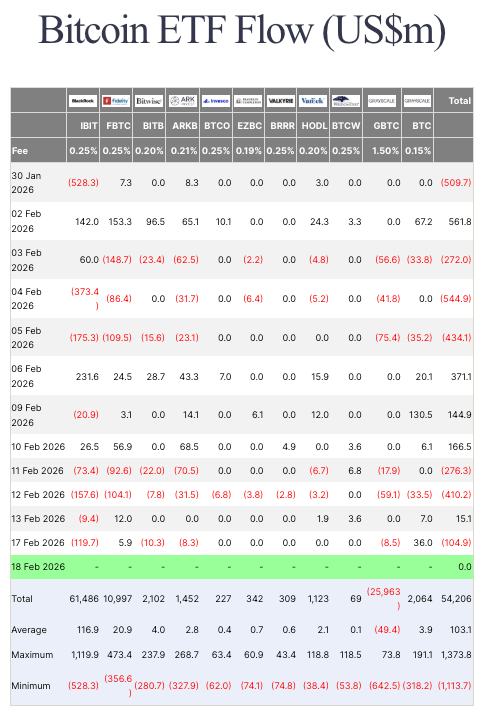
By mid-February 2026, mainstream coverage started framing the same idea: Bitcoin has struggled to break through nearby levels while ETF demand cools, and caution returns as the ETF honeymoon fades. While the details differ across outlets, the shared premise is easy to recognize on any flow tracker. Sessions flip between small greens, zeros, and reds, with fewer of the relentless up-only intake days that trained everyone to anchor on the tape.
What we have now is ETF fatigue, and it happens when the scoreboard stops acting like a metronome for the rest of the market. Flows still matter, sometimes a lot, but they’ve stopped behaving like a daily engine. They’ve turned into confirmation, or a missing ingredient, rather than the whole recipe.
The price is now listening harder to other inputs: derivatives, macro rates, and liquidity.
Over time, the market adapts. Allocations settle into rebalancing rhythms, hedging gets more efficient, and the surprise factor in the daily print fades. The flow still counts, but it seems to have stopped setting direction by itself.
When the 7-day average drifts toward zero for a full week, the price starts taking cues from positioning and liquidity rather than the print.
Early February tape: big inflows still show up, yet the rhythm changes
One reason ETF fatigue can fool people is that large inflow days still show up.
In early February, spot Bitcoin ETFs posted a roughly $562 million net inflow day that ended a long outflow streak. The inflow looked like the old world, where a big green day set the stage for a relief rally.

But, in a fatigue regime, a big green print can matter and still fail to restore the earlier rhythm where persistent inflows did the heavy lifting day after day. The market absorbs the good print, then immediately asks whether it can repeat. When repetition fails, price action starts behaving accordingly.
The same week offered the other half of the picture. We saw back-to-back inflows for the first time in about a month, including a roughly $471.1 million day and a roughly $144.9 million day. Those are meaningful numbers, and their existence makes a useful point: the post-flow regime doesn’t mean there’s no inflows, just that inflows stop arriving with the consistency that made them an easy trading framework.
Why flat flows can be worse than outflows
Outflows can create a kind of mechanical clarity. Red days force conversations about positioning, risk limits, and capitulation. They can push marginal leverage out of the system and leave a cleaner base for price discovery. None of this is guaranteed, and every selloff has its own structure, but the market at least receives information: someone is exiting, and the exit has size.
Flat flows give less information while removing a cushion.
When ETF net flows hover around zero, the wrapper still trades, arbitrage still functions, and headlines still print, but the marginal buyer that used to soak up supply becomes intermittent. Meanwhile, leverage in the rest of the system often remains. Perpetual swaps still carry exposure, options desks still run books, and systematic strategies still react to volatility.
In that environment, price can drift inside a range with thin depth and sharp wicks, because fewer natural buyers step in during micro-stress. The market can look calm on the surface, then slip on small sells because fewer passive bids sit close to the price.
This is how air pockets form. There’s no dramatic catalyst forcing a full flush, so positioning can stay stubborn. At the same time, the steady source of incremental demand that used to blunt sell pressure stops showing up reliably. The result can be a market that feels stable but is actually standing on a very shaky foundation.
Impact per dollar: the same flow, a different market
The best way to see the regime shift is to compare the impact per dollar across tape regimes.
- Inflow regime: money arrives repeatedly, rallies hold, pullbacks look orderly.
- Fatigue regime: money arrives episodically, rallies fade, wicks get sharper.
The $562 million day works as a contrast example. It mattered as it snapped a streak, and it also placed a spotlight on how quickly everyone demanded a second act.
Flat flows also change behavior around levels. When Bitcoin approaches a well-watched price area, traders look for confirmation. In 2024, confirmation often meant a flow print that matched the move.
In 2026, confirmation can fail simply because the flow print arrives flat. That failure can matter more than a modest outflow day, because it interrupts momentum without clearing the board.
Replacement engines, ranked by time horizon
When flows lose their role as the daily engine, the market rotates toward replacement engines. Think short horizon first, then medium, then background conditions. These forces decide whether a quiet flow week produces a calm range or a violent wick.
Short horizon: derivatives positioning. Funding, basis, and open interest determine how fragile the price becomes during small moves. When positioning builds in one direction, small spot moves can trigger liquidations, forced hedging, or dealer flows. That accelerant effect becomes louder when ETF flows stop acting as a stabilizer. The combination of ETF outflows and crowded positioning is a setup that can leave the market primed for volatility.
Medium horizon: macro sensitivity. A market anchored by ETFs and institutional wrappers tends to respond more to rates, real yields, and broad risk appetite, because the marginal allocator sits inside the same portfolio framework as equities and credit. To use this, you only need to track whether BTC behaves like a rates-sensitive risk asset during a week when ETF flows go quiet.
Background conditions: liquidity. Depth, spreads, and stablecoin flows determine how easily the market absorbs demand. When natural spot demand is intermittent, liquidity becomes the difference between a normal pullback and a sudden vacuum. ETF flows are useful precisely because they sit alongside derivatives and market-wide dashboards, which makes it easier to connect them to broader positioning and liquidity context.
Overrides: narrative shocks. Regulation headlines, sovereign actions, security events, and major corporate decisions can override any flow regime for a week. In a fatigue phase, these shocks can carry more weight because the baseline bid feels less dependable. The market starts asking a harsher question: if flows stay flat, what else can justify a breakout?
A three-scenario playbook for a post-flow week
There’s a very practical way to understand and stay on top of ETF fatigue. There are a few different ways for it to play out, so when it does, it’s useful to think of them as scenarios and then look for confirmation in the other engines.
Scenario A: Flows re-accelerate
- What flows look like: multiple strong green prints, with the 7-day average turning decisively higher.
- What price tends to do: upside grind with calmer pullbacks as the market trusts repetition.
- What to watch: whether derivatives froth stays contained as price trends.
Scenario B: Flows stay flat
- What flows look like: net flows hover around zero across several sessions.
- What price tends to do: range trade with air pockets, especially during off-hours liquidity.
- What to watch: derivatives as the warning system. Funding flipping positive while price fails to break higher can point to a crowded long. Funding turning negative while price holds can point to bearish positioning that lacks follow-through.
Scenario C: Flows turn persistently negative
- What flows look like: repeated red prints with a clearly negative weekly total.
- What price tends to do: higher volatility and faster drawdowns when weak spot demand meets one-sided leverage.
- What to watch: outflow streak framing and reflexive selling risk during liquidity thin spots.
Each scenario can coexist with the same daily headlines. The main difference lies in persistence and in whether the other engines confirm what the flows are showing.
What to watch next week
Start with the 7-day average of ETF flows rather than single prints and pair it with derivatives positioning. See whether funding stays one-sided, whether open interest expands into a range, and whether basis grows in a way that reflects leverage rather than hedging.
Then check liquidity behavior: whether spreads widen during stress and whether wicks become more frequent around key levels, a common symptom when the natural bid weakens and liquidity thins.
ETF fatigue doesn’t mean that ETFs are failing; it’s a natural consequence of the market growing up around them. The wrapper flows taught traders to read a simple scoreboard. The next phase asks for a deeper reading: flows as confirmation, positioning as accelerant, macro as gravity, and liquidity as the difference between a routine pullback and a sudden vacuum.
In this phase, flows confirm, positioning accelerates, and liquidity decides how far it goes.
