

WASHINGTON—This week marks ten years since the first-ever export cargo of US liquefied natural gas (LNG) departed the contiguous United States from a Gulf Coast terminal in Sabine Pass, Louisiana. Made possible by the twenty-first-century shale revolution, this moment was a turning point in the global energy landscape, after which the United States rapidly grew from a net importer of natural gas in the early 2010s to the world’s top exporter by 2022.
In commemorating this milestone, Lithuania’s LNG partnership with the United States stands out as a powerful example of transatlantic cooperation. It demonstrates how expanded US export capacity—combined with strategic infrastructure development, resolute energy-sector reform, and sufficient political will in Europe—can produce real alternatives to Russian gas. Once regarded as an isolated “energy island” on the Baltic Sea, Lithuania today has reshaped the regional energy landscape in Central and Eastern Europe by becoming a key gateway for US LNG imports in markets spanning Finland to Ukraine.
Today, Lithuania imports more than three-quarters of its LNG from the United States, helping bolster Vilnius’s status as a “model ally” to Washington. The rest of Lithuania’s imports come from Norway and some other smaller suppliers, allowing the country to preserve flexibility amid any potential fluctuations in the global LNG market. As Hungary and Slovakia attempt to disrupt European Union (EU) plans to phase out Russian gas by 2027, Lithuania’s experience directly challenges their claims that geography or historical dependence leave certain countries with “no alternatives” to Russian supply.
Lithuania’s path toward “Independence”
The Baltic states’ energy transition away from a complete dependence on Russian gas began in 2014 with the opening of a floating storage and regasification unit at the port of Klaipėda, Lithuania. The first of its kind in the Nordic-Baltic region, this offshore LNG terminal—symbolically named “Independence”—marked a turn away from the legacy of Soviet-era infrastructure inherited by Lithuania, Latvia, and Estonia from decades of foreign occupation.
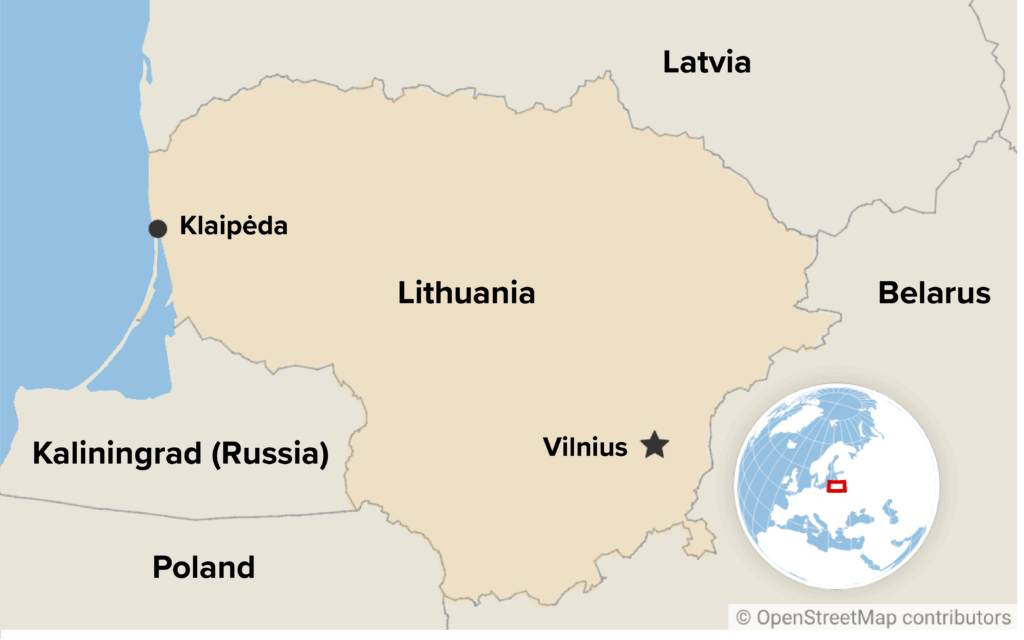
Lithuanian policymakers began this transition because they understood that the country’s complete reliance on Russian gas supplied via a single Gazprom-controlled pipeline posed profound risks to national sovereignty. This assessment was rooted in more than two decades of experience, including politically motivated pricing, supply cutoffs, sustained energy blackmail, and even a full energy blockade by Moscow.
Diversification required more than just the construction of new energy infrastructure. Russian influence also extended to governance, including through Gazprom’s dominant role in Lithuania’s national gas company. Overcoming this influence required comprehensive gas sector reform: This meant unbundling transmission from supply, ensuring third-party access, and creating a regulatory framework capable of attracting alternative suppliers. The EU’s role was pivotal in supporting Lithuania throughout this process.
Lithuania inaugurated its LNG terminal at a time when Western Europe continued to deepen its energy dependence on an increasingly aggressive Russia and LNG was still seen as an expensive novelty. While some critics questioned the project’s economic viability, Lithuania nevertheless accepted the upfront infrastructure costs and initially higher prices for LNG compared to pipeline gas in exchange for long-term security and resilience.
February 24: When foresight met geopolitical reality
That bet paid off. By the time the United States shipped its first LNG cargo in 2016, Lithuania already had the infrastructure and regulatory environment needed to engage Washington as a strategic energy partner. Exactly six years after the first export of US LNG on February 24, 2016, Russia’s full-scale invasion of Ukraine in 2022 validated longstanding Baltic fears about the use of energy coercion as a deliberate instrument of war. Long-term investment in diversification allowed Lithuania and its Baltic neighbors to become the first EU member states to ban all Russian energy imports, which happened in April 2022. After Russia’s full-scale invasion, the export of US LNG to Europe became an asset of immediate geopolitical necessity—including in helping Ukraine strengthen its energy resilience under wartime conditions.
In recent months, the US-Lithuania partnership has enabled shipments of US LNG to Ukraine through Klaipėda under contracts between Ukraine’s Naftogaz and Poland’s ORLEN. In parallel, US-sourced LNG was also delivered to Ukraine ahead of this year’s especially harsh winter under a direct agreement between Ukraine’s DTEK and Lithuania’s LNG terminal operator, KN Energies.
US LNG, after regasification in Klaipėda, travels through the Lithuania-Poland gas interconnector and Poland’s transmission system until it reaches the gas exit-entry point on the Polish-Ukrainian border. Beside the entry point in Klaipėda, Ukraine is also increasing imports of US gas via LNG terminals in Poland and Greece, further strengthening the importance of the north-south energy transit corridor.
Hungary and Slovakia: Dependence by design
Last month, EU countries approved a new law to end European gas imports from Russia, which have totaled more than $129 billion since February 2022. However, the agreement—which would phase out all Russian LNG and pipeline gas imports by 2027—has faced pushback from Budapest and Bratislava.
Their arguments against a phaseout cite price increases, technical constraints, and geographical limitations, as Hungary and Slovakia are both landlocked countries sitting on the traditional east-west gas supply routes. However, when measured against Lithuania’s experience, these arguments are unconvincing.
Hungary and Slovakia stand to benefit from an abundance of alternatives in today’s far more favorable energy environment. Both countries are embedded in a highly interconnected European gas network, with access to LNG terminals in Poland, Croatia, Lithuania, and Greece. Hungary and Slovakia do not need to engage in high-level advocacy aimed at persuading the United States to open access to its gas reserves, as Lithuania once did. US LNG is available and accessible, as proven by the existence of US LNG supply agreements with both countries. The fact that Slovakia has already received a US LNG shipment through the Klaipėda LNG terminal only underscores this point.
Yet Hungarian and Slovak leaders appear to be making the political choice to continue their countries’ reliance on Russia. Instead of committing to strategic reorientation away from Russian gas, Hungary chose to expand a long-term contract with Gazprom in 2024. In the case of Slovakia, a Poland-Slovakia gas interconnector remains largely unutilized. Current agreed US LNG import volumes for both countries remain marginal relative to continued Russian imports. By resisting a more comprehensive shift away from Russian gas, Hungary and Slovakia weaken the EU’s efforts to stop financing Russia’s war in Ukraine and dilute the strategic impact of US LNG exports designed to reinforce European resilience.
Message to Washington
Transatlantic energy cooperation is only expected to grow in the coming years as the Trump administration continues to oversee record-high levels of LNG exports, which are on track to double from 2025 levels by 2029.
A longtime advocate of energy diversification in Central and Eastern Europe, US President Donald Trump has rightfully criticized Europe for its continued purchases of Russian energy, but his administration has wavered by providing Hungary a one-year exemption from US energy sanctions on Moscow. Instead, Washington should work with its Hungarian and Slovak allies to encourage complete energy independence from Russia without buying into the arguments that a Russian gas supply phaseout would be unrealistic and economically damaging. Lithuania’s experience reveals these claims to be unfounded. Alternatives exist and have been implemented—with US LNG at the core of this effort. The acceleration of a Europe-wide phaseout will benefit US industry and build a stronger Europe, while reducing funds for Russia to wage war.
Proof of concept—and political will
Ten years after the first US LNG shipment, the US-Lithuanian partnership stands as a proof of concept. Deliberate steps taken early can reshape regional energy flows, supply allies under threat, and reinforce transatlantic strategic alignment. Lithuania shows that diversification away from Russian gas is not only feasible but strategically empowering.
