

February 25, 2026
Merz arrives in Beijing
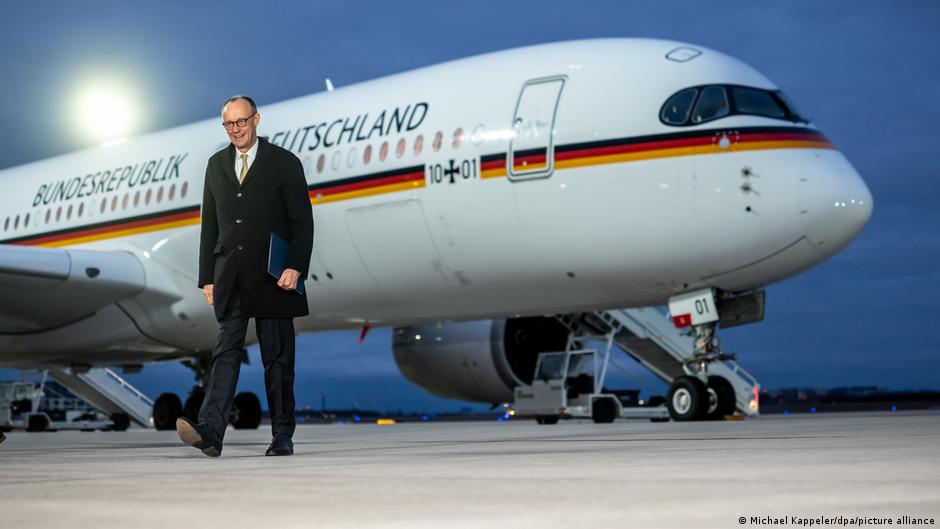
German Chancellor Friedrich Merz landed in Beijing on Wednesday for his first visit to China.
Merz is accompanied by a large delegation of business leaders.
The German chancellor will first be received by Premier Li Qiang with military honours.
Merz is scheduled to hold talks and have dinner with Chinese President Xi Jinping in the evening.
https://p.dw.com/p/59Lw9
February 25, 2026
Ukraine: ‘If China says stop, the war will stop’
Friedrich Merz‘s visit to China comes one day after the fourth anniversary of Russia’s full-scale invasion of Ukraine — with the war still ongoing and no end in sight.
The German Chancellor has been publicly critical of Beijing relationship with Moscow, accusing China of supporting the Russian war effort via oil imports and technological exports.
“If [Chinese President] Xi Jinping said tomorrow: ‘Stop it’ — then it would stop the day after the tomorrow,” Merz told the dpa news agency on Monday.
On Tuesday, the Chinese Foreign Ministry stressed that the war in Ukraine should not strain relations between Europe and China and that Beijing supports diplomatic efforts to find a political solution.
However, just as Russian President Vladimir Putin considers parts of eastern Ukraine as part of Russia — and indeed the entirety of Ukraine as belonging to Moscow’s sphere of influence — as the Chinese government considers the island nation of Taiwan to be Chinese territory.
Like most countries, Germany follows a so-called “one-China policy” in only officially recognizing the People’s Republic of China. However, Merz insisted that “we will determine the precise details [of that policy] ourselves” — and Germany does maintain unofficial economic, cultural and scientific relations with Taiwan.
https://p.dw.com/p/59Lpj
February 25, 2026
Merz: ‘It would be a mistake to decouple from China’
China overtook the United States as Germany‘s principle trading partner in 2025 and is set to remain a key market for German business in 2026.
Chancellor Friedrich Merz is therefore being accompanied on his visit to China by a large delegation of German industry representatives.
German businesses have called on Merz to raise issues such as overcapacity and export controls on critical raw materials, while German carmakers in particular have long complained of fierce Chinese competition boosted by domestic subsidies and unequal market access.
“It would be a mistake to seek to decouple from China,” Merz said on Tuesday before leaving Berlin, adding that severing ties with China would be like “shooting ourselves in the foot. We would be ruining our own economic opportunities.”
https://p.dw.com/p/59Lpb
February 25, 2026
Merz’s five key principles for Germany-China relations
Ahead of his departure for Beijing, German Chancellor Friedrich Merz used a Chinese proverb to sum up the message he wants to convey during his trip, making reference to China’s Year of the Horse, which began last week.
“A horse does not make the most of its strength alone, but by pulling the cart together with others,” he said, thereby calling on China, the second largest economy in the world after the United States, to work with its international partners tackle global issues.
As for Germany, Merz outlined five guiding principles for Berlin’s approach to Beijing:
- Dealing with China from a position of European strength. “A smart China policy begins at home,” Merz said. “Only when we in Germany and Europe are united, strong and competitive can we build a balanced partnership with China.”
- A common European policy towards China. It’s no coincidence that Merz, French President Emmanuel Macron and British Prime Minister Keir Starmer are all visiting China in such a short space of time. “We want our partnership with China to be balanced, reliable, regulated and fair,” he said. “That is our offer and it is also what we hope for from the Chinese side.”
- Fair competition. This is the key demand from German industry, representatives of which are accompanying Merz on his trip. German businesses have long complained about market access, untransparent regulations and state-subsidized domestic competition in China, leading Merz to insist: “We must be able to rely upon agreed rules.”
- Risk-reduction rather than decoupling. Despite the ideological differences between Germany and China, Merz insists that decoupling from China is not an option, saying it would be like “shooting ourselves in the foot” economically. Nevertheless, it won’t have gone unnoticed in Beijing that Merz visited India first.
- International cooperation. In a changing world order in which great powers are playing bigger and bigger roles, Merz believes China has to be reckoned with as a major geopolitical player, and that global challenges such as the battle against climate change can only be tackled together. China’s alliance of convenience with Russia and its rivalry with the United States in the Pacific also have knock-on effects on Europe and Germany.
https://p.dw.com/p/59LqP
February 25, 2026
Welcome to our coverage
Guten Tag! Welcome to DW’s coverage of German Chancellor Friedrich Merz‘s visit to China.
Merz will arrive in Beijing on Wednesday at the start of a two-day trip — the first visit to China by a German chancellor since Olaf Scholz in 2024.
China is simultaneously a geopolitical rival and a valuable trading partner for Germany, and so Merz will be accompanied by a large delegation of representatives from German industry.
Merz has meetings scheduled with Chinese Prime Minister Li Qiang and President Xi Jinping, with whom he is expected to discuss economic cooperation and global security — but also human rights.
In addition to the capital, Beijing, Merz will also visit the high-tech center of Hangzhou.
https://p.dw.com/p/59LpC
