

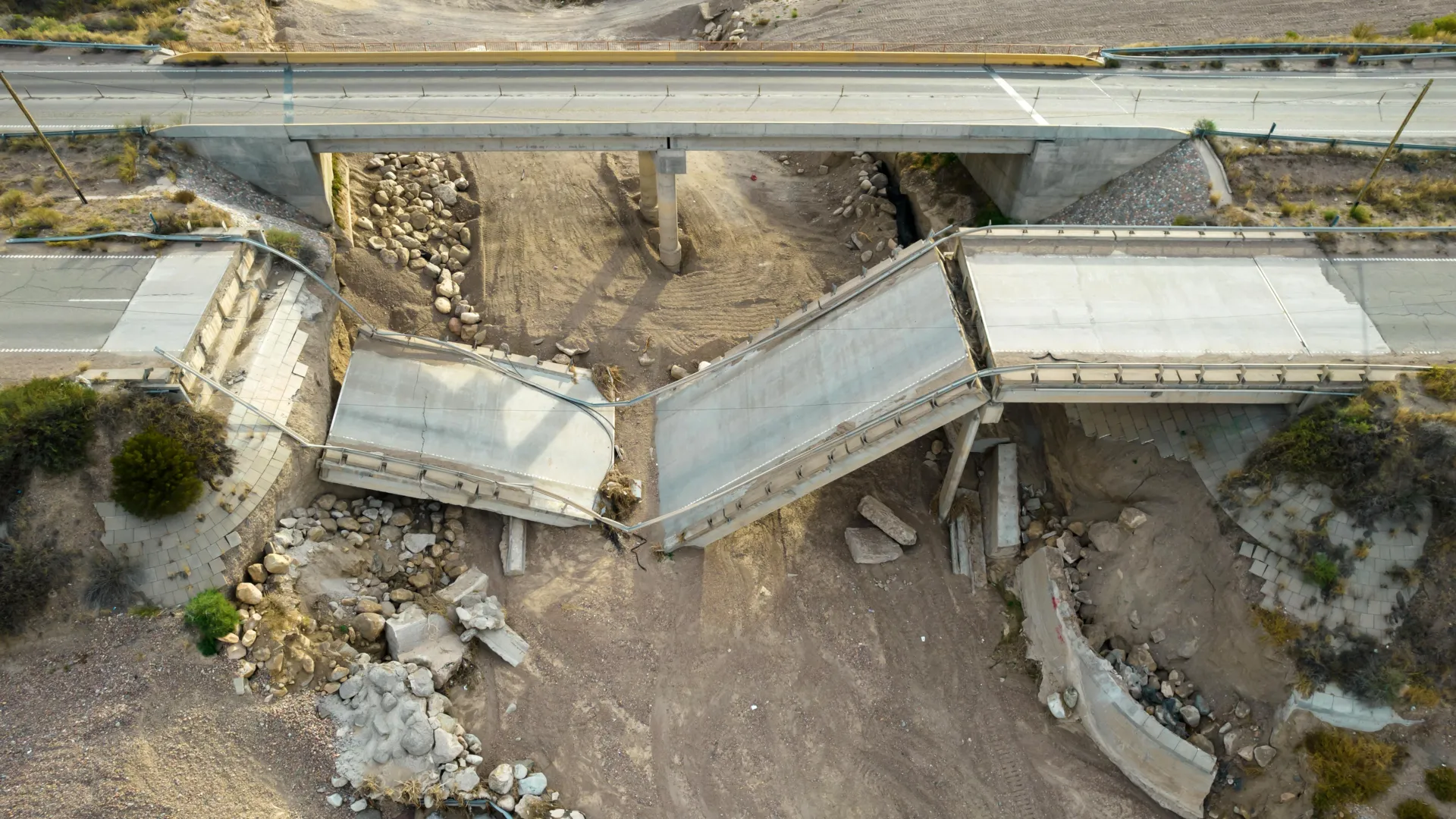
Scientists are using satellites to reveal which bridges around the world may be at risk of failure — and how to catch problems before disaster strikes.
- Adding satellite monitoring to bridge inspections reduces the number of structures labeled high risk by about one third.
- Among the bridges that still rank as high risk, roughly half could benefit from ongoing observations from space.
- The biggest gains could occur in regions such as Africa and Oceania, where bridge monitoring is currently limited or almost nonexistent.
A researcher from the University of Houston is helping identify vulnerable bridges across the planet and offering a new way to address potential failures before they become catastrophic.
In a global analysis of 744 bridges published in Nature Communications, Pietro Milillo and collaborators from several international institutions evaluated the condition of bridges around the world. Their results showed that bridges in North America are generally in the poorest condition, followed by those in Africa. The team also proposed a strategy that could transform how infrastructure is monitored worldwide by using satellites to track bridge stability and detect warning signs early.
Aging Infrastructure and a Growing Risk
Many of the bridges identified in the study are approaching the limits of their intended lifespan. Construction of bridges in North America surged during the 1960s, meaning many of these structures are now decades old and nearing or surpassing their original design life.
To address this challenge, researchers are turning to space based monitoring systems that rely on Synthetic Aperture Radar. This technology captures high resolution images frequently and covers large areas of the planet, while also providing access to extensive historical data.
“Our research shows that spaceborne radar monitoring could provide regular oversight for more than 60 percent of the world’s long-span bridges,” said Milillo, co author of the study and an associate professor of civil and environmental engineering at UH. “By integrating satellite data into risk frameworks, we can significantly lower the number of bridges classified as high-risk, especially in regions where installing traditional sensors is too costly.”
Detecting Tiny Movements From Space
The international research team included Dominika Malinowska from Delft University of Technology (TU Delft) and the University of Bath, Cormac Reale and Chris Blenkinsopp from the University of Bath, and Giorgia Giardina from TU Delft. They relied on a remote sensing method known as Multi-Temporal Interferometric Synthetic Aperture Radar (MT-InSAR).
This technique can complement traditional inspections by identifying extremely small shifts in structures. The system can measure movements as small as a few millimeters caused by slow geological processes such as landslides or ground subsidence. It can also reveal unusual patterns across wide areas that might signal emerging structural issues.
Bridges represent some of the most fragile components of transportation systems, yet the current approaches used to monitor them have clear limitations. Visual inspections carried out in person can be costly and sometimes subjective. They are also typically performed only twice a year, which means early warning signs of deterioration may go unnoticed between inspections.
Structural Health Monitoring (SHM) sensors provide a more continuous way to track structural performance. However, these systems are usually installed only on newer bridges or structures already known to have issues. According to the study, fewer than 20% of the world’s long span bridges are equipped with these sensors, leaving many structures without consistent monitoring.
A Satellite Based Monitoring Solution
“Remote sensing offers a complement to SHM sensors, can reduce maintenance costs, and can support visual inspections, particularly when direct access to a structure is challenging,” said Millilo. “For bridges specifically, MT-InSAR allows for more frequent deformation measurements across the entire infrastructure network, unlike traditional inspections, which typically occur only a few times per year and require personnel on the ground.”
Said Malinowska. “While using MT-InSAR to monitor bridges is well-established in academic circles, it has yet to be routinely adopted by the authorities and engineers responsible for them. Our work provides the global-scale evidence showing this is a viable and effective tool that can be deployed now.”
The researchers found that adding MT-InSAR data to bridge risk evaluations can improve accuracy. The technique analyzes satellite pixels known as persistent scatterers (PS), which have stable radar reflections. Using these signals reduces uncertainty and allows engineers to better prioritize which bridges require maintenance or closer inspection.
The approach proposed by the research team combines monitoring information from SHM sensors with satellite observations from systems such as the European Space Agency’s Sentinel-1 and the recently launched NASA NISAR mission. Integrating these data sources into a bridge’s structural vulnerability score allows engineers to receive more frequent updates than traditional inspection schedules provide.
With more consistent monitoring, authorities can gain a clearer picture of a bridge’s condition and make better decisions about maintenance and risk management.
