
LIVE NEWS
  • AI costs how much? GitHub Copilot users react to new usage-based pricing system.
  • European Parliament committee votes to scrap US tariffs
  • Hints and Solutions for June 2
  • It has the highest levels of toxic Pfas in drinking water in Scotland. But how did this remote island become awash with forever chemicals? | Pfas
  • For veterans, a place where peace can take root : NPR
  • This common amino acid helped mice survive deadly inflammation
  • Apple Will Reportedly Add Bill-Splitting Feature to iOS 27
  • Opinion | Putin Has No Good Way Out of His War
Prime Reports
  • Home
  • Popular Now
  • Crypto
  • Cybersecurity
  • Economy
  • Geopolitics
  • Global Markets
  • Politics
  • See More
    • Artificial Intelligence
    • Climate Risks
    • Defense
    • Healthcare Innovation
    • Science
    • Technology
    • World
Prime Reports
  • Home
  • Popular Now
  • Crypto
  • Cybersecurity
  • Economy
  • Geopolitics
  • Global Markets
  • Politics
  • Artificial Intelligence
  • Climate Risks
  • Defense
  • Healthcare Innovation
  • Science
  • Technology
  • World
Home»Science»NASA’s DART spacecraft changed an asteroid’s orbit around the sun
Science

NASA’s DART spacecraft changed an asteroid’s orbit around the sun

primereportsBy primereportsMarch 9, 2026No Comments2 Mins Read
Share Facebook Twitter Pinterest LinkedIn Tumblr Reddit Telegram Email
NASA’s DART spacecraft changed an asteroid’s orbit around the sun
Share
Facebook Twitter LinkedIn Pinterest Email

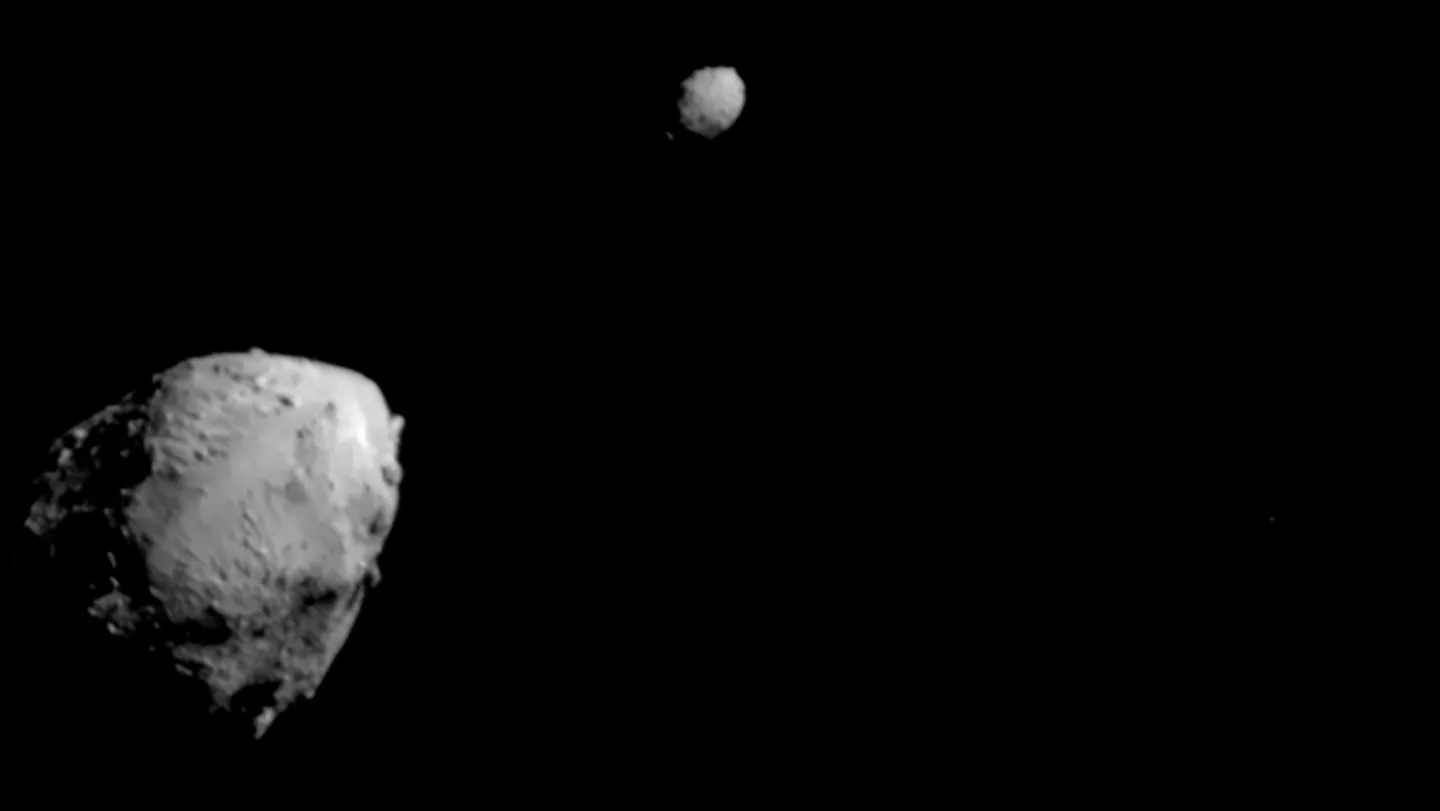
A spacecraft slowed the orbit of a pair of asteroids around the sun by more than 10 micrometers per second — the first time human activity has altered the orbit of a celestial object, researchers report March 6 in Science Advances. The experiment could have implications for protecting Earth from future asteroid strikes.

NASA’s Double Asteroid Redirection Test, or DART, intentionally crashed a spacecraft into the small asteroid Dimorphos in 2022. The goal was to change Dimorphos’ orbit around its larger sibling, Didymos. Within a month, researchers showed that the impact shortened Dimorphos’ 12-hour orbit by 32 minutes.

Sign up for our newsletter

We summarize the week’s scientific breakthroughs every Thursday.

Most of that change came from the impact itself. Some of it came from flying impact debris, which gave Dimorphos a little kick in the opposite direction of its motion.

Some of the rocks knocked off of Dimorphos fled the vicinity completely, escaping the gravitational influence of the Dimorphos–Didymos pair, says planetary defense researcher Rahil Makadia of the University of Illinois Urbana–Champaign. Those rocky runaways took some momentum away from the duo and changed their joint motion around the sun.

To figure out how much that motion was affected, astronomers watched the asteroids pass in front of distant stars, dimming some of the stars’ light like a tiny eclipse. These blinks, called stellar occultations, can be visible from anywhere on Earth and are predictable in advance.

“Oftentimes it’s amateur astronomers going out in the middle of nowhere to track Didymos based on predictions,” Makadia says. “There was an observer who drove two days each way into the Australian outback to get these measurements.”

Makadia and colleagues gathered 22 such measurements taken from October 2022 to March 2025. Calculating how far off occultation timings were from predictions revealed that the asteroids’ orbit around the sun was about 150 milliseconds slower than before the DART impact.

The result could be confirmed later this year, when the European Space Agency’s Hera spacecraft arrives at Didymos and Dimorphos for follow-up observations.

Didymos and Dimorphos are not a threat to Earth, Makadia says, and weren’t before DART. But knowing how a deliberate impact changes one asteroid’s orbit can help make defense plans against another, “in case we need to do a kinetic impact for real.”


Share. Facebook Twitter Pinterest LinkedIn Tumblr Email
Previous ArticleResearchers build atom-thin 2D thermometers that can be embedded directly in processors — can detect temperature changes in 100 nanoseconds, millions of times faster than the blink of an eye
Next Article Pentagon Task Force, FAA to Test Counter-Drone Laser
primereports
  • Website

Related Posts

Science

‘Transformative’ pancreatic cancer drug doubles survival time

June 1, 2026
Science

Heading a soccer ball just once is enough to raise levels of proteins associated with brain damage

June 1, 2026
Science

A new pancreatic cancer pill may be a game changer for patients

June 1, 2026
Add A Comment
Leave A Reply Cancel Reply

Top Posts

Paxton’s win over Cornyn sets up high-stakes Texas clash with Talarico

May 28, 202616 Views

Global Resources Outlook 2024 | UNEP

December 6, 202510 Views

Texas Democrat Talarico claims voting laws are rigged ahead of Paxton race

May 28, 20269 Views
Stay In Touch
  • Facebook
  • YouTube
  • TikTok
  • WhatsApp
  • Twitter
  • Instagram
Latest Reviews

Subscribe to Updates

Get the latest tech news from FooBar about tech, design and biz.

PrimeReports.org
Independent global news, analysis & insights.

PrimeReports.org brings you in-depth coverage of geopolitics, markets, technology and risk – with context that helps you understand what really matters.

Editorially independent · Opinions are those of the authors and not investment advice.
Facebook X (Twitter) LinkedIn YouTube
Key Sections
  • World
  • Geopolitics
  • Popular Now
  • Artificial Intelligence
  • Cybersecurity
  • Crypto
All Categories
  • Artificial Intelligence
  • Climate Risks
  • Crypto
  • Cybersecurity
  • Defense
  • Economy
  • Geopolitics
  • Global Markets
  • Healthcare Innovation
  • Politics
  • Popular Now
  • Science
  • Technology
  • World
  • About Us
  • Contact Us
  • Privacy Policy
  • Terms & Conditions
  • Disclaimer
  • Cookie Policy
  • DMCA / Copyright Notice
  • Editorial Policy

Sign up for Prime Reports Briefing – essential stories and analysis in your inbox.

By subscribing you agree to our Privacy Policy. You can opt out anytime.
Latest Stories
  • AI costs how much? GitHub Copilot users react to new usage-based pricing system.
  • European Parliament committee votes to scrap US tariffs
  • Hints and Solutions for June 2
© 2026 PrimeReports.org. All rights reserved.
Privacy Terms Contact

Type above and press Enter to search. Press Esc to cancel.