

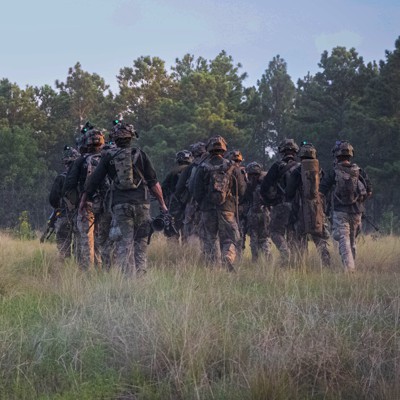
Wearable biometrics, improved science, and more data are changing U.S. Army attitudes toward human performance—particularly how soldiers adapt to the risks of overheating.
The U.S. military has been studying the effects of heat on troops for almost a century, dating to the 1927 establishment of the Harvard Fatigue Laboratory at the military’s request. Still, soldiers’ and commanders’ approach to core physical tasks—think timed runs, strenuous outdoor activity, or environmental exposure—lags the growing body of science about heat risks, sometimes by years or decades. That may finally be changing under new initiatives to expand research into human performance.
Lt. Col. David deGroot, who directs the Army Heat Center, told Defense One that new wearable devices—which track metrics like heart rate and body temperature—are providing military trainers and soldiers with a new window into how their bodies interact with the environment. This data offers insights well before physical symptoms of overheating appear. That timing is key: by the time a soldier experiences heat exhaustion or the first symptoms of a far more severe heat stroke, it is often too late to prevent a health incident that could sideline them from training or worse.
“We’ve got some still-evolving, non-invasive, wearable technologies that are going to be able to, not necessarily prevent a heat stroke, but detect it much, much sooner”—as many as 12 minutes sooner, giving time to reduce its severity, deGroot said on the sidelines of the March 4 Heat Forum at Fort Benning, Georgia. (Disclosure: the event was staged by FBC, a Defense One sister brand.)
New data also reveals the costs to units and individuals when they push too hard under the assumption that suffering makes a soldier tougher. The idea that ignoring discomfort is the hallmark of “good soldiering” goes back centuries, but deGroot argues it needs an update.
Too often, he said, it is the soldiers themselves, particularly those trying to qualify for Ranger School, who exhibit a specific risk factor for heat-related illness: a trait that might look good on a resume as being “highly motivated.” Troops who push themselves to attain a new personal best in every physical task run a much higher risk of suffering a heat stroke and taking themselves out of commission.
DeGroot is on a mission to remind soldiers, trainers, and commanders that it doesn’t make sense to attempt a personal record during every march or run; sometimes, it is best to simply hit the acceptable threshold and save the record-breaking for another day. He also clarified that simply drinking water is not a shield against heat sickness. In fact, he noted, 80 percent of heat stroke victims are actually well-hydrated.
“If you successfully hydrate, congratulations: you have successfully mitigated the risk of dehydration. But if you are sick, if you are not acclimatized, if you are overweight, or if you are excessively motivated, those risks still exist despite appropriate hydration,” he said.
He added that trainers too often confuse periods of physical rest with “inactivity” and grumble about science-backed ratio tables that dictate appropriate activity levels based on external factors.
“When you look at those tables, they’re not as restrictive as you think they might be,” he said. “There are a lot of things you can still be doing that are productive training or operational activities.”
The new science on heat isn’t just slowing training down. In some ways, it is speeding it up. Take research on acclimatization—the process of adjusting to different temperatures. Previous thinking suggested that soldiers needed as long as eight days to adjust to a new climate. However, research published last year showed a different approach. Researchers compared a standardized eight-day acclimatization group (90 minutes a day) against a group that performed four 90-minute bouts in one day and four more the next. Both groups reached the same level of acclimatization.
“When I read it, I was excited about it,” deGroot said. “This is a fascinating idea that I never even thought of.”
