
LIVE NEWS
  • Bitcoin Near $70,000 as ETFs Improve Bullish Signs
  • Cross-national comparative assessment of synergies and conflicts in climate policy mixes
  • Justice Department restarts program to restore gun rights : NPR
  • HIMSS26: Strengthen the Muscle of AI Strategy With Clinical Insight
  • Google starts rolling out Gemini in Chrome to users in Canada, India and New Zealand
  • Three Ships Hit by Projectiles in Middle East, UK Navy Says – Bloomberg.com
  • Amazon is linking site hiccups to AI efforts
  • Secret of hedgehog hearing discovered at far beyond human range
Prime Reports
  • Home
  • Popular Now
  • Crypto
  • Cybersecurity
  • Economy
  • Geopolitics
  • Global Markets
  • Politics
  • See More
    • Artificial Intelligence
    • Climate Risks
    • Defense
    • Healthcare Innovation
    • Science
    • Technology
    • World
Prime Reports
  • Home
  • Popular Now
  • Crypto
  • Cybersecurity
  • Economy
  • Geopolitics
  • Global Markets
  • Politics
  • Artificial Intelligence
  • Climate Risks
  • Defense
  • Healthcare Innovation
  • Science
  • Technology
  • World
Home»Science»Jupiter’s moons leave cold ‘footprints’ in the planet’s auroras, James Webb Space Telescope finds
Science

Jupiter’s moons leave cold ‘footprints’ in the planet’s auroras, James Webb Space Telescope finds

primereportsBy primereportsMarch 10, 2026No Comments5 Mins Read
Share Facebook Twitter Pinterest LinkedIn Tumblr Reddit Telegram Email
Jupiter’s moons leave cold ‘footprints’ in the planet’s auroras, James Webb Space Telescope finds
Share
Facebook Twitter LinkedIn Pinterest Email


Jupiter’s moons can have surprising effects on the world’s displays of auroral lights by “stomping down” on the planet’s gigantic magnetic environment.

These surprising effects, detected in observations from the James Webb Space Telescope (JWST), include a cold spot in Jupiter’s atmosphere, and a rapid increase in the density of charged particles.

“The moons constantly interact with the magnetic field and plasma surrounding the planet and that interaction leads to highly energetic particles traveling down magnetic field lines and then crashing into the planet’s atmosphere, creating the auroral footprints that map to where the moons orbit around Jupiter,” said Katie Knowles, who is a Ph.D. researcher at Northumbria University in the U.K., in a statement.

Article continues below


You may like

Jupiter’s auroral lights are created in similar fashion to Earth’s as charged particles riding on the solar wind slam into Jupiter’s magnetic field and are funneled down towards the gas giant’s poles. When they enter the atmosphere, they collide with atoms and molecules, causing them to glow. However, by interacting with Jupiter’s magnetic field, its four largest moons — the Galilean moons Io, Europa, Ganymede and Callisto — can leave an imprint on the aurora.

The footprints are exacerbated by a phenomenon known as the Io Plasma Torus. Io is the solar system‘s most volcanic body, and its volcanoes spew out tons of charged particles that drift into orbit around Jupiter, forming the plasma torus that is held in place by Jupiter’s magnetic field. As the Galilean moons orbit Jupiter, they interact with the plasma torus and the magnetic field, and drive ions towards Jupiter’s atmosphere, contributing to the aurora and generating electrical currents that influence how bright the auroral footprints are.

Previous multi-wavelength measurements have tracked how bright the aurora, and these footprints, can become. However, in September 2023, Northumbria’s Henrik Melin and Tom Stallard used the to take snapshots of the area on Jupiter’s where auroral events rotated into view. By watching the edge of Jupiter’s disk, the JWST was able to probe the side profile of Jupiter’s atmosphere directly beneath an aurora.

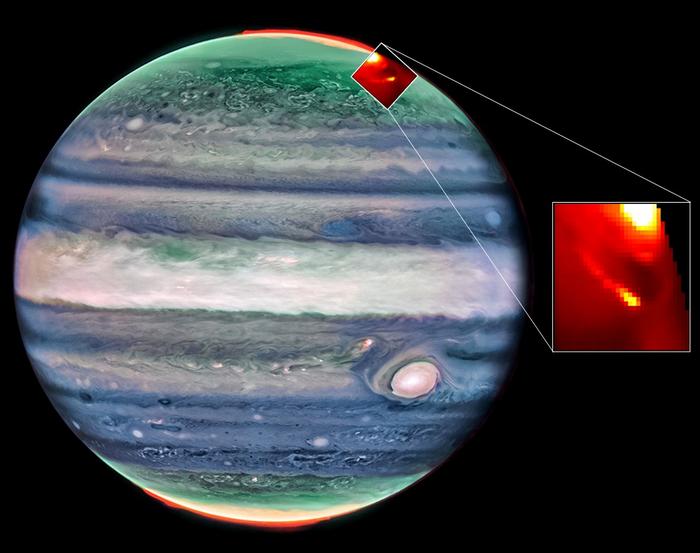
A view of Jupiter with a section of the top of the world enlarged. In the boxout, it's a reddish area with a bright yellow spot.

A JWST Near-Infrared Camera image of Jupiter and, inset, the JWST’s Near-Infrared Spectrometer’s observations of the cold spot associated with Io’s auroral footprint. (Image credit: NASA/ESA/CSA/Jupiter ERS Team; NIRCam image processing by Judy Schmidt; NIRSpec image: Katie L. Knowles (Northumbria University))

When Knowles analyzed that data, she found something unexpected.

Breaking space news, the latest updates on rocket launches, skywatching events and more!

The JWST took five snapshots, and in four of them, everything looked normal. But in one snapshot, a cold spot appeared in the atmosphere below an aurora connected to Io’s footprint. While the rest of the aurora was at a steady temperature of 919 degrees Fahrenheit (493 degrees Celsius), the cold spot was a “mere” 509 degrees Fahrenheit (265 degrees Celsius).

The density of ions streaming into the upper atmosphere to power the aurora around the cold spot was also far higher than had ever been measured before. One particularly abundant ion present was the trihydrogen cation (H3+) and the ion density was, on average, three times greater than the rest of the aurora. Moreover, within the cold spot, densities could vary by up to 45 times in just that small region.

“We found extreme variability in both temperature and density within Io’s auroral footprint that happened on the timescale of minutes,” said Knowles. “This tells us that the flow of high-energy electrons crashing into Jupiter’s atmosphere is changing incredibly rapidly.”


What to read next

Jupiter’s auroral lights are the most powerful in the solar system, but they are not the only auroral lights present in our corner of the neighborhood. Of course, there are Earth’s auroral lights — but Earth’s moon does not leave a footprint on our planet’s aurora because it does not interact with Earth’s magnetic field strongly enough. However, Saturn‘s moon Enceladus, which is spewing particles into space via its water geysers, does impact the aurora on the ringed planet. It is therefore possible that this cold spot phenomenon also happens there.

“This work opens up entirely new ways of studying not just Jupiter and its other Galilean moons, but potentially other giant planets and their moon systems,” said Knowles. “We’re seeing Jupiter’s atmosphere respond to its moons in real-time, which gives us insights into processes that occur throughout our solar system and perhaps further afar.”

However, questions remain.

For instance, the cold spot was only seen in one image. How often do they occur, what causes them to switch on and off, and how are they influenced by conditions in Jupiter’s magnetic environment?

Knowles is already searching for answers. In January 2026 she was awarded time on NASA’s Infrared Telescope Facility on Mauna Kea in Hawaii to track the various auroral footprints over six nights as they rotate with the planet, and she is currently analyzing the data.

The JWST observations are described in a paper published on March 3 in the journal Geophysical Research Letters.

Share. Facebook Twitter Pinterest LinkedIn Tumblr Email
Previous ArticleSenior ISIS leader killed in Iraqi intelligence operation
Next Article Trump’s sons invest in companies vying to fill gaps in US drone industry
primereports
  • Website

Related Posts

Science

Pipeline of new drugs to fight superbugs is ‘worryingly thin’, experts warn | Pharmaceuticals industry

March 10, 2026
Science

University joins UK's £17bn space sector

March 10, 2026
Science

Frailty sets in far earlier than you’d expect, but you can reverse it

March 9, 2026
Add A Comment
Leave A Reply Cancel Reply

Top Posts

Global Resources Outlook 2024 | UNEP

December 6, 20255 Views

The D Brief: DHS shutdown likely; US troops leave al-Tanf; CNO’s plea to industry; Crowded robot-boat market; And a bit more.

February 14, 20264 Views

German Chancellor Merz faces difficult mission to Israel – DW – 12/06/2025

December 6, 20254 Views
Stay In Touch
  • Facebook
  • YouTube
  • TikTok
  • WhatsApp
  • Twitter
  • Instagram
Latest Reviews

Subscribe to Updates

Get the latest tech news from FooBar about tech, design and biz.

PrimeReports.org
Independent global news, analysis & insights.

PrimeReports.org brings you in-depth coverage of geopolitics, markets, technology and risk – with context that helps you understand what really matters.

Editorially independent · Opinions are those of the authors and not investment advice.
Facebook X (Twitter) LinkedIn YouTube
Key Sections
  • World
  • Geopolitics
  • Popular Now
  • Artificial Intelligence
  • Cybersecurity
  • Crypto
All Categories
  • Artificial Intelligence
  • Climate Risks
  • Crypto
  • Cybersecurity
  • Defense
  • Economy
  • Geopolitics
  • Global Markets
  • Healthcare Innovation
  • Politics
  • Popular Now
  • Science
  • Technology
  • World
  • About Us
  • Contact Us
  • Privacy Policy
  • Terms & Conditions
  • Disclaimer
  • Cookie Policy
  • DMCA / Copyright Notice
  • Editorial Policy

Sign up for Prime Reports Briefing – essential stories and analysis in your inbox.

By subscribing you agree to our Privacy Policy. You can opt out anytime.
Latest Stories
  • Bitcoin Near $70,000 as ETFs Improve Bullish Signs
  • Cross-national comparative assessment of synergies and conflicts in climate policy mixes
  • Justice Department restarts program to restore gun rights : NPR
© 2026 PrimeReports.org. All rights reserved.
Privacy Terms Contact

Type above and press Enter to search. Press Esc to cancel.