
LIVE NEWS
  • Police issue warning to protesters before al-Quds Day rally in London | Metropolitan police
  • Bitcoin holds $71,000 as Trump warns of Iran oil strikes
  • Interpol Nets 94 Arrests in Major Cybercrime Sweep
  • 4 questions to ask yourself : NPR
  • How America and Israel built vast military targeting machines
  • Goldman: Software giants face ‘radical transformation’ as agentic AI rises
  • US bombs key Iranian island amid oil concerns
  • Science news this week: AMOC’s collapse signal, the sun’s galactic migration, the world’s smallest QR code and oil’s dying days
Prime Reports
  • Home
  • Popular Now
  • Crypto
  • Cybersecurity
  • Economy
  • Geopolitics
  • Global Markets
  • Politics
  • See More
    • Artificial Intelligence
    • Climate Risks
    • Defense
    • Healthcare Innovation
    • Science
    • Technology
    • World
Prime Reports
  • Home
  • Popular Now
  • Crypto
  • Cybersecurity
  • Economy
  • Geopolitics
  • Global Markets
  • Politics
  • Artificial Intelligence
  • Climate Risks
  • Defense
  • Healthcare Innovation
  • Science
  • Technology
  • World
Home»Science»How risky is the Artemis 2 astronaut launch to the moon? NASA would rather not say
Science

How risky is the Artemis 2 astronaut launch to the moon? NASA would rather not say

primereportsBy primereportsMarch 13, 2026No Comments5 Mins Read
Share Facebook Twitter Pinterest LinkedIn Tumblr Reddit Telegram Email
How risky is the Artemis 2 astronaut launch to the moon? NASA would rather not say
Share
Facebook Twitter LinkedIn Pinterest Email


NASA’s Artemis 2 moon mission will put its astronauts in danger — but just how much danger is tough to say.

The agency announced on Thursday (March 12) that it’s targeting April 1 for the launch of Artemis 2, which will send four astronauts on a 10-day journey around the moon and back to Earth.

All crewed space missions are risky. But Artemis 2 will be just the second flight of the Artemis program and the first to carry astronauts, so there’s not enough data to properly quantify the risks involved, NASA officials said.

Article continues below


You may like

“I wouldn’t actually put a number on it,” Lori Glaze, acting associate administrator for NASA’s Exploration Systems Development Mission Directorate, said during a briefing on Thursday (March 12) following completion of the Artemis 2 flight readiness review.

Reporters repeatedly pressed Glaze and John Honeycutt, chair of the Artemis 2 mission management team, for numbers during that briefing. And a few did come up.

For example, Honeycutt noted that new rockets have historically launched successfully on their debut flights about 50% of the time. So that may have been the expectation for Artemis 1, the first flight of the Artemis program’s Space Launch System (SLS) rocket. (Artemis 1 was a success, sending an uncrewed Orion capsule to lunar orbit and back in late 2022.)

Human spaceflight programs that are launching regularly could probably expect a failure rate of about 2% — 1 in 50 — on their second or third liftoffs, Honeycutt added. But Artemis’ cadence isn’t exactly regular, given that there will be about a 3.5-year gap between the first and second missions if Artemis 2 does indeed get off the pad in early April.

Breaking space news, the latest updates on rocket launches, skywatching events and more!

“That basically means we’re probably not 1 in 50 on the mission going exactly like we want to, but we’re probably not 1 in 2 like we were on the first flight,” Honeycutt said.

“That’s what I would tell you,” he added. “I think we’re being really careful not to really lay probabilistic numbers on the table for this mission, just given the small amount of data.”

The range Honeycutt cited is consistent with numbers released recently by the NASA Office of Inspector General (OIG), in a report about NASA’s handling of its Artemis Human Landing System Contracts — awards given to SpaceX and Blue Origin to develop and operate crewed moon landers for the program.


What to read next

In the report, which was posted online Tuesday (March 12), the OIG estimated that there’s a 1-in-30 risk of failure overall during a crewed Artemis mission to the lunar surface, and a 1-in-40 risk during the moon operations phase.

The OIG report also puts this risk threshold into context, comparing it to that of other NASA human spaceflight programs. For example, the relevant number is 1 in 200 for a 210-day commercial crew mission to the International Space Station — that is, one flown by SpaceX with its Falcon 9 rocket and Dragon capsule. (Boeing also holds a NASA commercial crew contract but has yet to fly an operational astronaut flight to the orbiting lab.)

The risk of crew loss during the Apollo moon missions was a rather frightening 1 in 10, according to the OIG report. And the managers of NASA’s space shuttle program, which flew from 1981 to 2011, “thought they were operating at a 1 in 100 loss of crew threshold, but years later determined the actual number was 1 in 10 for the early flights,” the OIG report reads.

Honeycutt’s reluctance to put a hard number on the Artemis 2 risk therefore makes a lot of sense. As that example from the space shuttle days shows, estimates made using scant data are likely to be imprecise and in need of future revision.

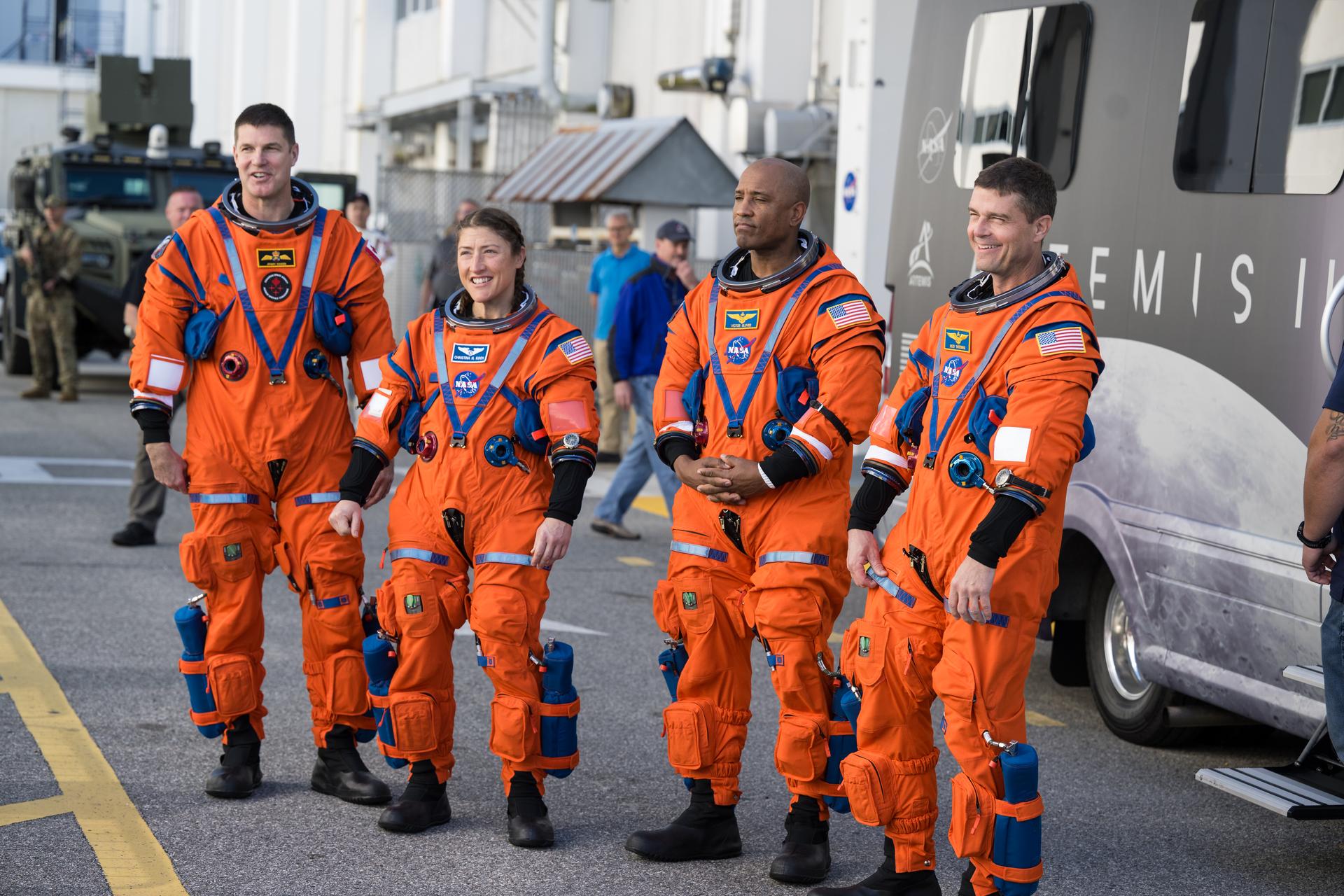
Four people in orange spacesuits stand on a road

The four crewmembers of NASA’s Artemis 2 moon mission. Left to right: The Canadian Space Agency’s Jeremy Hansen and NASA’s Christina Koch, Victor Glover and Reid Wiseman. (Image credit: NASA/Aubrey Gemignani)

There are other complications as well, which are related to the relatively small sample sizes and diversity of dangers involved in human spaceflight.

“We have pursued loss of mission, loss of crew-type number assessments, but I’m not sure we understand what they mean,” Honeycutt said.

As an example, he explained that the agency’s modeling work identifies micrometeors and orbital debris (MMOD) as the biggest single risk to the human spaceflight enterprise.

“It’s real, right? But when have the last two bad events occurred? Going uphill, in that highly energetic event,” Honeycutt said, presumably referring to the space shuttle Challenger and Columbia accidents in 1986 and 2003, respectively, which killed a total of 14 astronauts. (Challenger exploded 73 seconds after liftoff, and Columbia broke apart during reentry due to damage the orbiter sustained during launch.)

“So, you know, we can fool ourselves sometimes into thinking, ‘Really? Is that the biggest risk to the mission — MMOD?'” he said.

Honeycutt seemed to realize that such admissions, valid and honest as they are, would probably spawn stories like the one you’re reading now. “Well, this oughta make for some good reading over the next few days,” he said with a smile, drawing laughter from the journalists in the room.

Share. Facebook Twitter Pinterest LinkedIn Tumblr Email
Previous ArticleRelease of man’s confession sparks legal concerns
Next Article Iran’s new supreme leader was ‘wounded and likely disfigured’ in US-Israeli strikes, Hegseth contends
primereports
  • Website

Related Posts

Science

Science news this week: AMOC’s collapse signal, the sun’s galactic migration, the world’s smallest QR code and oil’s dying days

March 14, 2026
Science

Yaks may hint at a way to treat brain diseases like MS

March 13, 2026
Science

Monty Python Got It Wrong About Medieval Disease

March 13, 2026
Add A Comment
Leave A Reply Cancel Reply

Top Posts

Global Resources Outlook 2024 | UNEP

December 6, 20255 Views

The D Brief: DHS shutdown likely; US troops leave al-Tanf; CNO’s plea to industry; Crowded robot-boat market; And a bit more.

February 14, 20264 Views

German Chancellor Merz faces difficult mission to Israel – DW – 12/06/2025

December 6, 20254 Views
Stay In Touch
  • Facebook
  • YouTube
  • TikTok
  • WhatsApp
  • Twitter
  • Instagram
Latest Reviews

Subscribe to Updates

Get the latest tech news from FooBar about tech, design and biz.

PrimeReports.org
Independent global news, analysis & insights.

PrimeReports.org brings you in-depth coverage of geopolitics, markets, technology and risk – with context that helps you understand what really matters.

Editorially independent · Opinions are those of the authors and not investment advice.
Facebook X (Twitter) LinkedIn YouTube
Key Sections
  • World
  • Geopolitics
  • Popular Now
  • Artificial Intelligence
  • Cybersecurity
  • Crypto
All Categories
  • Artificial Intelligence
  • Climate Risks
  • Crypto
  • Cybersecurity
  • Defense
  • Economy
  • Geopolitics
  • Global Markets
  • Healthcare Innovation
  • Politics
  • Popular Now
  • Science
  • Technology
  • World
  • About Us
  • Contact Us
  • Privacy Policy
  • Terms & Conditions
  • Disclaimer
  • Cookie Policy
  • DMCA / Copyright Notice
  • Editorial Policy

Sign up for Prime Reports Briefing – essential stories and analysis in your inbox.

By subscribing you agree to our Privacy Policy. You can opt out anytime.
Latest Stories
  • Police issue warning to protesters before al-Quds Day rally in London | Metropolitan police
  • Bitcoin holds $71,000 as Trump warns of Iran oil strikes
  • Interpol Nets 94 Arrests in Major Cybercrime Sweep
© 2026 PrimeReports.org. All rights reserved.
Privacy Terms Contact

Type above and press Enter to search. Press Esc to cancel.