

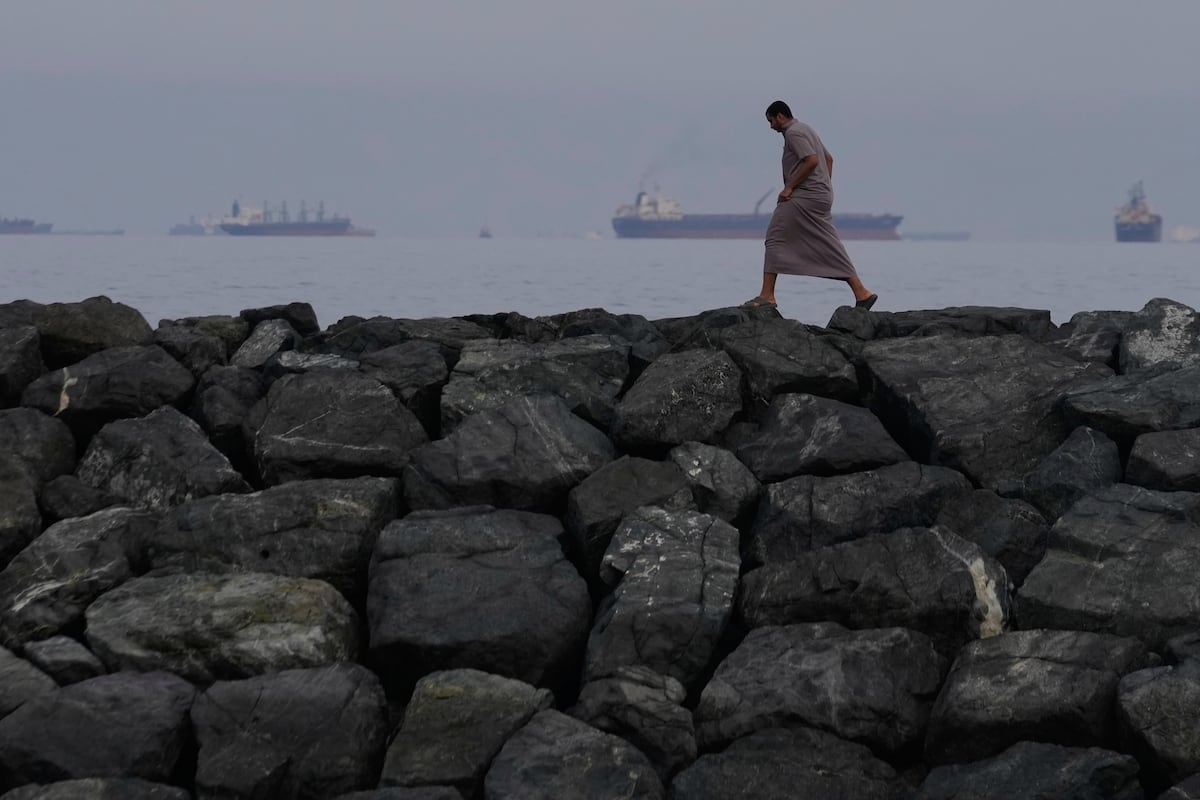
President Donald Trump on Friday evening announced the most aggressive U.S. action to date aimed at easing concerns over global oil supply and getting shipping moving in the vital Strait of Hormuz.
Writing on Truth Social, Trump said that at his direction, Central Command “executed one of the most powerful bombing raids in the History of the Middle East, and totally obliterated every MILITARY target in Iran’s crown jewel, Kharg Island.”
The president said he refrained from wiping out the oil infrastructure on the island, but warned, “should Iran, or anyone else, do anything to interfere with the Free and Safe Passage of Ships through the Strait of Hormuz, I will immediately reconsider this decision.”
Details of exactly what happened on Kharg Island remain unclear but the military gambit outlined by Trump appears to come, at least in part, in response to an earlier statement from Iran’s newly appointed supreme leader, saying that the Islamic Republic would seek to keep the Strait of Hormuz blocked.
Mojtaba Khamenei made the defiant order in a written statement that was read out on Iranian state television. He has yet to be seen in public since being elevated to his current role after his father, Ayatollah Ali Khamenei, was killed on Feb. 28.
More than a dozen ships have reportedly been attacked in the Persian Gulf since the start of the conflict. The Islamic Revolutionary Guard Corps, which declared that any vessel attempting to pass through the strait would be targeted, has claimed responsibility for several of those ambushes.
The supreme leader described the siege of the shipping channel as a “lever” to exert pressure on the nation’s adversaries. The strait is a vital maritime artery, carrying roughly 20% of the world’s petroleum liquids and liquefied natural gas trade.
By snarling shipping through the Strait of Hormuz, Iran has sent Brent crude oil futures soaring past $100 a barrel for the first time since 2022, up from approximately $70 before the war began.
Experts say the Iranian strategy, if not effectively countered, is capable of sowing chaos in the Gulf — with serious ramification for the wider world.
“These strikes target commercial vessels regardless of flag or ownership, including neutral of third-party ships and those connected to Gulf neighbors, fueling widespread fear and uncertainty,” Scarlett Suarez, a senior intelligence analyst at Dryad Global, a maritime research firm, said in an interview with Military Times. “Disruption is achieved through indiscriminate asymmetric attacks.”
During the 1980s “Tanker War” phase of the Iran-Iraq War, the Islamic Republic mined waters in and around the Strait of Hormuz. In 1988, an Iranian mine severely damaged the guided-missile frigate USS Samuel B. Roberts in the Persian Gulf, prompting a major American retaliation, known as Operation Praying Mantis, in which several Iranian vessels and two oil platforms were destroyed.
Tehran’s strategy relies on asymmetric naval warfare, oscillating between the use of fast-attack boats, unmanned vessels, drones, shore-based missile batteries and an array of sea mines.
“It’s a multidimensional threat,” Ret. Navy Capt. Bill Hamblet, now the U.S. Naval Institute’s editor-in-chief of “Proceedings,” told Military Times. “Finding the mines, clearing the mines, that’s a slow, methodical, mechanical process. And then protecting the mine-clearing operation from the other threats that could come out while they are trying to do that.”
Hamblet explained that these additional threats include not only drones and missiles, but also small, nimble attack craft.
“They arm them up with either small missiles or machine guns, and those boats can go at up to 50 knots. So, you need to be able to defend against those threats while clearing mines or escorting merchant ships,” he said.
The Islamic Republic possesses between 5,000 and 6,000 naval mines, according to a congressional report released in 2025. The arsenal includes limpet mines, which are attached directly to a ship’s hull; moored mines, which float beneath the surface and detonate on contact; and bottom mines, which rest on the seafloor and explode when they detect a passing vessel.
Secretary of Defense Pete Hegseth, in a briefing at the Pentagon on Friday, told reporters there is “no clear evidence” that Iran has placed new mines in the Strait of Hormuz.
“As the world is seeing, they are exercising sheer desperation in the Strait of Hormuz,” he said. “Something we’re dealing with, we have been dealing with it.”
Hegseth added: “Don’t need to worry about it.”
Tanya Noury is a reporter for Military Times and Defense News, with coverage focusing on the White House and Pentagon.
