

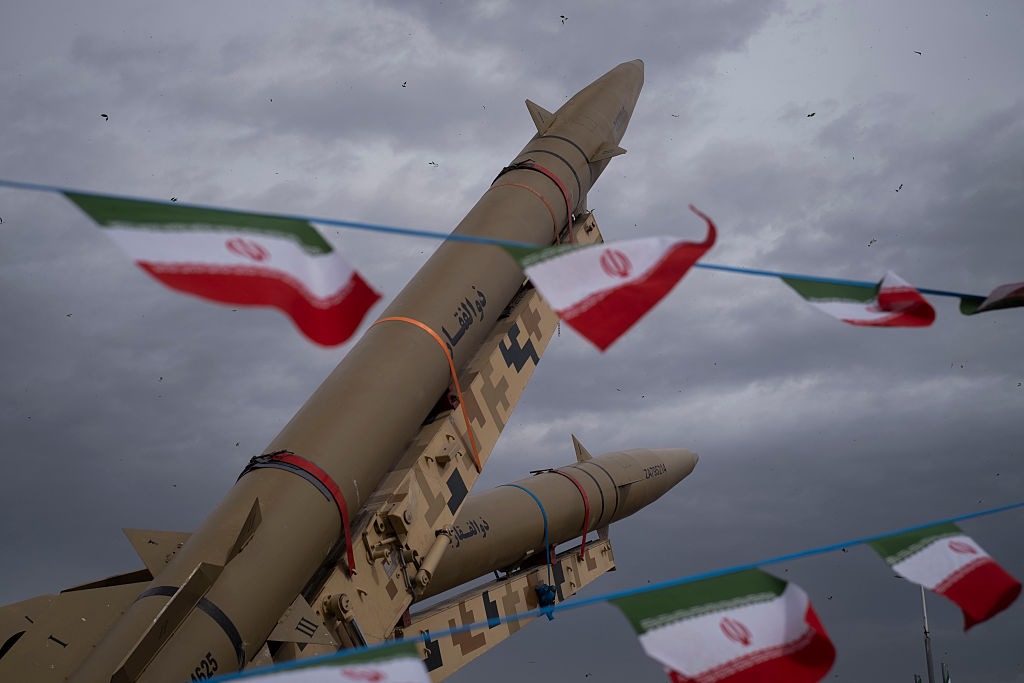
Contrary to conventional wisdom, Iran would be more a national-security state than a theocracy, writes Vali R Nasr in his book Iran’s Grand Strategy: A Political History. Iran’s supreme leader does not see himself as a cleric, but as a de facto commander-in-chief of the Islamic Revolutionary Guard Corps. Essentially every Iranian institution has been shaped by the country’s confrontation with the West.
Naser, a professor at the Johns Hopkins University, emphasises the importance of history in shaping Iran’s grand strategy. Iran sees itself as a grand civilisation. But it is a lonely civilisation as its mainly Muslim Shia population is surrounded by many Muslim Sunni-dominant states. Modern Iran was created by the Safavid dynasty in the 16th century, which adopted Shia Islam to distinguish itself from the Ottoman Empire.
Iran is also a country of Persian language speakers in a region dominated by speakers of Arabic or Turkic languages. Iran’s loneliness would be a very important driver of the of the anxiety of the way Iran thinks about national security.
During the 19th century, Iran was brutalised by imperialism, losing territory to Russia and Britain. Its economy was also deeply penetrated by imperialism. In 1953, the prime minister of Iran was overthrown in a British and US supported coup d’etat to protect British oil interests following the nationalisation of the country’s oil industry.
This strengthened the rule of pro-Western shah of Iran, Mohammad Reza Pahlavi. The shah was then ousted in 1979 in the Iranian Revolution, led by Ruhollah Khomeini, an Islamist cleric. The revolutionaries believed that the shah was a US puppet, and his father a British puppet. For Khomeini, the goal and achievement of the revolution was to restore Iran’s independence after two centuries of external domination, and Islam was a vehicle for achieving such independence.
In November 1979, Iranian students stormed and closed the US embassy in Tehran, taking 66 Americans hostage. Nasr argues that Khomeini approved this because he was convinced that if there was a US embassy in Iran, there would be an attempted repeat of the 1953 coup.
A defining event in shaping Iran’s grand strategy was the eight-year-long Iran–Iraq War, which began with the Iraqi invasion of Iran in September 1980. This war left Iran with the feeling that the whole world was against it, as everyone—Arab countries, the United States, western Europeans and the United Nations—supported Iraq. So the lessons of the Iran–Iraq war—that Iran is alone and must be independent and self-reliant—became ingrained in Iran’s revolutionary guards, many of whose memoirs Nasr read.
Nasr reports that Henry Kissinger was the father of Iran’s civil nuclear energy program. In the 1970s, as US secretary of state, he played a significant role in supporting the programme under the shah by authorising plans to sell billions of dollars in nuclear equipment to Iran, intending to help the country transition away from oil reliance. Iran’s interest in the 2015 Iran nuclear deal, or Joint Comprehensive Plan of Action, was a de facto way of opening to the West, without the fanfare of establishing diplomatic relations.
Following its invasion of Iraq in 2003, the US rejected Iran’s offers for cooperation. So Iran fostered Shia militias in Iraq to make life difficult for the US. This was supported by then Syrian leader, Bashar Hafez al-Assad, who expressed concerns to Iran’s leaders that the US might go after Iran and Syria after Iraq. Supreme leader Ali Khamenei replied that they had to make sure that this crocodile did not digest its food easily.
By Iran’s ‘forward defence doctrine’, it supported Hezbollah, Hamas, Houthis, and militias in Iraq and Syria so that the US and Israel were distracted well away from Iran. But the Gaza war proved to be a very big turning point with the degrading of these groups. Iran also suffered by the fall of the Assad regime in Syria.
The regime’s grand strategy has come at a high cost and is no longer working. Its forward defences have been virtually demolished. Iran’s population is frustrated and civil unrest has grown. Many Iranians would like a normal state and a growing economy. They are not the population of the 1980s, most are young and have no memory of the revolution. But despite its authoritarian reputation, abrupt change is difficult because Iran’s politics is riddled with factions, from hard-liners to reformers, as well as different ethnic groups.
Nasr’s book was published in May 2025, prior to the Israeli and US attacks on Iran in June 2025 and the conflict presently underway. His portrait is of an Iran now weakened externally and internally, and vulnerable. But the national-security state is still very much present, and it is motivated to protect the country’s independence and control the domestic population.
