

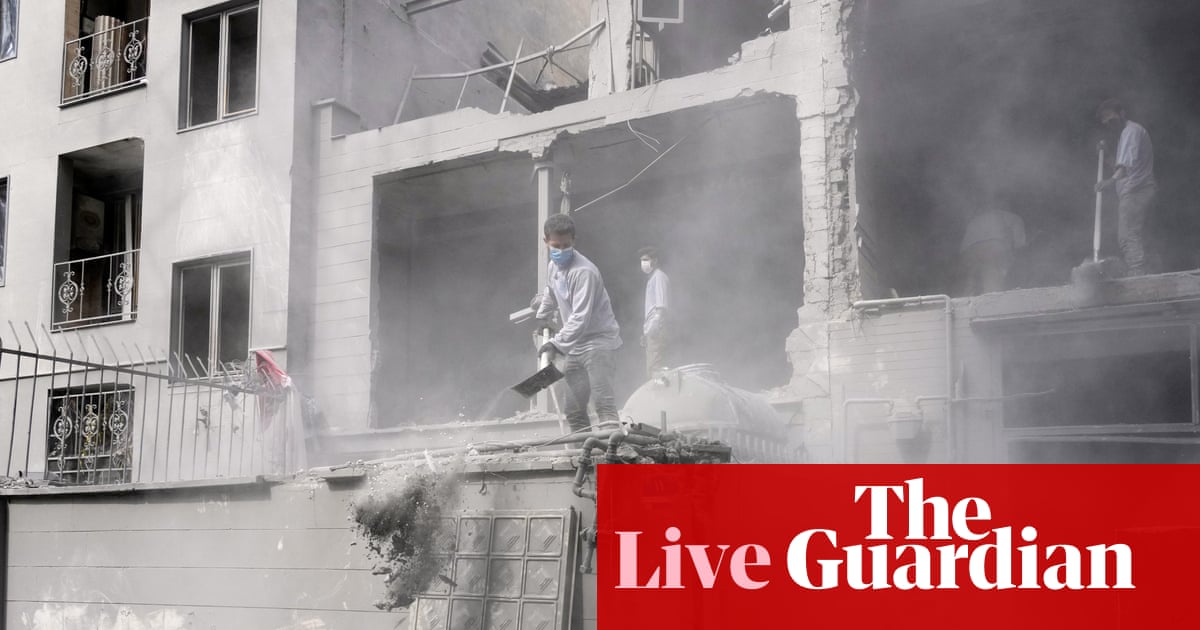
Israel issues evacuation orders for several Beirut neighbourhoods
In a post on X, Israeli military spokesperson Avichay Adraee warned several neighbourhoods in the southern suburbs of Beirut to evacuate “immediately” ahead of Israeli attacks.
He said the warning especially applies to residents of Haret Hreik, Ghobeiry, Laylaki, Bourj el-Barajneh, Ghadir Perimeter and Shiyah.
“The defense army will not hesitate to target anyone present near Hezbollah elements, their facilities, or their combat means. You are putting yourselves and your lives in danger – therefore, evacuate the area immediately,” Adraee said.
At least 826 people, including many children, have been killed in Lebanon by Israeli strikes, according to the ministry of health. The ministry says 31 health workers have been killed. Hundreds of thousands of people have been forced to flee their homes by sweeping Israeli evacuation orders in the devastating Israeli-US assault on the country.
Key events
Death toll from Israeli attacks on Gaza reaches 72,239, says health ministry
Israeli airstrikes in Gaza have continued even as Israeli jets carry out attacks in Iran and Lebanon.
Gaza health authorities now say the direct death toll from Israeli attacks since 7 October 2023 is at least 72,239 Palestinian people, including 663 killed since a ceasefire came into effect in October 2025.
These figures are generally seen as reliable by UN agencies and independent experts. Most of the people killed in these Israeli attacks have been civilians, many of whom were women and children.
At least four Palestinian people, including two boys and a woman pregnant with twins, were killed earlier today in Nuseirat, a refugee camp in central Gaza, according to hospital authorities.
As my colleague Julian Borger notes in this story, progress in the so-called Gaza peace plan has stalled over disagreements on how Hamas should be disarmed, with Israel threatening to go back to its full-scale war if the condition is not carried out quickly.
Injuries suffered after Iranian missiles reportedly fired at Israel
There have been reports of missile and drone activity across Israel, with sirens reported in northern towns as well as central and southern areas including Tel Aviv.
The IDF said earlier on X that it had detected Iranian missiles being fired at Israel.
The Times of Israel is reporting that five people have been injured from seven separate Iranian missile attacks on Israel since midnight. We have not been able to verify these figures or reports.
In a post on Telegram, Iran’s Fars news agency has quoted the education spokesperson as having said that “school activities” will be virtual until the end of March, with school re-openings kept under review amid the US-Israeli war.
We reported in an earlier post that Israel’s foreign minister denied a report in Semafor that said Israel was running low on ballistic missile interceptors to repel incoming Iranian missile attacks. Here is an extract of that Semafor report – which was published on Saturday -for a fuller context:
Israel had reportedly entered the current war already low on interceptors that were fired during last summer’s conflict with Iran.
Israel’s long-range defense system has strained under Iran’s attacks; CNN reported that Iran was adding cluster munitions to its missiles, which may exacerbate the depletion of the stock.
The US has been aware of Israel’s low capacity for months, one US official said: “It’s something we expected and anticipated.”
This official emphasized to Semafor that the US is not running similarly low on interceptors of its own.
The Times of Israel and Hareetz are reporting that the Israeli government, in a late night telephone vote, approved transferring 2.6 billion shekels (£625m; $826m) to the defence ministry for an urgent procurement of armaments and advanced weapons.
The Reuters news agency is reporting that the Israeli foreign minister Gideon Saar said the government was not planning to hold direct talks with Lebanon in the coming days and had not told the US it was running low on missile interceptors.
Israel’s Haaretz newspaper reported yesterday that Israel and Lebanon were expected to hold direct talks in the coming days. Semafor also reported that Israel had informed Washington it was running critically low on ballistic missile interceptors.
Asked about the two reports, Saar was quoted as having said on Sunday: “For the two questions, the answers is no.”
Israel issues evacuation orders for several Beirut neighbourhoods
In a post on X, Israeli military spokesperson Avichay Adraee warned several neighbourhoods in the southern suburbs of Beirut to evacuate “immediately” ahead of Israeli attacks.
He said the warning especially applies to residents of Haret Hreik, Ghobeiry, Laylaki, Bourj el-Barajneh, Ghadir Perimeter and Shiyah.
“The defense army will not hesitate to target anyone present near Hezbollah elements, their facilities, or their combat means. You are putting yourselves and your lives in danger – therefore, evacuate the area immediately,” Adraee said.
At least 826 people, including many children, have been killed in Lebanon by Israeli strikes, according to the ministry of health. The ministry says 31 health workers have been killed. Hundreds of thousands of people have been forced to flee their homes by sweeping Israeli evacuation orders in the devastating Israeli-US assault on the country.
UK ‘intensively looking’ at what it can do to help reopen strait of Hormuz, energy secretary says
Over in the UK, the energy secretary, Ed Miliband, said the government was “intensively” looking at what it can do to help reopen the strait of Hormuz, a day after Donald Trump said the UK should send warships to help keep the world’s most vital oil transit point open.
Miliband was asked on Sky News’s Sunday Morning with Trevor Phillips whether Britain was looking at sending minesweepers or mine hunting drones to the strait, through which about a fifth of the world’s oil passes.
The energy secretary said:
We are talking to our allies. There’s different ways in which we can make maritime shipping possible. We are intensively looking with our allies at what can be done, because it’s so important that we get the strait reopened.
Speaking to the BBC, he described reopening the strait as a “priority for the world” and said that “any options that can get the strait reopened are being looked at”.
He said the British government has been in contact with allies – including the US – about getting navigation through the strait back to prewar levels.
Iran has attacked ships and reportedly started to lay mines in the strait, in effect closing it to marine traffic, leading to a huge rise in global oil prices. Last year, about 20m barrels of oil passed through the strait each day.
Supreme leader is ‘in good health’ and ‘fully managing the situation’, foreign minister says
The Iranian foreign minister also said that the new supreme leader, Mojtaba Khamenei, is “in good health” and “fully managing the situation”.
Abbas Araghchi said that he welcomes “any regional initiative that leads to a just end to the war”, adding there is no such specific proposal “on the table” yet.
Iranian officials have admitted Khamenei was hurt in the Israeli strike that opened the war but claim the 56-year-old’s injuries are not serious.
Khamenei, recently named as successor to his father Ayatollah Ali Khamenei, who was killed in the US-Israeli strikes, has not appeared in public since assuming power, fuelling rumours about his health.
His first public address was broadcast by state media on 12 March – but this was read out by a presenter, only adding to the speculation.
In an interview with NBC News yesterday, the US president, Donald Trump, questioned whether Iran’s new supreme leader was “even alive”. “I’m hearing he’s not alive, and if he is, he should do something very smart for his country, and that’s surrender,” Trump added.
Iran ready to help investigate strikes on civilian areas, foreign minister says
In an interview with the Al-Araby al-Jadeed website, Iran’s foreign minister Abbas Araghchi said his country is ready to form a committee with countries in the region to investigate who was behind strikes in civilian or residential areas in the Middle East. He denied Iran had targeted such areas.
Araghchi said lines of diplomatic communication were open with Gulf states, including Qatar, Saudi Arabia and Oman.
In response to US-Israeli attacks, Iran started launching missile and drone attacks across the Gulf region, targeting what it says are US military assets – but many of these strikes have hit civilian infrastructure.
Gulf countries are angry at having been pulled into the war, a conflict they had diplomatically tried to prevent.
Here are some of the latest images being sent to us over the newswires from the Lebanese capital of Beirut in the aftermath of Israeli bombing:
Pentagon identifies six US service members killed in aircraft crash over Iraq
Edward Helmore
The names of the six US service members who died when a military refueling aircraft crashed over Iraq on Thursday have been released.
The Pentagon on Saturday identified the crew members as Maj John “Alex” Klinner, 33, of Auburn, Alabama; Capt Ariana Savino, 31, of Covington, Washington; Tech Sgt Ashley Pruitt, 34, of Bardstown, Kentucky; Capt Seth Koval, 38, of Mooresville, Indiana; Capt Curtis Angst, 30, of Wilmington, Ohio; and Tech Sgt Tyler Simmons, 28, of Columbus, Ohio.
The Pentagon has said the loss of the KC-135 Stratotanker was not caused by hostile or friendly fire.
US Central Command, which oversees the Middle East, has said the crash occurred in western Iraq on Thursday following an unspecified incident involving two aircraft in “friendly airspace”. The other tanker involved in the incident landed safely in Israel.
The crash brings the US death toll in Operation Epic Fury to at least 13 service members, with the seven others killed in combat. About 140 US service members have been injured, including eight severely, the Pentagon said earlier this week. You can read more here:
You can read a useful explainer about what the IRGC is and the power they yield here:
IRGC vows to ‘pursue and kill’ Benjamin Netanyahu ‘with force’ – report
In a post to Telegram, The Iranian news agency Mehr reported that the Islamic Revolution Guard Corps (IRGC) has vowed to kill the Israeli prime minister, Benjamin Netanyahu.
The IRGC was quoted as saying they “will continue to pursue and kill him with force”.
The IRGC is a major military, political and economic force in Iran, loyal to the country’s supreme leader.
The Tasnim news agency, which is associated with Iran’s Revolutionary Guards, reported that 153 health facilities across the country have been damaged in US-Israeli attacks.
The report, which we have not yet been able to independently verify, said Kermanshah university, in western Iran, suffered the most damage among medical universities.
Ten people – three employees and seven members of the public – were reportedly killed in the attacks.
Israel says it has launched ‘extensive strikes’ on Iran
The IDF said 10 minutes ago in a post on X that it had launched a wave of “extensive strikes” across western Iran.
It claims it is striking “infrastructure” of the Iranian regime but Israel has killed many civilians in its attacks over the last two weeks.
