
LIVE NEWS
  • AI costs how much? GitHub Copilot users react to new usage-based pricing system.
  • European Parliament committee votes to scrap US tariffs
  • Hints and Solutions for June 2
  • It has the highest levels of toxic Pfas in drinking water in Scotland. But how did this remote island become awash with forever chemicals? | Pfas
  • For veterans, a place where peace can take root : NPR
  • This common amino acid helped mice survive deadly inflammation
  • Apple Will Reportedly Add Bill-Splitting Feature to iOS 27
  • Opinion | Putin Has No Good Way Out of His War
Prime Reports
  • Home
  • Popular Now
  • Crypto
  • Cybersecurity
  • Economy
  • Geopolitics
  • Global Markets
  • Politics
  • See More
    • Artificial Intelligence
    • Climate Risks
    • Defense
    • Healthcare Innovation
    • Science
    • Technology
    • World
Prime Reports
  • Home
  • Popular Now
  • Crypto
  • Cybersecurity
  • Economy
  • Geopolitics
  • Global Markets
  • Politics
  • Artificial Intelligence
  • Climate Risks
  • Defense
  • Healthcare Innovation
  • Science
  • Technology
  • World
Home»Healthcare Innovation»Cells can sense 10x farther than expected and it may explain cancer spread
Healthcare Innovation

Cells can sense 10x farther than expected and it may explain cancer spread

primereportsBy primereportsMarch 16, 2026No Comments3 Mins Read
Share Facebook Twitter Pinterest LinkedIn Tumblr Reddit Telegram Email
Cells can sense 10x farther than expected and it may explain cancer spread
Share
Facebook Twitter LinkedIn Pinterest Email


The fairy tale of the princess and the pea tells of a young royal so sensitive she could detect a tiny pea hidden beneath many mattresses. In biology, something similar happens when a cell senses conditions far beyond what it directly touches. Until recently, this remarkable ability was mostly linked to unusual cells such as cancer cells. New research shows that ordinary cells can achieve a similar feat when they work together.

Engineers at Washington University in St. Louis reported their findings in the journal PNAS. Their work sheds light on how cells detect and respond to their environment beyond the surface they attach to. Understanding this process could help scientists learn more about how cancer cells move through the body and may reveal new ways to slow or prevent that spread.

The Mechanics of Long Range Cell Sensing

Amit Pathak, a professor of mechanical engineering and materials science at the McKelvey School of Engineering, studies how cells interact with the physical properties of their surroundings. He explained that “depth mechano-sensing” describes the process that allows cells to detect features beyond the surface they are attached to.

In earlier studies, Pathak and his colleagues found that abnormal cells with a “high front-rear polarity” (indicative of migrating cells) have an especially strong ability to sense their environment. These cells can detect physical cues up to 10 microns beyond the area where they are attached.

This sensing ability relies partly on how a cell pulls and reshapes the fibrous collagen around it. By deforming these fibers, the cell extends its reach into extracellular matrix (ECM) and can “feel” what lies in the next layer. That next layer could be something stiff such as a tumor, softer tissue, or even bone nearby. By detecting the stiffness of the ECM, a single abnormal cell can determine the direction it should move.

Collective Cell Forces Extend the Sensing Range

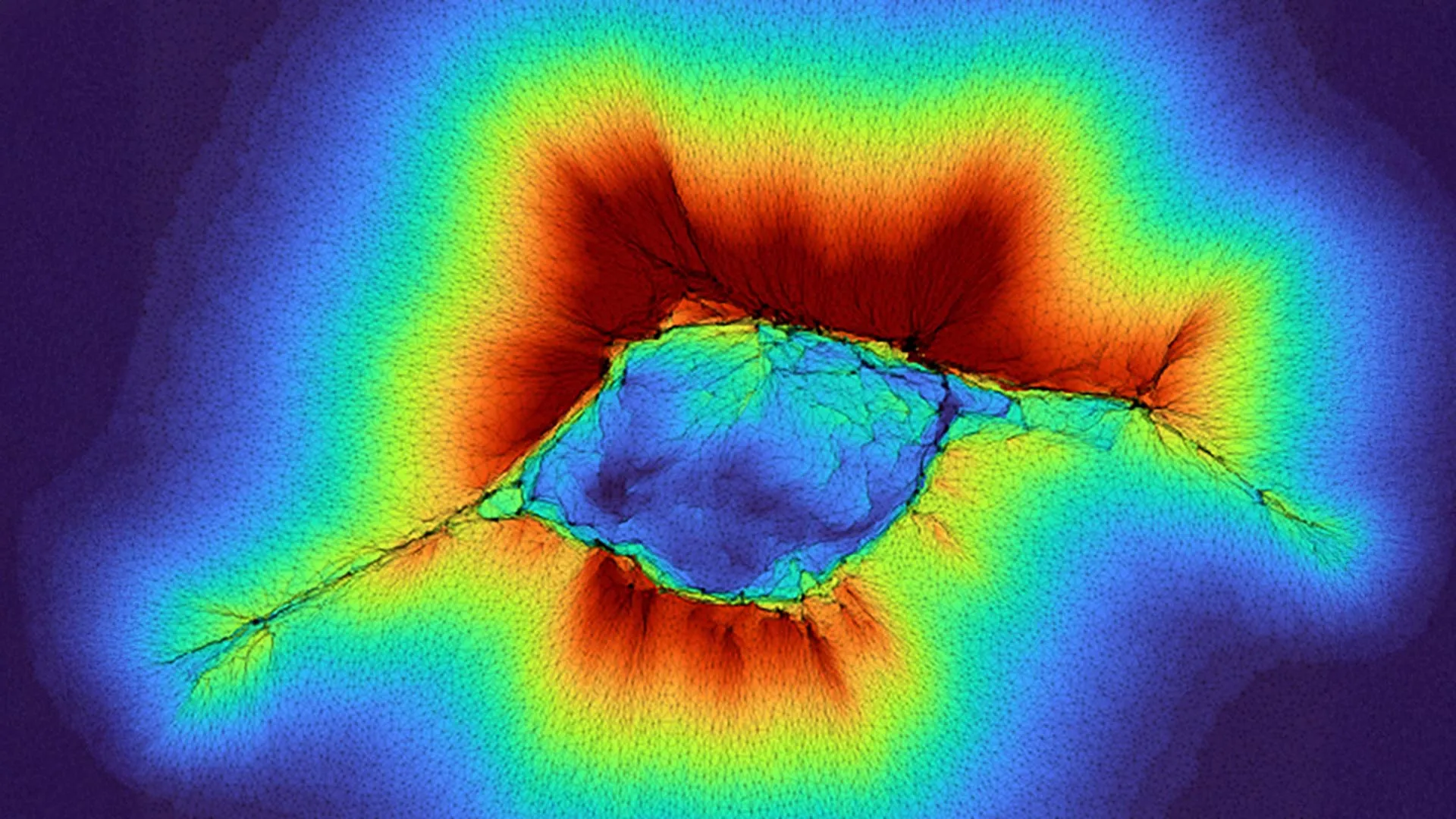
The new research shows that groups of epithelial cells, which form the surfaces of many tissues, can achieve an even greater sensing range. When these cells act together, they generate enough force to probe through the fibrous collagen and detect layers as far as 100 microns away.

“Because it’s a collective of cells, they are generating higher forces,” said Pathak, who conducted the research with PhD student Hongsheng Yu.

Computer models suggest that this process unfolds in two stages as cells cluster together and begin migrating. During these phases, the information the cells gather about their surroundings influences how they move and spread.

Implications for Understanding Cancer Spread

Cancer cells appear to benefit from this enhanced sensing ability. Their capacity to detect what lies ahead helps them escape the tumor environment and move through surrounding tissue while avoiding detection. This ability allows them to migrate more easily, even in softer environments.

Researchers now want to determine exactly how this sensing range is controlled and whether specific regulators determine how far cells can detect their surroundings. Identifying those regulators could open the door to new cancer treatments. If scientists can disrupt a cancer cell’s ability to “feel” its path forward, they may be able to limit how far the disease spreads.

Funding for this research was provided by the National Institutes of Health (NIH) (R35GM128764) and National Science Foundation, Civil, Mechanical and Manufacturing Innovation (2209684).

Share. Facebook Twitter Pinterest LinkedIn Tumblr Email
Previous ArticleAn engineering thesis disguised as a coupe: A history of the Honda Prelude
Next Article AP analysis: Two weeks into war with Iran, Trump has been knocked back on his political heels
primereports
  • Website

Related Posts

Healthcare Innovation

This common amino acid helped mice survive deadly inflammation

June 2, 2026
Healthcare Innovation

Clinical Workflow Automation: Where AI Is Making Real Inroads

June 2, 2026
Healthcare Innovation

Medicaid work requirement rules published by Trump’s CMS

June 2, 2026
Add A Comment
Leave A Reply Cancel Reply

Top Posts

Paxton’s win over Cornyn sets up high-stakes Texas clash with Talarico

May 28, 202616 Views

Global Resources Outlook 2024 | UNEP

December 6, 202510 Views

Texas Democrat Talarico claims voting laws are rigged ahead of Paxton race

May 28, 20269 Views
Stay In Touch
  • Facebook
  • YouTube
  • TikTok
  • WhatsApp
  • Twitter
  • Instagram
Latest Reviews

Subscribe to Updates

Get the latest tech news from FooBar about tech, design and biz.

PrimeReports.org
Independent global news, analysis & insights.

PrimeReports.org brings you in-depth coverage of geopolitics, markets, technology and risk – with context that helps you understand what really matters.

Editorially independent · Opinions are those of the authors and not investment advice.
Facebook X (Twitter) LinkedIn YouTube
Key Sections
  • World
  • Geopolitics
  • Popular Now
  • Artificial Intelligence
  • Cybersecurity
  • Crypto
All Categories
  • Artificial Intelligence
  • Climate Risks
  • Crypto
  • Cybersecurity
  • Defense
  • Economy
  • Geopolitics
  • Global Markets
  • Healthcare Innovation
  • Politics
  • Popular Now
  • Science
  • Technology
  • World
  • About Us
  • Contact Us
  • Privacy Policy
  • Terms & Conditions
  • Disclaimer
  • Cookie Policy
  • DMCA / Copyright Notice
  • Editorial Policy

Sign up for Prime Reports Briefing – essential stories and analysis in your inbox.

By subscribing you agree to our Privacy Policy. You can opt out anytime.
Latest Stories
  • AI costs how much? GitHub Copilot users react to new usage-based pricing system.
  • European Parliament committee votes to scrap US tariffs
  • Hints and Solutions for June 2
© 2026 PrimeReports.org. All rights reserved.
Privacy Terms Contact

Type above and press Enter to search. Press Esc to cancel.