

Saud, S., Haseeb, A., Chen, S. & Li, H. The role of information and communication technology and financial development in shaping a low-carbon environment: a belt and road journey toward development. Inform. Technol. Dev. 29, 83–102 (2023).
Masciari, E. & Napolitano, E. V. The environmental cost of high performance computing system simulation. In 2024 32nd Euromicro Int. Conf. Parallel, Distributed and Network-Based Processing (PDP) (eds Chis, A. E. et al.) 289–292 (IEEE, 2024).
Li, T. et al. Carbon emissions of 5G mobile networks in China. Nat. Sustain. 6, 1620–1631 (2023). This study develops a data-driven framework to characterize a carbon efficiency trap within China’s 5G networks. The authors propose DeepEnergy, an energy-saving method, to reduce carbon emissions and help the network achieve more than 50% of its net-zero goal by 2023.
Shobande, O. A. & Asongu, S. A. Searching for sustainable footprints: does ICT increase CO₂ emissions? Environ. Model. Assess. 28, 133–143 (2023).
Israr, A., Yang, Q., Li, W. & Zomaya, A. Y. Renewable energy powered sustainable 5G network infrastructure: opportunities, challenges and perspectives. J. Netw. Comput. Appl. 175, 102910 (2021).
Auer, G. et al. How much energy is needed to run a wireless network? IEEE Wirel. Commun. 18, 40–49 (2011).
Kabeyi, M. J. B. & Olanrewaju, O. A. Sustainable energy transition for renewable and low carbon grid electricity generation and supply. Front. Energy Res. 9, 743114 (2022).
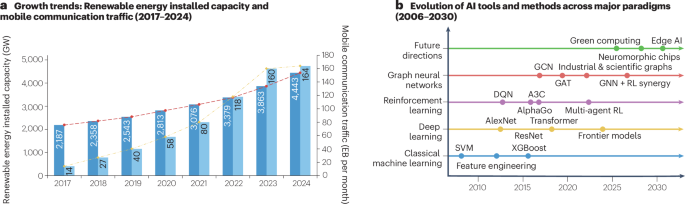
International Renewable Energy Agency (IRENA). Renewable Capacity Statistics 2025 (IRENA, 2025).
Pan, S. L. & Nishant, R. Artificial intelligence for digital sustainability: an insight into domain-specific research and future directions. Int. J. Inf. Manage. 72, 102668 (2023).
Ahmad, T. et al. Artificial intelligence in sustainable energy industry: status quo, challenges and opportunities. J. Clean. Prod. 289, 125834 (2021).
Mao, B. et al. AI models for green communications towards 6G. IEEE Commun. Surv. Tutor. 24, 210–247 (2022). This paper surveys AI-based approaches for green communications, highlighting how AI, particularly machine learning, can manage networks, improve energy efficiency and address the increasing energy demands of 5G and 6G, while discussing challenges and open research issues for sustainable 6G development.
Li, R. et al. Intelligent 5G: when cellular networks meet artificial intelligence. IEEE Wirel. Commun. 24, 175–183 (2017). This article explores the emergence of native intelligence in key aspects of 5G cellular networks and emphasizes the need for full AI integration to manage complex configurations and new service demands, highlighting opportunities and challenges for AI to orchestrate intelligent 5G networks and realize information and communication technology as a primary enabler.
Ge, L. & Li, Y. in Smart Power Distribution Network: Situation Awareness, Planning, and Operation (eds Ge, L. & Li, Y.) 3–17 (Springer Nature, 2023). This book chapter provides a comprehensive overview of smart power distribution networks, focusing on situational awareness, planning and operational strategies to enhance efficiency, reliability and adaptability in modern power systems.
Walia, G. K., Kumar, M. & Gill, S. S. AI-empowered fog/edge resource management for IoT applications: a comprehensive review, research challenges and future perspectives. IEEE Commun. Surv. Tutor. 26, 619–669 (2023).
Hua, H. et al. Edge computing with artificial intelligence: a machine learning perspective. ACM Comput. Surv. 55, 1–35 (2023).
Meng, Y. et al. Transmission and distribution network-constrained large-scale demand response based on locational customer directrix load for accommodating renewable energy. Appl. Energy 350, 121681 (2023).
Zhao, Q., Li, G., Cai, J., Zhou, M. & Feng, L. A tutorial on internet of behaviors: concept, architecture, technology, applications, and challenges. IEEE Commun. Surv. Tutor. 25, 1227–1260 (2023).
Notton, G. et al. Intermittent and stochastic character of renewable energy sources: consequences, cost of intermittence and benefit of forecasting. Renew. Sustain. Energy Rev. 87, 96–105 (2018).
Purkait, P., Basu, M. & Nath, S. R. in Challenges and Opportunities of Distributed Renewable Power (eds De, S. et al.) 37–100 (Springer, 2024). This book chapter explores the integration of renewable energy sources into existing power grids, discussing the opportunities, challenges and solutions for effective integration while highlighting recent advances in simulation tools, mathematical models and technologies such as power electronics, information and communication technology, and smart grids to support a sustainable energy future.
Hamdan, A., Ibekwe, K. I., Ilojianya, V. I., Sonko, S. & Etukudoh, E. A. AI in renewable energy: a review of predictive maintenance and energy optimization. Int. J. Sci. Res. Arch. 11, 718–729 (2024).
Chen, L., Li, X. & Zhu, J. Carbon peak control for achieving net-zero renewable-based smart cities: digital twin modeling and simulation. Sustain. Energy Technol. Assess. 65, 103792 (2024).
Gaur, L., Afaq, A., Arora, G. K. & Khan, N. Artificial intelligence for carbon emissions using system of systems theory. Ecol. Inform. 76, 102165 (2023). This study explores the dual impact of AI on the environment, analysing the complex relationship between the potential of AI to combat climate change and its contribution to carbon emissions, and advocates for sustainable AI practices throughout its life cycle to balance efficiency with environmental responsibility.
Cowls, J., Tsamados, A., Taddeo, M. & Floridi, L. The AI gambit: leveraging artificial intelligence to combat climate change—opportunities, challenges, and recommendations. AI Soc. 38, 283–307 (2023).
Alzoubi, Y. I. & Mishra, A. Green artificial intelligence initiatives: potentials and challenges. J. Clean Prod. 468, 143090 (2024).
Wang, H., Lei, Z., Zhang, X., Zhou, B. & Peng, J. A review of deep learning for renewable energy forecasting. Energy Conv. Manag. 198, 111799 (2019).
Yang, T., Zhao, L., Li, W. & Zomaya, A. Y. Dynamic energy dispatch strategy for integrated energy system based on improved deep reinforcement learning. Energy 235, 121377 (2021).
Zhu, Z., Sun, C., He, Y., Shen, J. & Sun, J. Layout methods for integrated energy supply service stations from the perspective of combination optimization. J. Adv. Transp. 2021, 6664115 (2021).
Sinsel, S. R., Riemke, R. L. & Hoffmann, V. H. Challenges and solution technologies for the integration of variable renewable energy sources—a review. Renew. Energy 145, 2271–2285 (2020).
Adefarati, T. & Bansal, R. C. Integration of renewable distributed generators into the distribution system: a review. IET Renew. Power Gener. 10, 873–884 (2016).
Yang, T., Zhao, L., Li, W. & Zomaya, A. Y. Reinforcement learning in sustainable energy and electric systems: a survey. Annu. Rev. Control. 49, 145–163 (2020).
Arumugham, V. et al. An artificial-intelligence-based renewable energy prediction program for demand-side management in smart grids. Sustainability 15, 5453 (2023). This paper presents a model for accurately predicting and managing renewable energy supply in smart grids, using prediction models and demand response programmes to optimize energy scheduling and reduce operational costs, with results validated through a multi-objective ant colony optimization algorithm.
Boza, P. & Evgeniou, T. Artificial intelligence to support the integration of variable renewable energy sources to the power system. Appl. Energy 290, 116754 (2021).
Nemitallah, M. A. et al. Artificial intelligence for control and optimization of boilers’ performance and emissions: a review. J. Clean. Prod. 417, 138109 (2023).
Aliramezani, M., Koch, C. R. & Shahbakhti, M. Modeling, diagnostics, optimization, and control of internal combustion engines via modern machine learning techniques: a review and future directions. Prog. Energy Combust. Sci. 88, 100967 (2022).
Lee, J. et al. Intelligent maintenance systems and predictive manufacturing. J. Manuf. Sci. Eng. 142, 110805–110827 (2020).
Wong, K. P. & Cheung, H. N. Thermal generator scheduling algorithm based on heuristic-guided depth-first search. IEE Proc. C. Gener. Transm. Distrib. UK 137, 33 (1990).
Cao, D. et al. Reinforcement learning and its applications in modern power and energy systems: a review. J. Mod. Power Syst. Clean. Energy. 8, 1029–1042 (2020).
Fan, Z., Yan, Z. & Wen, S. Deep learning and artificial intelligence in sustainability: a review of SDGs, renewable energy, and environmental health. Sustainability 15, 13493 (2023).
Feroz, A. K., Zo, H. & Chiravuri, A. Digital transformation and environmental sustainability: a review and research agenda. Sustainability 13, 1530 (2021).
Cao, X., Liu, L., Cheng, Y. & Shen, X. Towards energy-efficient wireless networking in the big data era: a survey. IEEE Commun. Surv. Tutor. 20, 303–332 (2018).
Freitag, C. et al. The climate impact of ICT: a review of estimates, trends and regulations. Preprint at http://arxiv.org/abs/2102.02622 (2021).
Dhar, P. The carbon impact of artificial intelligence. Nat. Mach. Intell. 2, 423–425 (2020). This article discusses the dual impact of AI on the environment, highlighting how AI can both contribute to carbon emissions, especially during model training, and help mitigate climate change. The article emphasizes the need for transparent quantification of AI’s carbon footprint, proposes strategies for reducing emissions through more efficient AI models and infrastructure, and advocates for policies that promote sustainable AI practices.
Hussain, F., Hassan, S. A., Hussain, R. & Hossain, E. Machine learning for resource management in cellular and IoT networks: potentials, current solutions, and open challenges. IEEE Commun. Surv. Tutor. 22, 1251–1275 (2020).
Chen, M., Miao, Y., Gharavi, H., Hu, L. & Humar, I. Intelligent traffic adaptive resource allocation for edge computing-based 5G networks. IEEE Trans. Cogn. Commun. Netw. 6, 499–508 (2019).
Srivastava, V., Tripathi, S., Singh, K. & Son, L. H. Energy efficient optimized rate based congestion control routing in wireless sensor network. J. Ambient. Intell. Hum. Comput. 11, 1325–1338 (2020).
Serradilla, O., Zugasti, E., Rodriguez, J. & Zurutuza, U. Deep learning models for predictive maintenance: a survey, comparison, challenges and prospects. Appl. Intell. 52, 10934–10964 (2022).
Katurde, A. D. et al. SecureSense: AI/ML based anomaly detection tool. In 2024 Int. Conf. Intelligent Systems for Cybersecurity (ISCS) (eds Chhikara, R. et al.) 1–6 (IEEE, 2024).
Goswami, P. et al. AI based energy efficient routing protocol for intelligent transportation system. IEEE Trans. Intell. Transp. Syst. 23, 1670–1679 (2021).
Ehsan, S. & Hamdaoui, B. A survey on energy-efficient routing techniques with QoS assurances for wireless multimedia sensor networks. IEEE Commun. Surv. Tutor. 14, 265–278 (2012).
Jiang, M. et al. Integrated demand response modeling and optimization technologies supporting energy Internet. Renew. Sust. Energ. Rev. 203, 114757 (2024).
Basit, M. A., Dilshad, S., Badar, R. & Sami Ur Rehman, S. M. Limitations, challenges, and solution approaches in grid-connected renewable energy systems. Int. J. Energy Res. 44, 4132–4162 (2020).
Zhou, Z. et al. Carbon-aware load balancing for geo-distributed cloud services. In 2013 IEEE 21st Int. Symp. Modelling, Analysis and Simulation of Computer and Telecommunication Systems (eds Riley, G. & Walrand, J.) 232–241 (IEEE, 2013).
Ahmad, T., Madonski, R., Zhang, D., Huang, C. & Mujeeb, A. Data-driven probabilistic machine learning in sustainable smart energy/smart energy systems: key developments, challenges, and future research opportunities in the context of smart grid paradigm. Renew. Sust. Energ. Rev. 160, 112128 (2022).
Motepe, S., Hasan, A. N. & Stopforth, R. Improving load forecasting process for a power distribution network using hybrid AI and deep learning algorithms. IEEE Access. 7, 82584–82598 (2019). This paper proposes a novel hybrid AI and deep learning system for load forecasting in South African power-distribution networks, incorporating fuzzy logic, data preprocessing and weather data to improve accuracy. The comparative study shows that long short-term memory outperforms optimally pruned extreme learning machines and adaptive neuro-fuzzy inference systems in forecasting load, especially when including temperature data, and provides valuable insights for maintenance planning.
Chen, C., Liu, Y., Chen, L. & Zhang, C. Bidirectional spatial–temporal adaptive transformer for urban traffic flow forecasting. IEEE Trans. Neural Netw. Learn. Syst. 34, 6913–6925 (2022).
Engeland, K. et al. Space–time variability of climate variables and intermittent renewable electricity production—a review. Renew. Sust. Energ. Rev. 79, 600–617 (2017).
Hamdi, A. et al. Spatiotemporal data mining: a survey on challenges and open problems. Artif. Intell. Rev. 55, 1441–1488 (2022).
Sun, C. et al. Attention-based graph neural networks: a survey. Artif. Intell. Rev. 56, 2263–2310 (2023).
Kong, Z., Jin, X., Xu, Z. & Zhang, B. Spatio-temporal fusion attention: a novel approach for remaining useful life prediction based on graph neural network. IEEE Trans. Instrum. Meas. 71, 1–12 (2022).
Hsu, W.-J., Spyropoulos, T., Psounis, K. & Helmy, A. Modeling spatial and temporal dependencies of user mobility in wireless mobile networks. IEEE/ACM Trans. Netw. 17, 1564–1577 (2009).
Chen, Z. et al. Knowledge graphs meet multi-modal learning: a comprehensive survey. Preprint at http://arxiv.org/abs/2402.05391 (2024).
Qi, W. et al. A resource-efficient cross-domain sensing method for device-free gesture recognition with federated transfer learning. IEEE Trans. Green. Commun. Netw. 7, 393–400 (2023).
Aimen, A., Sidheekh, S., Ladrecha, B., Ahuja, H. & Krishnan, N. C. Adaptation: blessing or curse for higher-way meta-learning. IEEE Trans. Artif. Intell. 5, 1844–1856 (2023).
Liu, Y. et al. Vertical federated learning: concepts, advances, and challenges. IEEE Trans. Knowl. Data Eng. 36, 3615–3634 (2024).
Shi, Z. et al. Artificial intelligence techniques for stability analysis and control in smart grids: methodologies, applications, challenges and future directions. Appl. Energy 278, 115733 (2020).
Barredo Arrieta, A. et al. Explainable artificial intelligence (XAI): concepts, taxonomies, opportunities and challenges toward responsible AI. Inf. Fusion. 58, 82–115 (2020).
Alam, M. Challenges of integrating spatiotemporal data with AI/ML models for road traffic congestion prediction. J. Adv. Artif. Intell. 1, 8–14 (2025).
Aouedi, O., Le, V. A., Piamrat, K. & Ji, Y. Deep learning on network traffic prediction: recent advances, analysis, and future directions. ACM Comput. Surv. 57, 1–37 (2025).
Wang, J. et al. Inherent spatiotemporal uncertainty of renewable power in China. Nat. Commun. 14, 5379 (2023).
Li, R., Decocq, B., Barros, A., Fang, Y.-P. & Zeng, Z. Estimating 5G network service resilience against short timescale traffic variation. IEEE Trans. Netw. Serv. Manag. 20, 2230–2243 (2023).
Munikoti, S., Agarwal, D., Das, L., Halappanavar, M. & Natarajan, B. Challenges and opportunities in deep reinforcement learning with graph neural networks: a comprehensive review of algorithms and applications. IEEE Trans. Neural Netw. Learn. Syst. 35, 15051–15071 (2023).
Xiao, H., Pu, X., Pei, W., Ma, L. & Ma, T. A novel energy management method for networked multi-energy microgrids based on improved DQN. IEEE Trans. Smart Grid 14, 4912–4926 (2023).
Liu, K. ang et al. Reliable PPO-based concurrent multipath transfer for time-sensitive applications. IEEE Trans. Veh. Technol. 72, 13575–13590 (2023).
He, B., Meng, Y. & Tang, L. An off-policy reinforcement learning-based adaptive optimization method for dynamic resource allocation problem. IEEE Trans. Neural Netw. Learn. Syst. 36, 3504–3518 (2023).
Liu, S., He, M., Wu, Z., Lu, P. & Gu, W. Spatial–temporal graph neural network traffic prediction based load balancing with reinforcement learning in cellular networks. Inf. Fusion. 103, 102079 (2024).
Yun, W.-K. & Yoo, S.-J. Q-learning-based data-aggregation-aware energy-efficient routing protocol for wireless sensor networks. IEEE Access. 9, 10737–10750 (2021).
Ning, Z. & Xie, L. A survey on multi-agent reinforcement learning and its application. J. Autom. Intell. 3, 73–91 (2024).
Jayanetti, A., Halgamuge, S. & Buyya, R. Multi-agent deep reinforcement learning framework for renewable energy-aware workflow scheduling on distributed cloud data centers. IEEE Trans. Parallel Distrib. Syst. 35, 604–615 (2024).
Yurtsever, E., Capito, L., Redmill, K. & Ozgune, U. Integrating deep reinforcement learning with model-based path planners for automated driving. In 2020 IEEE Intelligent Vehicles Symposium (IV) (ed. Morris, B.) 1311–1316 (IEEE, 2020).
Sarker, I. H., Janicke, H., Ferrag, M. A. & Abuadbba, A. Multi-aspect rule-based AI: methods, taxonomy, challenges and directions toward automation, intelligence and transparent cybersecurity modeling for critical infrastructures. Internet Things 25, 101110 (2024).
Erol-Kantarci, M. & Mouftah, H. T. Energy-efficient information and communication infrastructures in the smart grid: a survey on interactions and open issues. IEEE Commun. Surv. Tutor. 17, 179–197 (2014).
Xiong, Z., Luo, B., Wang, B.-C., Xu, X. & Huang, T. Multiobjective battery charging strategy based on deep reinforcement learning. IEEE Trans. Transp. Electrification 10, 6893–6903 (2024).
Korkmaz, J. & Ghajar, R. The modified hybrid multi-objective genetic algorithm and loss sensitivity factor for optimal siting and sizing of PV-based distributed generation in distribution networks. In 2023 IEEE 4th Int. Multidisciplinary Conf. Engineering Technology (IMCET) (ed. Sawaya, H.) 69–74 (IEEE, 2023).
Hu, L., Yang, Y., Tang, Z., He, Y. & Luo, X. FCAN-MOPSO: an improved fuzzy-based graph clustering algorithm for complex networks with multiobjective particle swarm optimization. IEEE Trans. Fuzzy Syst. 31, 3470–3484 (2023).
Yang, L., Li, X., Sun, M. & Sun, C. Hybrid policy-based reinforcement learning of adaptive energy management for the energy transmission-constrained island group. IEEE Trans. Ind. Inform. 19, 10751–10762 (2023).
Shirvani, M. H. An energy-efficient topology-aware virtual machine placement in cloud datacenters: a multi-objective discrete JAYA optimization. Sustain. Comput. Inform. Syst. 38, 100856 (2023).
Zhang, H. et al. An energy consumption optimization strategy for wireless sensor networks via multi-objective algorithm. J. King Saud. Univ. Comput. Inf. Sci. 36, 101919 (2024).
Fan, W., Fan, P. & Long, Y. Joint delay-energy optimization for multi-priority random access in machine-type communications. IEEE Trans. Wirel. Commun. 23, 1416–1431 (2023).
El-Afifi, M. I., Sedhom, B. E., Padmanaban, S. & Eladl, A. A. A review of IoT-enabled smart energy hub systems: rising, applications, challenges, and future prospects. Renew. Energy Focus. 25, 100634 (2024).
Hu, S., Chen, X., Ni, W., Hossain, E. & Wang, X. Distributed machine learning for wireless communication networks: techniques, architectures, and applications. IEEE Commun. Surv. Tutor. 23, 1458–1493 (2021). This survey provides a comprehensive review of distributed machine learning techniques, such as federated learning and distributed reinforcement learning, in the context of wireless communications. The article highlights the unique challenges posed by large-scale, geographically dispersed systems and increasing data privacy concerns.
Du, H. et al. Exploring collaborative distributed diffusion-based AI-generated content (AIGC) in wireless networks. IEEE Netw. 38, 178–186 (2023).
Duan, Q. et al. Combining federated learning and edge computing toward ubiquitous intelligence in 6G network: challenges, recent advances, and future directions. IEEE Commun. Surv. Tutor. 25, 2892–2950 (2023).
Shanmugam, L., Tillu, R. & Tomar, M. Federated learning architecture: design, implementation, and challenges in distributed AI systems. J. Knowl. Learn. Sci. Technol. 2, 371–384 (2023).
Shi, Y., Yang, K., Jiang, T., Zhang, J. & Letaief, K. B. Communication-efficient edge AI: algorithms and systems. IEEE Commun. Surv. Tutor. 22, 2167–2191 (2020).
Shao, Y. et al. Distributed graph neural network training: a survey. ACM Comput. Surv. 56, 1–39 (2024).
Yu, W., Ruan, K., Tang, H. & Huang, J. Routing hypergraph convolutional recurrent network for network traffic prediction. Appl. Intell. 53, 16126–16137 (2023).
Wang, Y., Li, Y., Shi, Q. & Wu, Y.-C. ENGNN: a general edge-update empowered GNN architecture for radio resource management in wireless networks. IEEE Trans. Wirel. Commun. 23, 5330–5344 (2023).
Wu, Y., Dai, H.-N. & Tang, H. Graph neural networks for anomaly detection in industrial Internet of Things. IEEE Internet Things J. 9, 9214–9231 (2021).
Barbieri, L., Kianoush, S., Nicoli, M., Serio, L. & Savazzi, S. A close look at the communication efficiency and the energy footprints of robust federated learning in industrial IoT. IEEE Internet Things J. 12, 15130–15150 (2025).
Wang, Q., Chen, Y., Wong, W.-F. & He, B. Scalable and load-balanced full-graph GNN training on multiple GPUs. IEEE Trans. Knowl. Data Eng. 37, 4239–4253 (2025).
Zhang, P. et al. Towards net-zero carbon emissions in network AI for 6G and beyond. IEEE Commun. Mag. 62, 58–64 (2024). This article addresses the challenges of reducing carbon emissions in the development of 6G networks, despite advancements in energy efficiency. The article introduces a dynamic energy-trading and task-allocation framework to reduce carbon emissions in network AI systems, particularly those utilizing federated edge intelligence.
Wu, C.-J. et al. Sustainable AI: environmental implications, challenges and opportunities. Proc. Mach. Learn. Syst. 4, 795–813 (2022).
Ding, R.-X. et al. Large-scale decision-making: characterization, taxonomy, challenges and future directions from an artificial intelligence and applications perspective. Inf. Fusion. 59, 84–102 (2020).
Yeom, S.-K., Shim, K.-H. & Hwang, J.-H. Toward compact deep neural networks via energy-aware pruning. Preprint at http://arxiv.org/abs/2103.10858 (2021).
Bouza, L., Bugeau, A. & Lannelongue, L. How to estimate carbon footprint when training deep learning models? A guide and review. Environ. Res. Commun. 5, 115014 (2023).
Bolón-Canedo, V., Morán-Fernández, L., Cancela, B. & Alonso-Betanzos, A. A review of green artificial intelligence: towards a more sustainable future. Neurocomputing 59, 128096 (2024).
Appio, F. P., Lima, M. & Paroutis, S. Understanding smart cities: innovation ecosystems, technological advancements, and societal challenges. Technol. Forecast. Soc. Change 142, 1–14 (2019).
Jalby, W. et al. The long and winding road toward efficient high-performance computing. Proc. IEEE 106, 1985–2003 (2018).
Song, A., Chen, D. & Zong, Z. Unveiling the truth: an analysis of the energy and carbon footprint of training an OPT model using DeepSpeed on the H100 GPU. In Proc. 14th Int. Green and Sustainable Computing Conf. (eds Krishna, C. M. & Magno, M.) 36–38 (ACM, 2023).
Desislavov, R., Martínez-Plumed, F. & Hernández-Orallo, J. Trends in AI inference energy consumption: beyond the performance-vs-parameter laws of deep learning. Sustain. Comput. Inform. Syst. 38, 100857 (2023).
Gil, Y. et al. Artificial intelligence for modeling complex systems: taming the complexity of expert models to improve decision making. ACM Trans. Interact. Intell. Syst. 11, 1–49 (2021).
Salehi, S. & Schmeink, A. Data-centric green artificial intelligence: a survey. IEEE Trans. Artif. Intell. 5, 1973–1989 (2023).
Castellanos-Nieves, D. & García-Forte, L. Strategies of automated machine learning for energy sustainability in green artificial intelligence. Appl. Sci. 14, 2076–3417 (2024).
Wang, X. & Zhu, W. Advances in neural architecture search. Natl. Sci. Rev. 11, nwae282 (2024).
Wan, Q., Wang, L., Wang, J., Song, S. L. & Fu, X. NAS-SE: designing a highly-efficient in-situ neural architecture search engine for large-scale deployment. In Proc. 56th Annual IEEE/ACM Int. Symposium on Microarchitecture (ed. Pekhimenko, G.) 756–768 (ACM, 2023).
Iman, M., Arabnia, H. R. & Rasheed, K. A review of deep transfer learning and recent advancements. Technologies 11, 40 (2023).
Gharoun, H., Momenifar, F., Chen, F. & Gandomi, A. Meta-learning approaches for few-shot learning: a survey of recent advances. ACM Comput. Surv. 56, 1–41 (2024).
Chungath, T. T., Nambiar, A. M. & Mittal, A. Transfer learning and few-shot learning based deep neural network models for underwater sonar image classification with a few samples. IEEE J. Ocean. Eng. 49, 294–310 (2023).
Yousefpour, A. et al. Green federated learning. Preprint at http://arxiv.org/abs/2303.14604 (2023).
Savazzi, S., Rampa, V., Kianoush, S. & Bennis, M. An energy and carbon footprint analysis of distributed and federated learning. IEEE Trans. Green. Commun. Netw. 7, 248–264 (2022). This paper presents a novel framework for analysing the energy and carbon footprints of distributed and federated learning methods, comparing vanilla federated learning and decentralized approaches. The study underscores the importance of balancing communication efficiency, learner population size, energy consumption and model accuracy to achieve sustainability in distributed learning systems.
Ye, M., Fang, X., Du, B., Yuen, P. C. & Tao, D. Heterogeneous federated learning: state-of-the-art and research challenges. ACM Comput. Surv. 56, 1–44 (2023).
Su, S., Zhou, Z., Ouyang, T., Zhou, R. & Chen, X. Learning to be green: carbon-aware online control for edge intelligence with colocated learning and inference. In 2023 IEEE 43rd Int. Conf. Distributed Computing Systems (ICDCS) (eds Frieder, O. & Jia, X.-H.) 567–578 (IEEE, 2023).
Gligorea, I. et al. Adaptive learning using artificial intelligence in e-learning: a literature review. Educ. Sci. 13, 1216 (2023).
Lattanzi, E., Contoli, C. & Freschi, V. A study on the energy sustainability of early exit networks for human activity recognition. IEEE Trans. Sustain. Comput. 9, 61–74 (2024).
Bothe, S., Farooq, H., Forgeat, J. & Cyras, K. Time-series prediction using nature-inspired small models and curriculum learning. In 2023 IEEE 34th Annual Int. Symp. Personal, Indoor and Mobile Radio Communications (PIMRC) (eds Tong, W. & Zhu, P.-Y.) 1–6 (IEEE, 2023).
Lazzaro, D. et al. Minimizing energy consumption of deep learning models by energy-aware training. In Int. Conf. Image Analysis and Processing (eds Foresti, L. G. et al.) 515–526 (Springer, 2023).
Verdecchia, R., Sallou, J. & Cruz, L. A systematic review of green AI. Wiley Interdiscip. Rev. Data Min. Knowl. Discov. 13, e1507 (2023).
Lacoste, A., Luccioni, A., Schmidt, V. & Dandres, T. Quantifying the carbon emissions of machine learning. Preprint at http://arxiv.org/abs/1910.09700 (2019).
Luccioni, A., Lacoste, A. & Schmidt, V. Estimating carbon emissions of artificial intelligence [opinion]. IEEE Technol. Soc. Mag. 39, 48–51 (2020).
Patterson, D. et al. Carbon emissions and large neural network training. Preprint at http://arxiv.org/abs/2104.10350 (2021).
Schaefer, C. J., Taheri, P., Horeni, M. & Joshi, S. The hardware impact of quantization and pruning for weights in spiking neural networks. IEEE Trans. Circuits Syst. II-Express Brief. 70, 1789–1793 (2023).
Harma, S. B. et al. Effective interplay between sparsity and quantization: from theory to practice. Preprint at http://arxiv.org/abs/2405.20935 (2024).
Singh, R. & Gill, S. S. Edge AI: a survey. Internet Things Cyber-Physical Syst. 3, 71–92 (2023).
Himeur, Y., Sayed, A., Alsalemi, A., Bensaali, F. & Amira, A. Edge AI for Internet of Energy: challenges and perspectives. Internet Things 25, 101035 (2023).
Bullo, M., Jardak, S., Carnelli, P. & Gündüz, D. Sustainable edge intelligence through energy-aware early exiting. In 2023 IEEE 33rd Int. Workshop on Machine Learning for Signal Processing (MLSP) (eds Adaly, T. & Uncini, A.) 1–6 (IEEE, 2023).
Tan, M. & Le, Q. EfficientNet: Rethinking model scaling for convolutional neural networks. In Int. Conf. Machine Learning (eds Chaudhuri, K. & Salakhutdinov, R.) 6105–6114 (PMLR 2019).
Wang, X., Yu, F., Dou, Z.-Y., Darrell, T. & Gonzalez, J. E. SkipNet: learning dynamic routing in convolutional networks. In Proc. Eur. Conf. Computer Vision (ECCV) (eds Ferrari, V. et al.) 409–424 (Springer, 2018).
Hu, T.-K., Chen, T., Wang, H. & Wang, Z. Triple wins: boosting accuracy, robustness and efficiency together by enabling input-adaptive inference. Preprint at http://arxiv.org/abs/2002.10025 (2020).
Deng, Y., Dai, Q. & Zhang, Z. in Artificial Intelligence, Evolutionary Computing and Metaheuristics: In the Footsteps of Alan Turing (ed. Yang, X.-S.) 345–369 (Springer, 2013).
Dai, S., Genc, H., Venkatesan, R. & Khailany, B. Efficient transformer inference with statically structured sparse attention. In 2023 60th ACM/IEEE Design Automation Conf. (DAC) (ed. Henkel, J.) 1–6 (IEEE, 2023).
Zawish, M., Ashraf, N., Ansari, R. I. & Davy, S. Energy-aware AI-driven framework for edge-computing-based IoT applications. IEEE Internet Things J. 10, 5013–5023 (2022).
Yokoyama, A. M., Ferro, M., de Paula, F. B., Vieira, V. G. & Schulze, B. Investigating hardware and software aspects in the energy consumption of machine learning: a green AI-centric analysis. Concurr. Comput. Pract. Exp. 35, e7825 (2023).
Balaram, V. Rare earth elements: a review of applications, occurrence, exploration, analysis, recycling, and environmental impact. Geosci. Front. 10, 1285–1303 (2019).
Ligozat, A.-L., Lefevre, J., Bugeau, A. & Combaz, J. Unraveling the hidden environmental impacts of AI solutions for environment life cycle assessment of AI solutions. Sustainability 14, 5172 (2022). This article examines the environmental impacts of AI, particularly its role in addressing greenhouse gas emissions, while highlighting the energy and greenhouse gas costs of training large AI models. The article proposes a study of the potential negative environmental effects of AI for green, using life-cycle assessment methodologies to analyse these impacts and evaluate the overall environmental benefits of AI solutions while addressing gaps in current research.
Bernardo, P. P., Gerum, C., Frischknecht, A., Lübeck, K. & Bringmann, O. UltraTrail: a configurable ultralow-power TC-ResNet AI accelerator for efficient keyword spotting. IEEE Trans. Comput-Aided Des. Integr. Circuits Syst. 39, 4240–4251 (2020).
Shiri, A. et al. E2HRL: an energy-efficient hardware accelerator for hierarchical deep reinforcement learning. ACM Transact. Des. Automat. Electron. Syst. TODAES 27, 1–19 (2022).
Chen, Z., Blair, H. T. & Cong, J. Energy-efficient LSTM inference accelerator for real-time causal prediction. ACM Transact. Des. Automat. Electron. Syst. TODAES 27, 1–19 (2022).
Choi, C. et al. Reconfigurable heterogeneous integration using stackable chips with embedded artificial intelligence. Nat. Electron. 5, 386–393 (2022).
Shastri, B. J. et al. Photonics for artificial intelligence and neuromorphic computing. Nat. Photonics 15, 102–114 (2021).
Zhang, X., Jiang, W., Shi, Y. & Hu, J. When neural architecture search meets hardware implementation: from hardware awareness to co-design. In 2019 IEEE Computer Society Annual Symposium on VLSI (ISVLSI) (eds Wen, W.-J. et al.) 25–30 (IEEE, 2019).
Bouzidi, H., Odema, M., Ouarnoughi, H., Al Faruque, M. A. & Niar, S. HADAS: hardware-aware dynamic neural architecture search for edge performance scaling. In 2023 Design, Automation & Test in Europe Conf. Exhibition (DATE) (ed. O’Connor, I.) 1–6 (IEEE, 2023).
Tang, Z., Wang, Y., Wang, Q. & Chu, X. The impact of GPU DVFS on the energy and performance of deep learning: an empirical study. In Proc. Tenth ACM Int. Conf. Future Energy Systems (eds Lin, X.-J. & Low, S.) 315–325 (ACM, 2019).
Drechsler, R., Metz, C. A. & Plump, C. Energy-efficient CNN inferencing on GPUs with dynamic frequency scaling. In Int. Conf. Innovations in Data Analytics (eds Bhattacharya, A. et al.) 375–389 (Springer, 2023).
Rao, A., Plank, P., Wild, A. & Maass, W. A long short-term memory for AI applications in spike-based neuromorphic hardware. Nat. Mach. Intell. 4, 467–479 (2022).
Shrestha, A. et al. A survey on neuromorphic computing: models and hardware. IEEE Circuits Syst. Mag. 22, 6–35 (2022).
Akopyan, F. et al. TrueNorth: design and tool flow of a 65 mW 1 million neuron programmable neurosynaptic chip. IEEE Trans. Comput-Aided Des. Integr. Circuits Syst. 34, 1537–1557 (2015).
Ganguly, C., Meem, M. Z., Kabir, S. K. & Biswas, S. N. Analysis of a low-power full adder and half adder using a new adiabatic logic. In 2023 26th Int. Conf. Computer and Information Technology (ICCIT) (ed. Rahardja, U.) 1–5 (IEEE, 2023).
Jiang, L. & Chen, F. CarbonScaling: extending neural scaling laws for carbon footprint in large language models. Preprint at https://arxiv.org/abs/2508.06524 (2025).
Wang, X., Du, H., Gao, Y. & Kim, D. I. AOLO: analysis and optimization for low-carbon oriented wireless large language model services. Preprint at https://arxiv.org/abs/2503.04418 (2025).
International Energy Agency. Energy and AI. IEA https://www.iea.org/reports/energy-and-ai (2025).
Fu, Z., Chen, F., Zhou, S., Li, H. & Jiang, L. LLMCO2: advancing accurate carbon footprint prediction for LLM inferences. ACM SIGENERGY Energy Inform. Rev. 5, 63–68 (2025).
Režun, T. & Kapusta, D. The energy and water footprint of generative AI: a vanguard leadership perspective. Int. Leadersh. J. 17, 60–67 (2025).
Jegham, N., Abdelatti, M., Elmoubarki, L. & Hendawi, A. How hungry is AI? Benchmarking energy, water, and carbon footprint of LLM inference. Preprint at https://arxiv.org/abs/2505.09598 (2025).
Xu, X. et al. Scaling for edge inference of deep neural networks. Nat. Electron. 1, 216–222 (2018).
Cao, Z., Zhou, X., Hu, H., Wang, Z. & Wen, Y. Toward a systematic survey for carbon neutral data centers. IEEE Commun. Surv. Tutor. 24, 895–936 (2022).
Khan, T., Tian, W., Ilager, S. & Buyya, R. Workload forecasting and energy state estimation in cloud data centres: ML-centric approach. Futur. Gener. Comp. Syst. 128, 320–332 (2022).
Cui, Y., Cao, K. & Wei, T. Reinforcement learning-based device scheduling for renewable energy-powered federated learning. IEEE Trans. Industr. Inform. 19, 6264–6274 (2022).
Lin, T., Stich, S. U., Barba, L., Dmitriev, D. & Jaggi, M. Dynamic model pruning with feedback. Preprint at https://arxiv.org/abs/2006.07253 (2020).
Elthakeb, A. T., Pilligundla, P., Mireshghallah, F., Yazdanbakhsh, A. & Esmaeilzadeh, H. ReLeQ: a reinforcement learning approach for automatic deep quantization of neural networks. IEEE Micro 40, 37–45 (2020).
Gou, J., Yu, B., Maybank, S. J. & Tao, D. Knowledge distillation: a survey. Int. J. Comput. Vis. 129, 1789–1819 (2021).
Xi, L. Optimizing product lifecycle management with AI: from development to deployment. Int. IT J. Res. 2, 8–14 (2024).
Forsberg, E. & Harris, C. Teaching an AI to Recycle by Looking at Scrap Metal: Semantic Segmentation through Self-Supervised Learning with Transformers. MSc thesis, Linköping Univ. (2022).
Midgley M. Practical changes could reduce AI energy demand by up to 90%. UCL News https://www.ucl.ac.uk/news/2025/jul/practical-changes-could-reduce-ai-energy-demand-90 (2025).
Li, Y., Tolosa, L., Rivas-Echeverria, F. & Marquez, R. Integrating AI in education: navigating UNESCO global guidelines, emerging trends, and its intersection with sustainable development goals. Preprint at https://doi.org/10.26434/chemrxiv-2025-wz4n9 (2025).
Zewe, A. Explained: generative AI’s environmental impact. MIT News https://news.mit.edu/2025/explained-generative-ai-environmental-impact-0117 (2025).
Lechowicz, A. et al. Carbon- and precedence-aware scheduling for data processing clusters. In ACM Special Interest Group on Data Communication 2025 (eds Curado, M. & Rothenberg, C. E.) 1241–1244 (ACM, 2025).
Gu, D. et al. GreenFlow: a carbon-efficient scheduler for deep learning workloads. IEEE Trans. Parallel Distrib. Syst. 36, 168–184 (2025).
Sorrell, S. Jevons’ paradox revisited: the evidence for backfire from improved energy efficiency. Energy Policy 37, 1456–1469 (2009).
Alkurd, R., Abualhaol, I. Y. & Yanikomeroglu, H. Personalized resource allocation in wireless networks: an AI-enabled and big data-driven multi-objective optimization. IEEE Access. 8, 144592–144609 (2020).
Mazidi, M. R., Aghazadeh, M., Teshnizi, Y. A. & Mohagheghi, E. Optimal placement of switching devices in distribution networks using multi-objective genetic algorithm NSGAII. In 2013 21st Iranian Conf. Electrical Engineering (ICEE) (eds Almasgna, F. & Akbari, A.) 1–6 (IEEE, 2013).
Hosna, A. et al. Transfer learning: a friendly introduction. J. Big Data 9, 102 (2022).
Wang, Y., Yao, Q., Kwok, J. T. & Ni, L. M. Generalizing from a few examples: a survey on few-shot learning. ACM Comput. Surv. 53, 63 (2020).
Fontenla-Romero, O., Guijarro-Berdiñas, B., Hernández-Pereira, E. & Pérez-Sánchez, B. An effective and efficient green federated learning method for one-layer neural networks. In Proc. 39th ACM/SIGAPP Symposium on Applied Computing (ed. Hong, J.-M.) 1050–1052 (ACM, 2024).
Han, S., Pool, J., Tran, J. & Dally, W. Learning both weights and connections for efficient neural network. Adv. Neural Inf. Process. Syst. 28, 1135–1143 (2015).
Han, Y. et al. Dynamic neural networks: a survey. IEEE Trans. Pattern Anal. Mach. Intell. 44, 7436–7456 (2021).
Mao, H. et al. Exploring the regularity of sparse structure in convolutional neural networks. Preprint at http://arxiv.org/abs/1705.08922 (2017).
Matsumoto, K., Mori, H. & Orii, Y. Cooling from the bottom side (laminate (substrate) side) of a three-dimensional (3D) chip stack. In 2014 Int. 3D Systems Integration Conf. (3DIC) (eds Franzon, P. & Garrou, P.) 1–6 (IEEE, 2014).
Chitty-Venkata, K. T., Bian, Y., Emani, M., Vishwanath, V. & Somani, A. K. Differentiable neural architecture, mixed precision and accelerator co-search. IEEE Access. 11, 106670–106687 (2023).
Wang, Y., Wang, Z., Xing, N. & Zhao, S. UAV Coverage path planning based on deep reinforcement learning. In 2023 IEEE 6th Int. Conf. Computer and Communication Engineering Technology (CCET) (ed. Ma, L.) 143–147 (IEEE, 2023).
Yang, W. & Thapliyal, H. Low-power and energy-efficient full adders with approximate adiabatic logic for edge computing. In 2020 IEEE Computer Society Annual Symposium on VLSI (ISVLSI) (eds Theocharides, T. & Narayanan, V.) 312–315 (IEEE, 2020).
Ohalete, N. C. et al. AI-driven solutions in renewable energy: a review of data science applications in solar and wind energy optimization. World J. Adv. Res. Rev. 20, 401–417 (2023).
