

In the ten-plus years since Nvidia tied its strategy and
future onto AI, using the burgeoning technology as its North Star, co-founder
and chief executive officer Jensen Huang has repeatedly said that the premiere
GPU maker was no longer simply a hardware company, but a foundational entity in
the AI space. It was a message that he’s repeated this week at Nvidia’s GTC
2026 conference in San Jose, California.
For sure, there was been plenty of hardware talk during
Huang’s keynote address during the show’s opening day, including platforms from
Grace-Blackwell
NVL72 to Vera-Rubin
NVL72 to Nvidia’s plans
for the Groq Language Processing Units (LPUs), not to mention storage
systems and interconnects and the cloud business.
But the overall focus of both the talk and the conference
itself has been agentic AI, a market in which Nvidia is the dominant player, a
position that Huang intends to keep and is willing spend a lot of money to
ensure.
That entails not only having a hand in everything up and
down the stack, but also in what runs on the hardware. One of the key areas for
Nvidia is developing
and making available open source advanced AI foundation and physical AI models
that run on its infrastructure, a move that comes as the AI industry shifts its
emphasis from model training to inferencing.
Nvidia has been become more open with models since November 2023, when it
released its first Nemotron open model, born from the company’s broader
NeMo framework for building custom generative AI models.
As we have pointed out before in our analysis, Nvidia is
perhaps the only company that can afford to give away its models because it can
make its revenue stream back on AI systems. This may eventually be too costly
for Meta Platforms to give it away as Google, OpenAI, and Anthropic most
certainly do not.
The Nemotron family has expanded significantly in the
intervening years, with open AI models customized for particular industries
that Huang pointed to during his keynote. Among the nine listed are agentic AI,
financial services, healthcare, industrial, quantum,
and telecommunications. Nvidia’s open models hit on all of those industries,
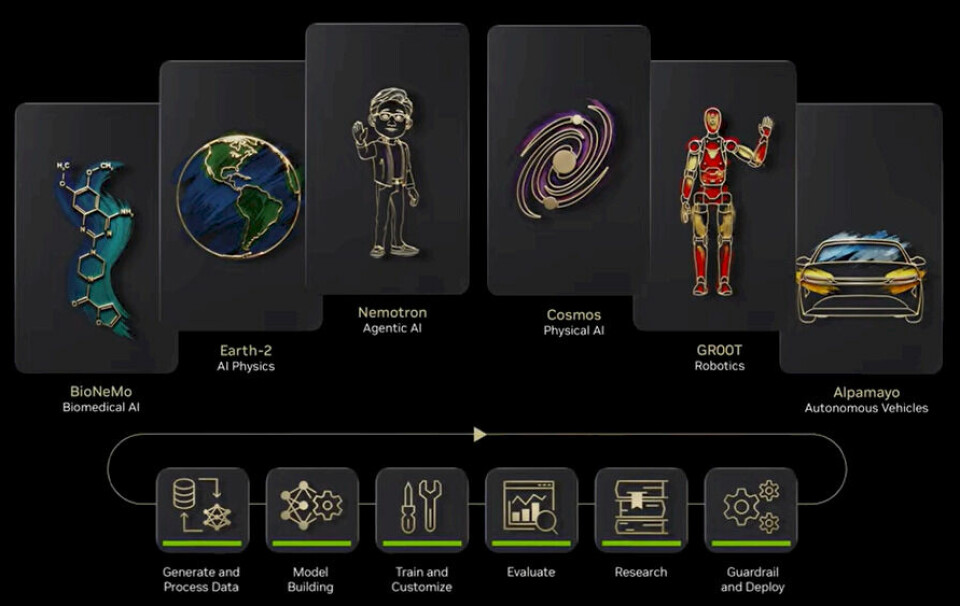
with examples being Cosmos for physical AI, Alpamayo for autonomous
vehicles, BioNeMo for biology, and Nemotron 3, the latest set of
multi-modal models for multi-agent systems.
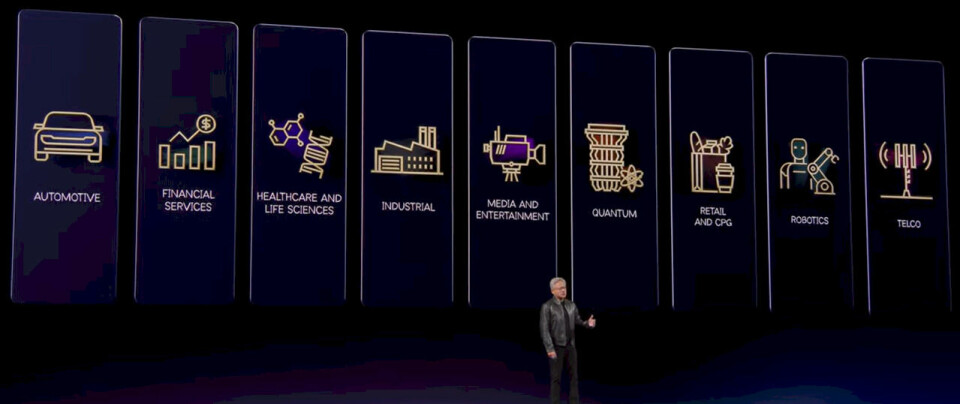
“This is Nvidia’s open model initiative,” he said. “We are
now at the frontier of every single domain of AI models, whether it’s Nemotron,
Cosmos World Foundation Model, Groot, artificial general robotics – humanoid
robotics models – Alpamayo for autonomous vehicle, BioNemo for digital biology,
Earth2 for AI physics. We are at the frontier on every single one.”
The push into open models is important for Nvidia to
establish itself as something more than the hardware provider that unpins AI.
It becomes the model that runs on top of it, and Nvidia is pressing that
advantage with the open models, which cost significantly less than those
developed and owned by others.
It’s an effort that Huang and the rest of Nvidia believes in
so much that they’re investing $26 million into it over the next five years, a
figure reported
by Wired and confirmed by Nvidia.
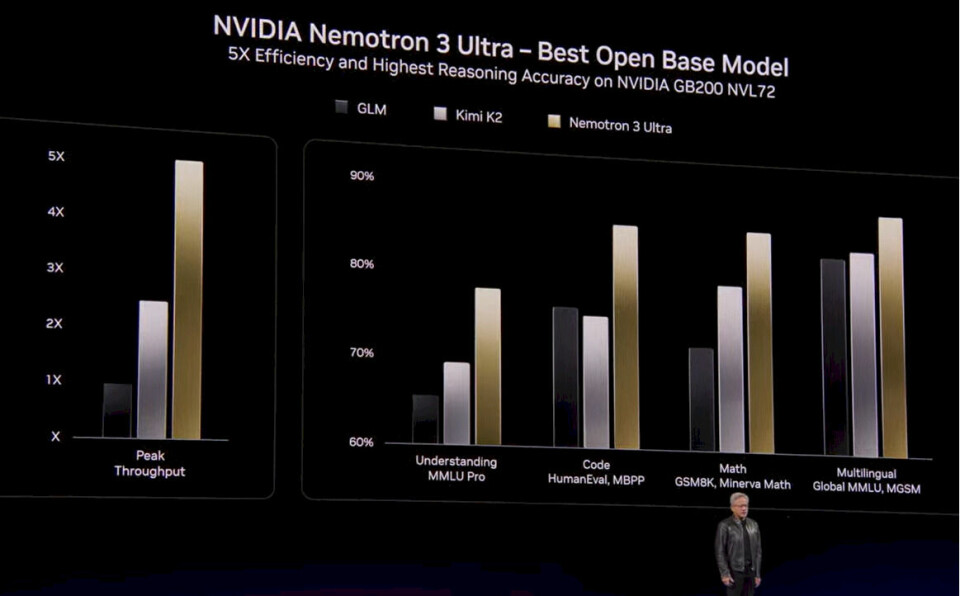
At the show, Nvidia expanded its family of Nemotron 3 open
models that it first introduced last year, including Nemotron 3 Ultra, which
leverages the vendor’s NVFP4 format on the Blackwell GPU platform aimed at
running such applications as coding assistants, search, and workflow
automation.
Other new Nemotron 3 models are Omni, which integrates
audio, vision, and language understanding to draw information from videos and
documents with greater efficiency and accuracy that similar offerings, and VoiceChat
to enable AI to listen and respond at the same time during real-time
conversations through a combination of speech recognition, large language model
(LLM) processing, and text-to-speech. There also are safety models for
detecting unsafe content in text and images and a retrieval pipeline to improve
the relevance and accuracy of the models’ outputs.
Also part
of the model barrage was NemoClaw, a reference model that puts security and
privacy guardrails and governance features into the widely popular OpenClaw
agentic personal assistant that is being rapidly adopted by businesses and
individuals alike but which has been dogged by security concerns. Now when
organizations want to bring OpenClaw into their environments – Huang said it’s
being used throughout Nvidia – they can use the NemoClaw model complete with
security features, the CEO said.
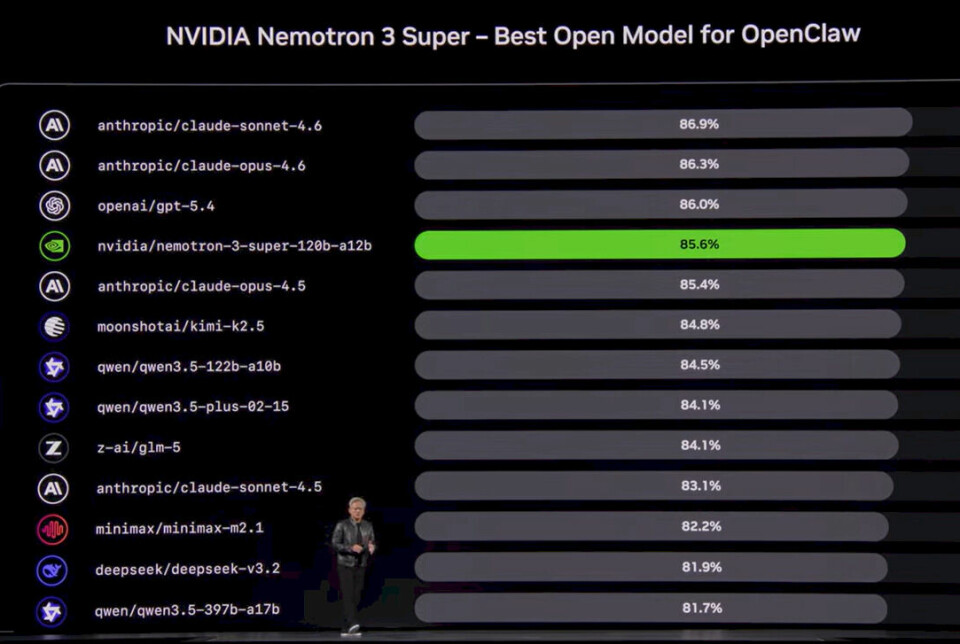
Days before the show opened, Nvidia released
Nemotron 3 Super, a model that has 12 billion active parameters and 120
billion in all that is designed to drive high compute efficiency and accuracy,
which are issues for multi-agent system that can generated up to
15 times the number of tokens of standard chats, creating what Nvidia
developers call a “context explosion” by resending history, tool outputs, and
reason steps that eventually causes the agents to drift from its original goal.
Nvidia developers addressed the typical tradeoffs when
balancing efficiency and accuracy through architectural changes, including
using a latent mixture-of-experts that call four times as many specialists for
the same inference costs by compressing tokens before they reach the experts
and multi-token prediction that forecasts multiple future tokens in one pass to
reduce the generation time for long sequences and allow for built-in
speculative decoding. They also integrated Mamba layers for sequence efficiency
with Transformer layers to precision reasoning to drive higher throughput with
four times the memory and compute efficiency.
The work on Nemotron 3 Super echoes back to Huang’s keynote
statement that Nvidia intends to keep working on the models, assuring
organizations that signing on to them is a good bet.
“Each and one of these, we’re going to continue to advance
these models – vertical integration, horizontal openness – so that we can
enable everybody to join the AI revolution,” he said. “We want to create the
foundation model so that all of you can fine-tune it and post-train it into
exactly the intelligence you need. Nemotron 3 Ultra is going to be the best
base model the world’s ever created. This allows us to help every country build
their sovereign AI, and we’re working with so many different companies out
there.”
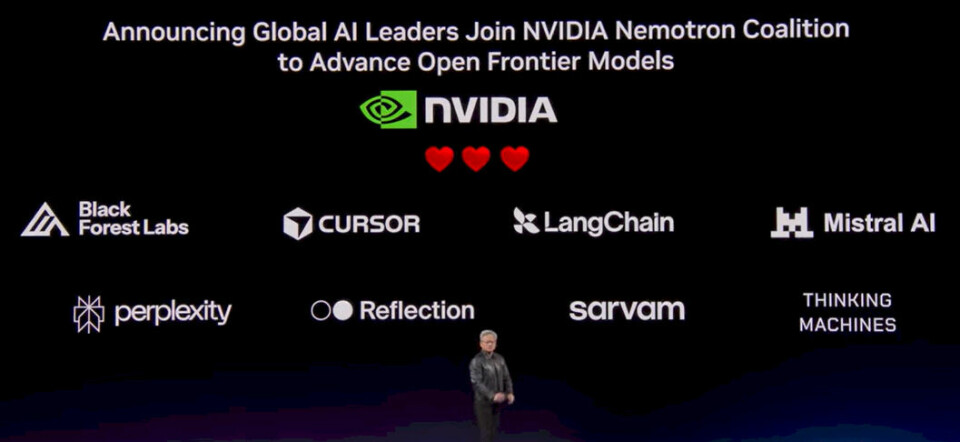
Some of those companies are part of Nvidia’s new Nemotron
Coalition – what Nvidia calls Nemotron 4 – which is bringing together model
builders and AI developers to advance the development of Nvidia frontier open
models through joint research, data, and compute. The first companies in are Black
Forest Labs, Cursor, LangChain, Mistral AI, Perplexity, Reflection AI, Sarvam,
and Thinking Machines Lab.
The coalition’s first project is a base open model that will
be co-developed by Mistral AI and Nvidia, and trained on Nvidia’s DGX Cloud,
with other group members adding data, evaluations, and domain expertise to
support post-training and ongoing development, according to Nvidia. The model
will be foundational to the upcoming Nemotron 4 models.
“We have invested billions of dollars of AI infrastructure
so that we could develop the core engines for AI that’s necessary for all the
libraries of inference and so on, but also to create the AI models to activate
every single industry in the world,” Huang said. “I have said that every single
enterprise company, every single software company in the world needs an agentic
system, needs an agent strategy. You need to have an OpenClaw strategy, and
they all agree and they’re all partnering with us to integrate Nemo, the NemoClaw
reference design, the Nvidia Agentic AI toolkit and, of course, all of our open
models.”
Editor’s Note: It is way uncool to call yourself Thinking
Machines. That company has a special
place in both the history of AI and supercomputing in the 1980s and 1990s,
and the only way this would even be possible is with the blessing of Danny Hillis. Tacking “Labs”
on it doesn’t make it OK.
