

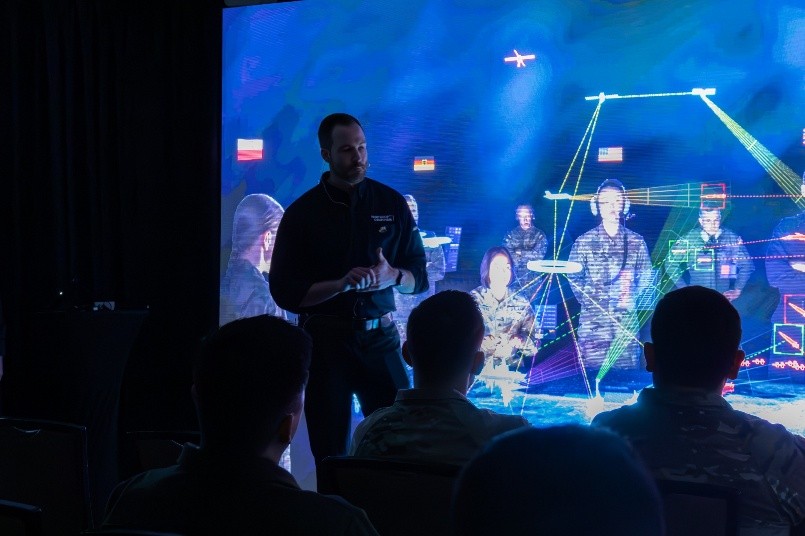
A consortium of nine defense firms building the command and control layer for the Pentagon’s Golden Dome missile defense shield recently conducted a live demonstration, and according to the effort’s czar Gen. Michael Guetlein, proved it’s on target to deliver an operational capability by 2028.
Speaking March 17 at the McAleese Defense Programs Conference, Guetlein did not discuss the details of the demonstration, but said it proved that Golden Dome’s C2 network is, thus far, “comparable” to legacy Missile Defense Agency and Army capabilities.
Defense officials have said command and control is key to Golden Dome’s ability to connect sensors across air, land, and space into a common operating picture. During a March 17 hearing of the House Armed Services Committee’s strategic forces subpanel, U.S. Northern Command boss Gen. Gregory Guillot reiterated the importance of the C2 layer, noting that no single sensor could provide military leaders with the information they need to track and respond to advanced missile threats throughout the pre-launch and terminal phases.
“Perhaps the biggest challenge that Gen. Guetlein and I discuss is, how do we tie all this into a single command-and-control system that takes probably a dozen or more disparate command-and-control systems and ties it into one screen where operators can look from the boost [phase] all the way through the terminal phase and seamlessly inject all of the different sensors and effectors that it would take to defeat that,” Guillot said.
Developing that capability, which Guetlein calls Golden Dome’s “glue layer,” is no small feat, and it’s why the program set out early on to establish a team of contractors to get after the challenge. That industry team started about six months ago with a group of six firms, a “self-formed” consortium, that each have independent contracts with the Pentagon, Guetlein said.
“They operate as a unit,” he said. “They decide what they’re going to build, when they’re going to build it, how they’re going to build it, and and who the best athlete among them is to build it. Then they hold themselves accountable on a weekly, biweekly basis.”
Each week, the team briefs Guetlein on its progress.
“If at any point during that week, one of them did not carry their load, they can vote that individual off the island,” he said, adding that his chief engineer makes the final call, and so far, no consortium members have been removed from the program.
Since that initial group of six companies came on board, the Pentagon has added three prime contractors to help guide the effort: Northrop Grumman, Lockheed Martin, and Raytheon Technologies. Asked whether any one contractor is leading the work, Guetlein said the Defense Department is serving as the lead integrator.
“The government owns the technical baseline, but that group of nine partners are operating independently of each other and holding each other accountable through peer pressure, if you will, to perform,” he said. “So far, it’s working phenomenal.”
President Donald Trump, who announced the ambitious Golden Dome project just days into his second term, has given Guetlein and his team have an aggressive timeline for the effort, directing them to deliver an initial capability by 2028. Before then, Guetlein has set interim targets: to demonstrate some portion of the C2 capability this summer, and to start integrating interceptors—another technical feat—into that architecture by the summer of 2027.
The Pentagon’s cost estimate for Golden Dome has already grown to $185 billion, a $10 billion increase from its initial estimate that Guetlein said was driven by demand to more quickly scale deliveries of key space-based elements of the program. Some analysts expect the project could cost much more. The American Enterprise Institute, for example, has said the total pricetag could fall between $250 billion and $2.4 trillion depending on how the architecture takes shape.
Guetlein said those outside estimates are based on inaccurate assumptions about what the Pentagon is actually building—plans that the department has not revealed publicly. He declined to disclose the cost of the C2 element of Golden Dome and said the Pentagon is unlikely to reveal its funding estimates for individual components of the architecture.
