

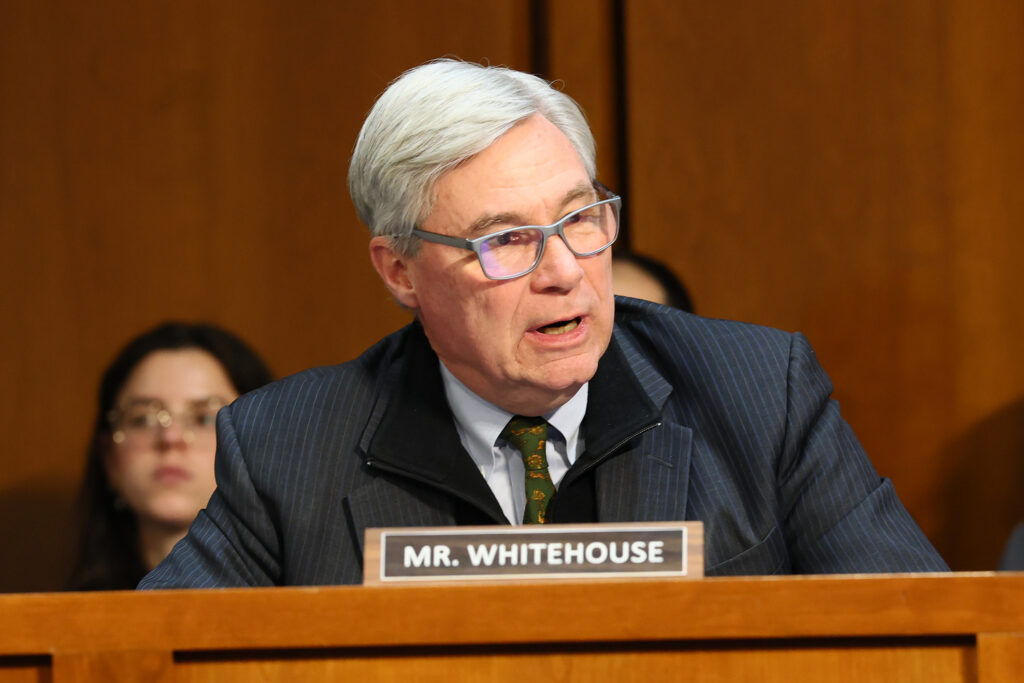
U.S. Sen. Sheldon Whitehouse (D-RI) launched an investigation into the discrepancy between reported and observed methane pollution from the Permian Basin—the largest-producing oil field in the United States and one of the largest in the world.
The investigation, announced Wednesday, follows a recent report by MethaneSAT, a short-lived methane-sensing satellite launched by the Environmental Defense Fund, Harvard University and others in 2024. That report, released in early February, found that methane emissions from oil and gas production facilities in the Permian Basin from May 2024 to June 2025 were four times higher than the U.S. Environmental Protection Agency’s official estimates.
“The inconsistency between emissions reported to EPA’s Greenhouse [Gas] Inventory and satellite data suggest that significant, previously unreported emissions may be occurring,” Whitehouse, the ranking member of the Senate Environment and Public Works Committee, said in a written statement. As a result, “substantial opportunities exist to reduce waste, improve operational efficiency, and mitigate climate change.”
Methane is a climate super-pollutant. Over 80 times more effective at warming the planet than carbon dioxide in the first two decades after its release, it is the second-leading driver of climate change. Its emissions also pose serious public health risks, contribute to smog formation and negatively impact agricultural production.
Whitehouse requested information by April 1 from eight leading oil and gas producers in the Permian Basin of West Texas and southeastern New Mexico—EOG Resources, ConocoPhillips, Occidental Petroleum, ExxonMobil, Diamondback Energy, Devon Energy, Chevron and Mewbourne Oil Company. The senator asked each company about the steps they are taking to address methane pollution in the region, how they monitor and measure their own emissions and their current estimates.
“We appreciate the Senator’s interest in this important topic and look forward to working with him to achieve our shared goal of increasing global supplies of natural gas and reducing cost for consumers and industry,” Allison Cook, a spokesperson for Chevron, said in an email.
A spokesperson for EOG Resources shared the company’s 2024 sustainability report, which noted a low rate of methane emissions, 0.04 percent of total U.S. gas production.
None of the other companies responded to a request for comment from Inside Climate News.
A spokesperson for S&P Global Energy, a research firm that focuses on energy, commodities and financial information, said the discrepancy relates to how the EPA requires emissions data to be reported. An S&P Global report published last year concluded methane emissions from the Permian Basin declined by nearly 20 percent from 2022 to 2024 as oil and gas production grew.
Sharon Wilson, executive director of the nonprofit organization Oilfield Witness, which uses optical gas imaging cameras to reveal emissions of methane and other pollutants in the Permian Basin and elsewhere, cautioned that the S&P Global report had not undergone the peer-review process customary for studies published in academic journals.
MethaneSAT’s findings hadn’t been confirmed through a peer-reviewed study published in an academic journal at the time of their release in February. However, a MethaneSAT study that includes data from the Permian is currently under review by the journal EGUsphere.
Steven Hamburg, chief scientist at the Environmental Defense Fund and MethaneSAT project lead, said emissions from the region are “very large” and the intensity, or rate of emissions, exceeds industry targets for emission reductions.
“Bottom line emissions are far too high, and it is technically and economically feasible to reduce emissions drastically,” Hamburg said in a written statement.
Two of the companies questioned by Whitehouse, ExxonMobil and Occidental Petroleum, have pledged to reduce methane emissions to 0.2 percent of total gas brought to market by 2030 under the Oil and Gas Decarbonization Charter, a voluntary industry group. MethaneSAT reported a significantly higher rate of emissions—2.4 percent of total marketed gas—for the entire Permian Basin.
A spokesperson for the Oil and Gas Decarbonization Charter did not respond to a request for additional information other than providing a link to the group’s 2025 annual report.
All of the companies except Mewbourne Oil are members of the Oil and Gas Methane Partnership 2.0, a global emissions-reduction program for oil and gas companies overseen by the United Nations Environment Programme (UNEP). Member companies commit to an individual methane reduction target, based either on absolute emissions volume or methane intensity.
A UNEP spokesperson said they support measurement data provided by efforts such as MethaneSAT. “The transparency provided by this data is essential for industry to effectively manage emissions and for consumers, investors and others to make informed decisions,” the spokesperson said in an email.
This story is funded by readers like you.
Our nonprofit newsroom provides award-winning climate coverage free of charge and advertising. We rely on donations from readers like you to keep going. Please donate now to support our work.
In a press release announcing the investigation, Whitehouse stated that reducing methane emissions “can largely be done at no net cost.” Methane is the primary component of natural gas, a valuable commodity whose price has spiked due to the ongoing U.S.-Israel war in Iran.
Wilson challenged the notion of reducing emissions at little to no cost, noting that methane is considered a byproduct in the Permian Basin and that a significant buildout of additional infrastructure, along with increased equipment maintenance, would be needed. Oil is the primary commodity in the region. Pipelines needed to bring gas to market are often insufficient, resulting in a large volume of gas being flared rather than sold.
Wilson emphasized that producing oil and gas inevitably releases pollution, and permitting new sites will lead to elevated levels.
Whitehouse said stronger federal oversight is needed.
“Fossil fuel companies can’t be trusted to control their dangerous methane leakage,” he said. “There’s a significant discrepancy between reported and tracked methane emissions in the Permian Basin that demands further investigation.”
About This Story
Perhaps you noticed: This story, like all the news we publish, is free to read. That’s because Inside Climate News is a 501c3 nonprofit organization. We do not charge a subscription fee, lock our news behind a paywall, or clutter our website with ads. We make our news on climate and the environment freely available to you and anyone who wants it.
That’s not all. We also share our news for free with scores of other media organizations around the country. Many of them can’t afford to do environmental journalism of their own. We’ve built bureaus from coast to coast to report local stories, collaborate with local newsrooms and co-publish articles so that this vital work is shared as widely as possible.
Two of us launched ICN in 2007. Six years later we earned a Pulitzer Prize for National Reporting, and now we run the oldest and largest dedicated climate newsroom in the nation. We tell the story in all its complexity. We hold polluters accountable. We expose environmental injustice. We debunk misinformation. We scrutinize solutions and inspire action.
Donations from readers like you fund every aspect of what we do. If you don’t already, will you support our ongoing work, our reporting on the biggest crisis facing our planet, and help us reach even more readers in more places?
Please take a moment to make a tax-deductible donation. Every one of them makes a difference.
Thank you,

Reporter, Boston
Phil McKenna is a Boston-based reporter for Inside Climate News. Before joining ICN in 2016, he was a freelance writer covering energy and the environment for publications including The New York Times, Smithsonian, Audubon and WIRED. Uprising, a story he wrote about gas leaks under U.S. cities, won the AAAS Kavli Science Journalism Award and the 2014 NASW Science in Society Award. Phil has a master’s degree in science writing from the Massachusetts Institute of Technology and was an Environmental Journalism Fellow at Middlebury College.
