

Do you ever worry that your brain’s slowing down and your mind is … what’s the word … fogging? If you do, I have news. A recent study on birdwatching, with the appropriately named lead author Erik Wing, found that learning to become an expert birder causes changes to the brain that may help to protect against age-related cognitive decline. Compared with novice birders, when true bird nerds tease apart difficult species, they show more activity in brain regions linked to visual processing, attention and working memory. These same areas also appear more compact, and age-related changes in them are smaller.
The take-home message is that learning to tell a chiffchaff from a willow warbler could help us to stay mentally sharp as we age. But what about discerning a common quaker from a clouded drab? Or a brown-line bright-eye from a bright-line brown eye? These are the names, not of birds, but of moths. I’ve been hooked on moths ever since I was a kid.
At the risk of alienating an entire community of wildlife enthusiasts, birds are the low-hanging fruit. Moths are orders of magnitude more difficult to distinguish. As part of a citizen science project called the Garden Moth Scheme, I regularly run a moth trap in my leafy back garden. The devices, which can be bought or cobbled together, use light to attract night-flying moths, which then stumble into the body of the trap, where they stay, unharmed, till morning.
Most weekends you’ll find me hunched over my field guide, sifting through the contents of my trap, before I delicately liberate my captives. There may well be 636 species of British birds, but there are four times as many species of British moths. These are divided into two groups: larger “macro” moths (900 species) and smaller “micro” moths (1,600 species). The wingspan of the smallest British bird, the goldcrest, is roughly the distance from forefinger to thumb. The wingspan of the smallest British moth, Enteucha acetosae, is shorter than a grain of rice.
At the height of summer, when moth numbers peak, my trap brims with hundreds of moths of dozens of species. Some species are so similar to others, they are set aside only by the briefest of detail – the curve of a forewing or the architecture of an antenna. Muddying the waters further, members of the same species can sometimes look distinctly different, with varying wing colours, or sometimes no wings at all. Reflecting these difficulties, the Victorian naturalists who named many of them did so with a wink. There is one moth called the confused and another dubbed the uncertain.
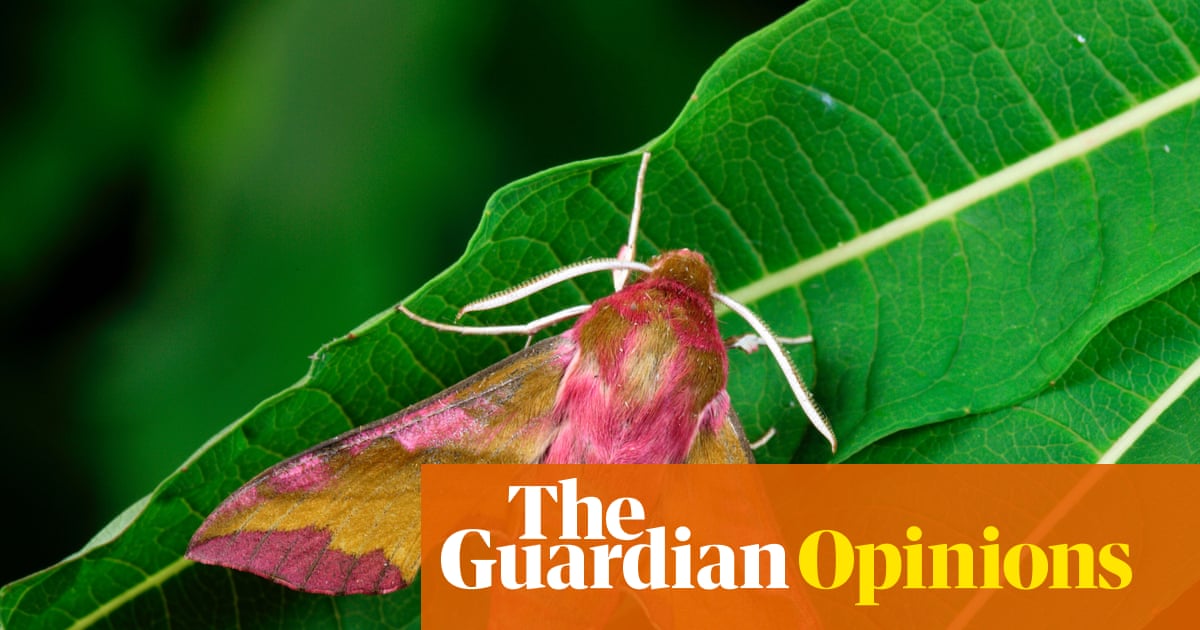
If you listen to the haters, moths are all drab, night-flying, clothes-munching pests. Not true. Some moths, such as the elephant hawk, make Elton John’s stage outfits look tame. In the UK, there are more species of day-flying moth than there are butterflies, and the larvae of just two moth species nibble on natural fibres, such as wool and cashmere – but even they can’t eat a whole sock.
Moths are much maligned and misunderstood, yet they play a vital role in the natural world, where they pollinate plants, provide food for wildlife and contribute to the cycling of nutrients between life and land. They’re also harbingers of environmental change.
The Garden Moth Scheme has been running nationally since 2008. More than 1,000 recorders have contributed their data, revealing a troubling trend. Half of our garden moth species are declining in abundance. This tells us that the balance of the natural world is off kilter.
I love moths for lots of reasons: for their pivotal place in our terrestrial ecosystems, for their oft-understated beauty, for the mindfulness they instil when I focus on their form and for their obstinacy in the face of an easy ID. I love them because they are endlessly surprising. The Chinese character looks like a tiny bird poo, tiger moths emit ultrasonic clicks to jam their bat nemeses’ sonar, and the death’s head hawkmoth mimics the scent of bees so it can raid honey from their hives.
I don’t consider myself to be an “expert moth-er”, but I’m trying. Every year I decipher new species, while re-acquainting myself with the garden’s more frequent visitors. Extrapolating from the bird world, Wing’s research hints that this may be time well spent. So, now I have another reason to appreciate moths. With every footman, rustic and carpet correctly classified, I am supporting the health of my brain.
