

U.S. troops are deploying to the Middle East by the thousands as the Pentagon weighs the possibility of ground operations in Iran. The movement raises a question: What would those missions actually look like on the ground?
Military analysts point to several possibilities, including coastal assaults, nuclear site raids or operations deeper inside the country.
Any one of these missions could unfold alone or evolve into something more broad. But across each scenario, U.S. forces would enter an environment where Iranian missiles, drones and ground units could begin targeting them as soon as they arrive.
A battle for the waterway
One version of the fight would likely unfold along the water.
U.S. forces could be tasked with seizing islands or coastal positions to reopen the Strait of Hormuz, a global shipping route that has been heavily disrupted by the war with Iran.
The mission could be a limited ground incursion, with Marines and airborne units deploying to seize important terrain, said Joe Costa, director of the Forward Defense program at the Atlantic Council’s Scowcroft Center.

President Donald Trump has publicly threatened Kharg Island, Iran’s primary oil export hub, which is located off the country’s coast.
In a Truth Social post on Monday, he said the U.S. would finish its “stay” in Iran, by “completely obliterating” Kharg Island.
Costa, a former senior Pentagon official who worked on U.S. war plans, including Iran, acknowledged speculation about Kharg, but also described a scenario in which U.S. forces would try to secure islands such as Abu Musa, Larak and the Tunbs, off Iran’s southern coast.
“This helps us take out Iranian reconnaissance units as we think of ways to reopen Hormuz. If you have the ability to secure some of the ports along the coast as well, you go a long way to supporting naval assets to start to open up the Strait,” Costa said, adding that the operation could rely on Marine units for the initial assault, with airborne forces supporting limited incursions and air assault operations — all under U.S. air superiority.
The USS Tripoli and embarked 31st Marine Expeditionary Unit arrived in the region’s waters last Friday, and the elements of the 82nd Airborne Division are deploying to the Middle East, the Pentagon confirmed last week.
An opening fight would not be in isolation, Costa said, and though there are mixed reports about Iranian military capacity right now, the country still appears to have functional command and control and is capable of attacks.
The first waves of U.S. ground troops would undoubtedly face Iranian fire, Costa warned.
“We have overwhelming force and would likely be successful in securing territory, but at that point every commander will face the daily decision of assuming risk to troops or risk to mission — force protection becomes paramount, especially if we start to see casualties mount up,” he said, adding, “There’s a high risk of that in this operation.”
Targeting nuclear sites
A different type of operation would focus on Iran’s nuclear program instead of territory.
Instead of seizing ground, U.S. forces could be tasked with entering fortified sites and securing material, likely under fire and deep within Iranian territory.
An operation aimed at seizing enriched uranium would likely involve special forces at a nuclear site in Isfahan, a populous city in the center of the country, said Nicole Grajewski, an expert on Iran’s missiles and the Islamic Revolutionary Guard Corps.
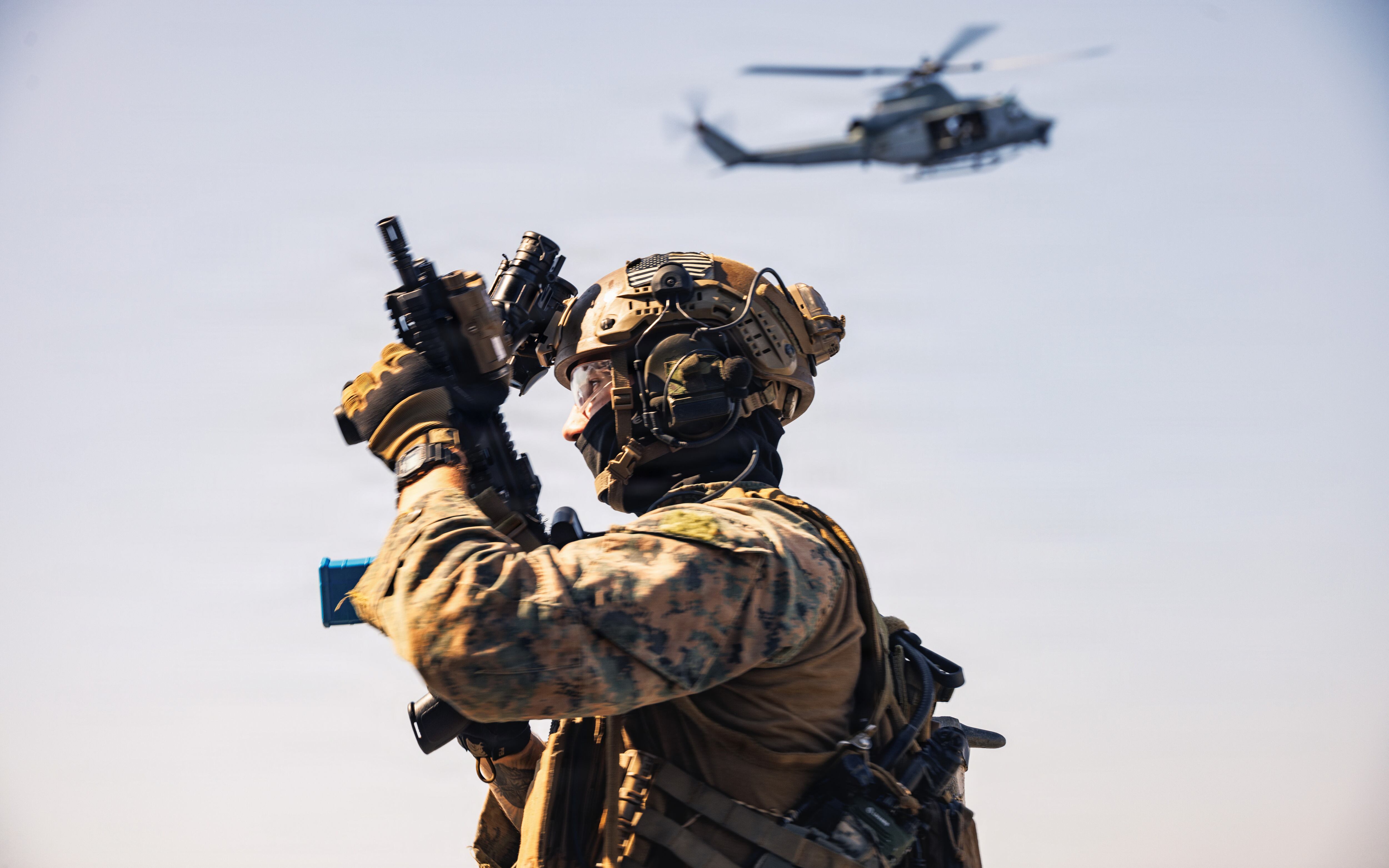
Excavating nuclear material would require a myriad of support, from construction equipment to Chemical, Biological, Radiological and Nuclear assets, Grajewski, a professor at Sciences Po, said.
Ground forces would likely have to dig deep underground to access the highly enriched uranium canisters “and then go in there, excavate it, then get out of the country,” she added.
An extraction team would likely be met with force. The area is heavily trafficked, and the nuclear site in Isfahan is located near numerous military and missile facilities, making it exceedingly risky.
Grajewski described the operation as likely “one that the U.S. military has not really done before,” and said experts could only speculate on how it would be accomplished.
“I’m not sure how they’re thinking about doing it,” she said, pondering if “they’re going to fly in there and do this quick extraction under the guise of night?”
Iran’s response
Even targeted operations like seizing an island or extracting nuclear materials carry the risk of evolving into something larger.
Dan Grazier, the director of the National Security Reform Program at the Stimson Center, said the challenges U.S. forces may face goes beyond securing land or items. It centers on how Iran chooses to fight once American soldiers are on its ground.
“The Iranians are going to do whatever they can to kill and capture as many Americans as they can,” said Grazier, who is also a Marine Corps veteran, “for the propaganda victory alone.”
Rather than seeking decisive engagement, Iranian forces would likely avoid conventional confrontation and stretch the conflict over time, he said. Instead of defeating U.S. forces, he added, Iran’s objective becomes making the conflict costly and prolonged, forcing leaders in Washington to decide whether the fight is worth continuing.
Any sustained ground operation would also risk widening the battlefield, as Iran could activate proxy groups across the region to further target U.S. forces and partners.
The Center for Strategic and International Studies in early March estimated that the first 100 hours of the war cost billions of dollars, and experts warn that critical air defense interceptors could be depleted faster than the rate of replacement.
The human cost has also risen as the war enters its second month. Thirteen American service members had been killed and over 300 injured as of late March. A survey earlier in March found that a majority of Americans thought the war had gone too far, and a separate poll showed diminished confidence in the president’s handling of it.
“The Iranians don’t stand any chance of defeating the United States on the ground, I don’t think,” Grazier said. “They do stand a chance of defeating the United States politically back home.”
Eve Sampson is a reporter and former Army officer. She has covered conflict across the world, writing for The New York Times, The Washington Post and The Associated Press.
