

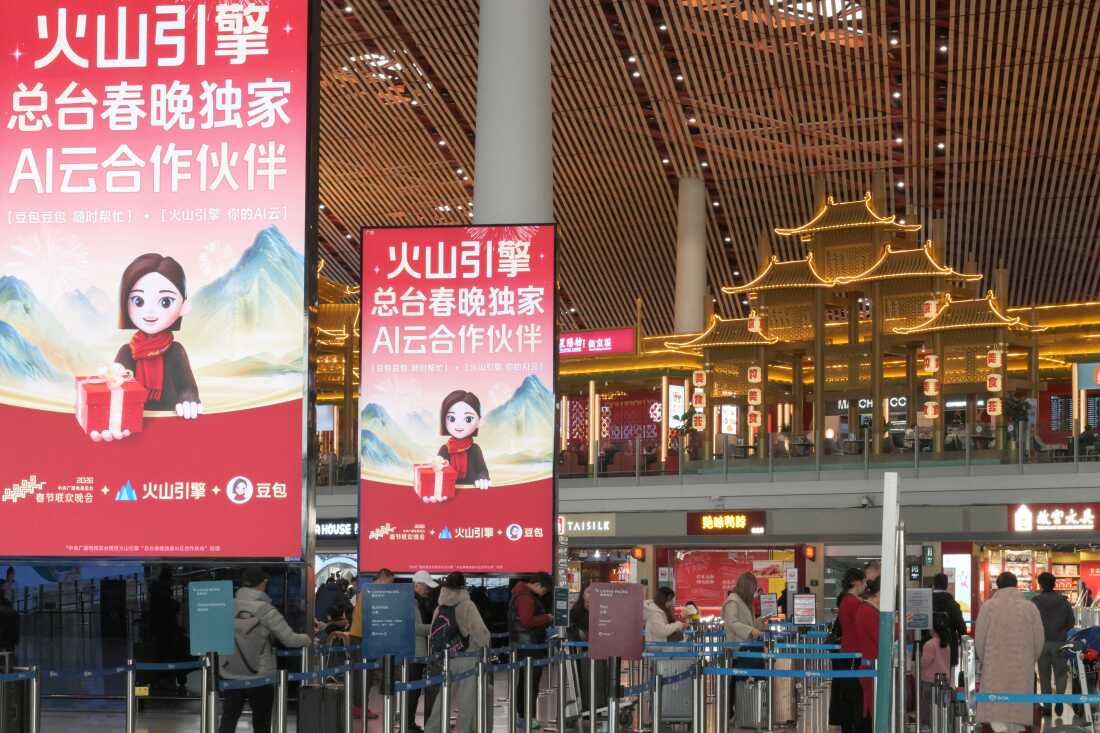

Advertising promoting ByteDance’s cloud and AI service platform ‘Volcano Engine’ and chatbot ‘Doubao’ at the Beijing Capital International airport in Beijing.
ADEK BERRY/AFP via Getty Images
hide caption
toggle caption
ADEK BERRY/AFP via Getty Images
BEIJING — When it comes to AI chatbots, U.S. companies tout that they are investing to build the best technology. For Chinese companies, it’s less about being on the cutting edge and more about getting people to use their apps all the time. People like 19-year-old delivery driver Li Hao.
Li says he’s a loyal user of ByteDance’s AI chatbot Doubao, China’s most popular. But over the Lunar New Year holiday in February he tried another one — Alibaba’s Qwen — because the company was giving away milk tea if it was ordered through the chatbot.
“I tried it and got a milk tea,” he said. “After that, I didn’t use it again.”
Welcome to the front lines of China’s chatbot wars.
The competitive landscape among AI apps in China is fierce. And companies have been dumping money into the market to try to win customers and show them how AI is useful in everyday life — in particular, for buying stuff. The free tea wasn’t just to entice new users; it was to get them used to the idea of tasking chatbots with a purchase.


The AI landscape is dominated by some of China’s top tech companies, including Alibaba, Tencent and ByteDance. There are also prominent startups, including Moonshot AI and DeepSeek, which made a splash last year with an AI model that outperformed expectations.
Alibaba alone says it allotted more than $430 million for holiday promotions. Tencent and Baidu gave away millions in coupons and prizes. The investment bank Morgan Stanley estimates that the top apps spent over $1.1 billion combined on promotions during the Lunar New Year holiday, when people traditionally give red envelopes of cash as gifts for good luck.
“The competition between domestic Chinese tech players [is] heating up again, which I believe is a good thing, you know, from the perspective of innovation,” said George Chen, a tech analyst with the Asia Group in Hong Kong.
Chen says the spending on holiday promotions gave him a sense of deja vu. A decade ago, Alibaba and Tencent engaged in a similar promo slug-fest over their online payment apps. And he says that gave the e-commerce industry a big boost.
“I would argue, because of the competition, that really pushes China’s e-commerce to grow this rapid[ly],” he said.
China’s e-commerce ecosystem is now one of the most developed in the world, with ubiquitous “super apps,” where you can do everything from paying a utility bill to booking a cruise, and get speedy delivery across most of the country.
“History is repeating,” Chen said.

The new battleground is AI. And Chinese companies want consumers to use their apps to actually do stuff — not just look things up.
With Qwen, for instance, ordering a milk tea is almost as simple as telling the chatbot: “I want to order a milk tea.” The prompt produces instant beverage suggestions available at shops nearby. You just need to pick one, and tell it how you like it — all within the AI app, rather than being sent to another app or website.
If you are a user of Alibaba’s payment app Alipay, Qwen already knows where you are and can do one-tap payment as well as figure out where to send the delivery.
Doubao, on the other hand, is incorporated into Douyin, the Chinese version of TikTok, like a person you can talk with via DM. Tencent’s Yuanbao chatbot is folded into Wechat, China’s most popular messaging platform, and connected to WeChat pay.
And unlike apps like Doordash or UberEats, chatbots can do more than order food. You could use the same chatbot conversation to do all kinds of transactions, from buying a plane ticket to hailing a ride or booking a doctor’s appointment.
Kyle Chan follows Chinese tech at the Brookings Institution think tank and says Alibaba wants Qwen to be the new everything app. “They kind of see the AI model as being the starting point for interfacing with sort of everything else you do in the online world, and maybe even, to a certain extent, in the offline way in the real world,” he said.
The Lunar New Year giveaways were so huge that they sparked chaos in some takeout shops when orders went through the roof, according to videos and reports online.
But they also drove the number of daily active users on AI platforms to records. The Chinese research firm QuestMobile reported that more than 73.5 million people used Qwen on Feb. 7 as the promotion was taking off. Alibaba has not disclosed official numbers.
ByteDance’s Doubao also saw its number of daily users pop, exceeding 144 million after partnering with state TV to run promotions during the widely-watched annual Lunar New Year TV gala.
Keeping those customers, though, could be a challenge. Daily use has dropped back down since the holiday frenzy, according to online news reports.
After availing himself of a free milk tea from Qwen, delivery driver Li Hao went back to his preferred AI.
“I still prefer using Doubao,” he said.
