

$2
billion here, $2 billion there, $2 billion everywhere and pretty soon it starts
adding up to real money. But with the current costs of a rack of
Grace-Blackwell compute and the expected – and much higher – cost of a rack of
future Vera-Rubin compute, the cash coming in is adding up to the cash being
invested in the chippery ecosystem by AI industry juggernaut Nvidia.
Our
best guess is that Nvidia will bring somewhere between $150 billion and $160
billion to the bottom line in its fiscal 2027 year that ends next January, and Big
Green can do a lot of $2 billion investments to help seed the kinds of chips it
wants the market to make in volume and at the same time secure alliances – sometimes
with competitors – that will help its own platform proliferate in what could very
well be a less homogeneous GenAI future.
Chip
maker Marvell, which like Nvidia has essentially become an AI datacenter company,
is the latest to get a $2 billion investment from Big Green. The investment is
being made to help Marvell ramp up various technologies into volume production,
and is being made concurrent with (but is apparently not dependent on) a
strategic partnership to allow some mixing and matching of various technologies
from both companies for customers to use to build their AI systems.
The
$2 billion investment in Marvell mirrors the
pair of $2 billion investments that Nvidia made in Lumentum and Coherent as
March was getting started. In the case of those two deals, Nvidia is making
sure Lumentum and Coherent can ramp up production of lasers used in co-packaged
optics (CPO) components as Nvidia is adding this technology to its Quantum-X
InfiniBand and Spectrum-X Ethernet scale out switches, which are used to lash
GPU-accelerated systems together into supercomputing clusters. (This is in
contrast to scale up networks, which are used to provide coherent memory across
CPUs, GPUs, and XPUs in a server node or a rackscale system using lower latency
and higher bandwidth switches and ports.) We think that both Lumentum and Coherent
are interesting to Nvidia’s potential future in that both have created optical
circuit switches akin to the ones that Google has used for more than a decade
as the backbone of its network and, more recently, as the spine in the coherent
memory networks for its TPU clusters.
Marvell
is interesting for other reasons, and ones beyond the obvious ones stated in
the announcement by the two companies.
The
deal explicitly calls for Marvell to support Nvidia’s licensable NVLink Fusion
ports, and to be super precise, says Marvell “will provide custom XPUs and
NVLink Fusion-compatible scale-up networking.” That does not necessarily mean
that Marvell will support Nvidia’s NVSwitch switches, and the wording sure does
sound like Marvell will be able to support the NVLink protocol on the UALink and/or
PCI-Express 6.0 switches; the company has just revealed the Structera S 60260, which
supports 260 lanes of PCI-Express and probably around 2.1 TB/sec of aggregate
bandwidth. This looks like an upgrade of an existing PCI-Express 5.0 product
that was created by XConn, which
Marvell acquired in January for $540 million. The current NVSwitch 4 and 5
ASICs from Nvidia deliver 1.8 TB/sec of bandwidth per port and have 7.2 TB/sec
of aggregate bandwidth. So maybe Marvell is also getting access to NVSwitch chippery
to hook into the AI systems that it is helping build.
Considering
that Amazon Web Services is the biggest custom AI chip customer that Marvell
has, and that AWS already has an NVLink Fusion partnership with Nvidia, and that
AWS has said that the future Trainium 4 XPU will support both UALink and NVLink
protocols, it stands to reason that the main partner that AWS has for
shepherding its Trainium chips from design to packaging – that would be Marvell
– would also need access to Nvidia’s technology.
The
question that we have is who is licensing the NVLink protocol, and under what
conditions are customers allowed to use the protocol in custom AI clusters that
might have homegrown CPUs and XPUs? No one has really talked about this in the
deals we have seen, but clearly if you are buying NVLink hardware, you probably
want rights to NVLink software, too. But, maybe these companies just want fat
and fast pipes and they plant to figure out the protocols for themselves. It
could be both. The hyperscalers and cloud builders are like that. Especially
the clouds, which need to have Nvidia and AMD systems to sell capacity on their
clouds because this is what most customers expect to use but who also want to
create their own compute engines (and soon interconnects) to allow them to
drive down costs for internal facing applications or those they provide as a
service.
Under
the partnership, Nvidia says that it will be supplying supporting technologies
for custom XPUs with NVLink Fusion ports, including Vera CPUs, Groq LPUs, ConnectX
NICs, Bluefield DPUs, NVLink interconnects, and Spectrum-X switches.
We
wonder if the Nvidia deal will see Big Green take a look at the
photonic fabric created by Celestial AI, which Marvell acquired in December
2025 for $3.25 billion. This photonic fabric allows for row-scale coherent
memory and has in-network collectives processing just like Nvidia has offered
in its past several generations of NVSwitch chips, compliments of the InfiniBand
technology that Nvidia got with its
$6.9 billion acquisition of Mellanox Technologies way back in April 2020.
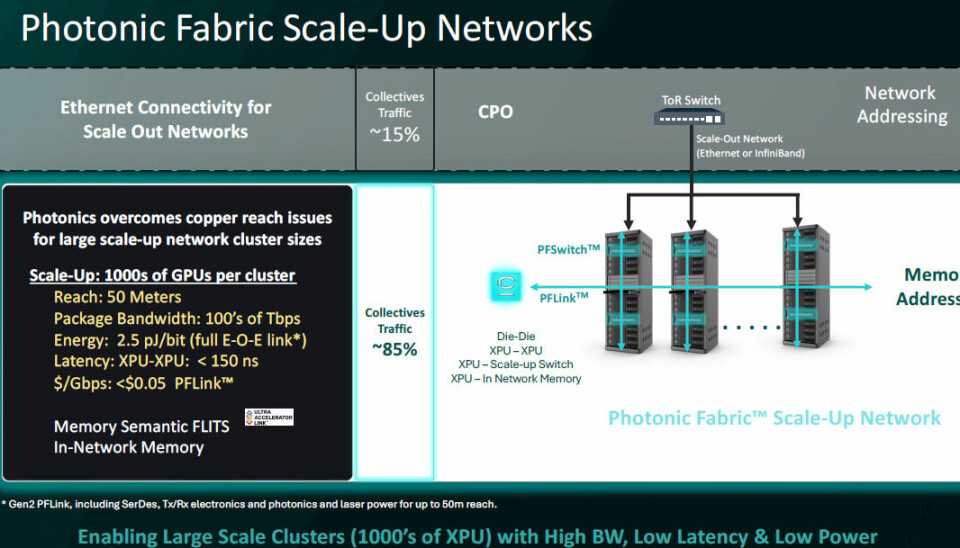
It
could turn out, as we have said, that under the strategic partnership that Marvell
(and therefore AWS and any future other XPU or CPU customers) are getting the
right to run NVLink protocols atop the Photonic Fabric (which is the technical and
trademarked name of the Celestial product) that Marvell has.
We
also wonder how long before there will be a partnership between Nvidia and
Broadcom, which is a rival with Nvidia in scale out networks but a supplier of
all kinds of things, including the VMware ESX Server hypervisor. Earlier this
month, I
mused about how Broadcom might be the only sizable counterbalance to the
hegemony of Nvidia right now, considering its dominant position in Ethernet
switch ASICs and its fast-growing custom XPU business.
Broadcom
makes Google’s TPUs and now also TPU racks for Anthropic, and is the
manufacturer of the MTIA XPUs from Meta Platforms as well. The rumor is that
ByteDance and Apple are two other big XPU customers, and there is now a sixth,
with OpenAI using Broadcom to shepherd its “Titan” XPU to market.
It is unclear if any of these companies want NVLink
Fusion ports on their devices. But if they do, Nvidia and Broadcom will bury
the hatchet and cut a deal. That deal will no doubt include cross-coupling of
technologies, much as we think is happening in the Marvell deal.
