

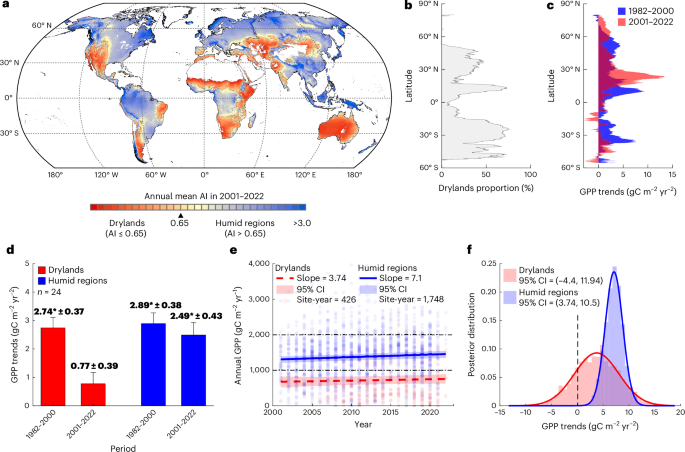
Huang, J. et al. Dryland climate change: recent progress and challenges. Rev. Geophys. 55, 719–778 (2017).
Koppa, A. et al. Dryland self-expansion enabled by land–atmosphere feedbacks. Science 385, 967–972 (2024).
Walker, A. P. et al. Integrating the evidence for a terrestrial carbon sink caused by increasing atmospheric CO2. New Phytol. 229, 2413–2445 (2021).
Ruehr, S. et al. Evidence and attribution of the enhanced land carbon sink. Nat. Rev. Earth Environ. 4, 518–534 (2023).
Yuan, W. et al. Increased atmospheric vapor pressure deficit reduces global vegetation growth. Sci. Adv. 5, eaax1396 (2019).
Friedlingstein, P. et al. Global carbon budget 2021. Earth Syst. Sci. Data 14, 1917–2005 (2022).
Peñuelas, J. et al. Shifting from a fertilization-dominated to a warming-dominated period. Nat. Ecol. Evol. 1, 1438–1445 (2017).
Knauer, J. et al. Higher global gross primary productivity under future climate with more advanced representations of photosynthesis. Sci. Adv. 9, eadh9444 (2023).
Green, J. K., Berry, J., Ciais, P., Zhang, Y. & Gentine, P. Amazon rainforest photosynthesis increases in response to atmospheric dryness. Sci. Adv. 6, eabb7232 (2020).
Nemani, R. R. et al. Climate-driven increases in global terrestrial net primary production from 1982 to 1999. Science 300, 1560–1563 (2003).
Wang, S. et al. Recent global decline of CO2 fertilization effects on vegetation photosynthesis. Science 370, 1295–1300 (2020).
Huang, M. et al. Air temperature optima of vegetation productivity across global biomes. Nat. Ecol. Evol. 3, 772–779 (2019).
Brienen, R. J. W. et al. Long-term decline of the Amazon carbon sink. Nature 519, 344–348 (2015).
Zhou, L. et al. Widespread decline of Congo rainforest greenness in the past decade. Nature 509, 86–90 (2014).
Poulter, B. et al. Contribution of semi-arid ecosystems to interannual variability of the global carbon cycle. Nature 509, 600–603 (2014).
Ahlström, A. et al. The dominant role of semi-arid ecosystems in the trend and variability of the land CO2 sink. Science 348, 895–899 (2015).
Wang, L. et al. Dryland productivity under a changing climate. Nat. Clim. Change 12, 981–994 (2022).
Sitch, S. et al. Trends and drivers of terrestrial sources and sinks of carbon dioxide: an overview of the TRENDY project. Global Biogeochem. Cycles 38, e2024GB008102 (2024).
Eyring, V. et al. Overview of the Coupled Model Intercomparison Project Phase 6 (CMIP6) experimental design and organization. Geosci. Model Dev. 9, 1937–1958 (2016).
Middleton, N. & Thomas, D. World Atlas of Desertification (Oxford Univ. Press, 1997).
Grossiord, C. et al. Plant responses to rising vapor pressure deficit. New Phytol. 226, 1550–1566 (2020).
Li, F. et al. Global water use efficiency saturation due to increased vapor pressure deficit. Science 381, 672–677 (2023).
Jung, M. et al. Recent decline in the global land evapotranspiration trend due to limited moisture supply. Nature 467, 951–954 (2010).
Sperry, J. S. & Love, D. M. What plant hydraulics can tell us about responses to climate-change droughts. New Phytol. 207, 14–27 (2015).
Denissen, J. M. C. et al. Widespread shift from ecosystem energy to water limitation with climate change. Nat. Clim. Change 12, 677–684 (2022).
Keeling, R. F. et al. Atmospheric evidence for a global secular increase in carbon isotopic discrimination of land photosynthesis. Proc. Natl Acad. Sci. USA 114, 10361–10366 (2017).
Xie, H. et al. Contrasting diurnal impacts of vapor pressure deficit on water use efficiency in two semiarid steppe ecosystems. Ecol. Process. 14, 68 (2025).
Chen, C. et al. China and India lead in greening of the world through land-use management. Nat. Sustain. 2, 122–129 (2019).
Miller, D. L. et al. Increased photosynthesis during spring drought in energy-limited ecosystems. Nat. Commun. 14, 7828 (2023).
Anderegg, W. R. L., Kane, J. M. & Anderegg, L. D. L. Consequences of widespread tree mortality triggered by drought and temperature stress. Nat. Clim. Change 3, 30–36 (2013).
Li, C. et al. Drivers and impacts of changes in China’s drylands. Nat. Rev. Earth Environ. 2, 858–873 (2021).
Ukkola, A. M. et al. Reduced streamflow in water-stressed climates consistent with CO2 effects on vegetation. Nat. Clim. Change 6, 75–78 (2016).
Crawford, A. J., McLachlan, D. H., Hetherington, A. M. & Franklin, K. A. High temperature exposure increases plant cooling capacity. Curr. Biol. 22, R396–R397 (2012).
Winkler, A. J. et al. Slowdown of the greening trend in natural vegetation with further rise in atmospheric CO2. Biogeosciences 18, 4985–5010 (2021).
Allen, C. D., Breshears, D. D. & McDowell, N. G. On underestimation of global vulnerability to tree mortality and forest die-off from hotter drought in the Anthropocene. Ecosphere 6, 129 (2015).
Pinzon, J. E. & Tucker, C. J. A non-stationary 1981–2012 AVHRR NDVI3g time series. Remote Sens. 6, 6929–6960 (2014).
Muñoz-Sabater, J. & Tucker, C. J. ERA5-Land Monthly Averaged Data from 1950 to Present (Copernicus Climate Change Service Climate Data Store, accessed 19 November 2025); https://doi.org/10.24381/cds.68d2bb30.
Schneider, U., Becker, A., Finger, P., Rustemeier E. & Ziese, M. GPCC Monitoring Product: Near Real-Time Monthly Land-Surface Precipitation from Rain-Gauges based on SYNOP and CLIMAT Data (Global Precipitation Climatology Centre, 2022); https://doi.org/10.5676/DWD_GPCC/MP_M_V2022_100.
Harris, I., Osborn, T. J., Jones, P. & Lister, D. Version 4 of the CRU TS monthly high-resolution gridded multivariate climate dataset. Sci. Data 7, 109 (2020).
Chen, M., Xie, P., Janowiak, J. E. & Arkin, P. A. Global land precipitation: a 50-yr monthly analysis based on gauge observations. J. Hydrometeorol. 3, 249–266 (2002).
Xie, P. & Arkin, P. A. Global precipitation: a 17-year monthly analysis based on gauge observations, satellite estimates, and numerical model outputs. Bull. Am. Meteorol. Soc. 78, 2539–2558 (1997).
Beck, H. E. et al. MSWEP: 3-hourly 0.25° global gridded precipitation (1979–2015) by merging gauge, satellite, and reanalysis data. Hydrol. Earth Syst. Sci. 21, 589–615 (2017).
Xie, P. et al. A gauge-based analysis of daily precipitation over East Asia. J. Hydrometeorol. 8, 607–626 (2007).
Gelaro, R. et al. The Modern-Era Retrospective Analysis for Research and Applications, version 2 (MERRA-2). J. Clim. 30, 5419–5454 (2017).
Abatzoglou, J. T., Dobrowski, S. Z., Parks, S. A. & Hegewisch, K. C. TerraClimate, a high-resolution global dataset of monthly climate and climatic water balance from 1958–2015. Sci. Data 5, 170191 (2018).
Pastorello, G. et al. The FLUXNET2015 dataset and the ONEFlux processing pipeline for eddy covariance data. Sci. Data 7, 225 (2020).
Haverd, V. et al. A new version of the CABLE land surface model (Subversion revision r4601) incorporating land use and land cover change, woody vegetation demography, and a novel optimisation-based approach to plant coordination of photosynthesis. Geosci. Model Dev. 11, 2995–3026 (2018).
Melton, J. R. et al. CLASSIC v1.0: the open-source community successor to the Canadian Land Surface Scheme (CLASS) and the Canadian Terrestrial Ecosystem Model (CTEM) – part 1: model framework and site-level performance. Geosci. Model Dev. 13, 2825–2850 (2020).
Lawrence, D. M. et al. The Community Land Model version 5: description of new features, benchmarking, and impact of forcing uncertainty. J. Adv. Model. Earth Syst. 11, 4245–4287 (2019).
Tian, H. et al. Anthropogenic and climatic influences on carbon fluxes from eastern North America to the Atlantic Ocean: a process-based modeling study. J. Geophys. Res. Biogeosci. 120, 757–772 (2015).
Ma, L. et al. Global evaluation of the Ecosystem Demography model (ED v3.0). Geosci. Model Dev. 15, 1971–1994 (2022).
Yang, X., Thornton, P., Ricciuto, D., Wang, Y. & Hoffman, F. Global evaluation of terrestrial biogeochemistry in the Energy Exascale Earth System Model (E3SM) and the role of the phosphorus cycle in the historical terrestrial carbon balance. Biogeosciences 20, 2813–2836 (2023).
Yuan, W. et al. Multiyear precipitation reduction strongly decreases carbon uptake over northern China. J. Geophys. Res. Biogeosci. 119, 881–896 (2014).
Meiyappan, P., Jain, A. K. & House, J. I. Increased influence of nitrogen limitation on CO2 emissions from future land use and land use change. Global Biogeochem. Cycles 29, 1524–1548 (2015).
Delire, C. et al. The global land carbon cycle simulated with ISBA-CTRIP: improvements over the last decade. J. Adv. Model. Earth Syst. 12, e2019MS001886 (2020).
Reick, C. H. et al. JSBACH 3 – the land component of the MPI Earth System Model: documentation of version 3.2. Ber. Erdsystemforsch. https://doi.org/10.17617/2.3279802 (2021).
Clark, D. B. et al. The Joint UK Land Environment Simulator (JULES), model description – part 2: carbon fluxes and vegetation dynamics. Geosci. Model Dev. 4, 701–722 (2011).
Smith, B. et al. Implications of incorporating N cycling and N limitations on primary production in an individual-based dynamic vegetation model. Biogeosciences 11, 2027–2054 (2014).
von Bloh, W. et al. Implementing the nitrogen cycle into the dynamic global vegetation, hydrology, and crop growth model LPJmL (version 5.0). Geosci. Model Dev. 11, 2789–2812 (2018).
Calle, L. & Poulter, B. Ecosystem age-class dynamics and distribution in the LPJ-wsl v2.0 global ecosystem model. Geosci. Model Dev. 14, 2575–2601 (2021).
Lienert, S. & Joos, F. A Bayesian ensemble data assimilation to constrain model parameters and land-use carbon emissions. Biogeosciences 15, 2909–2930 (2018).
Zaehle, S. et al. Carbon and nitrogen cycle dynamics in the O-CN land surface model: 2. role of the nitrogen cycle in the historical terrestrial carbon balance. Global Biogeochem. Cycles https://doi.org/10.1029/2009GB003522 (2010).
Vuichard, N. et al. Accounting for carbon and nitrogen interactions in the global terrestrial ecosystem model ORCHIDEE (trunk version, rev 4999): multi-scale evaluation of gross primary production. Geosci. Model Dev. 12, 4751–4779 (2019).
Walker, A. P. et al. The impact of alternative trait-scaling hypotheses for the maximum photosynthetic carboxylation rate (Vcmax) on global gross primary production. New Phytol. 215, 1370–1386 (2017).
Yue, X. & Unger, N. The Yale Interactive terrestrial Biosphere model version 1.0: description, evaluation and implementation into NASA GISS ModelE2. Geosci. Model Dev. 8, 2399–2417 (2015).
Kato, E., Kinoshita, T., Ito, A., Kawamiya, M. & Yamagata, Y. Evaluation of spatially explicit emission scenario of land-use change and biomass burning using a process-based biogeochemical model. J. Land Use Sci. 8, 104–122 (2013).
Sitch, S. et al. Recent trends and drivers of regional sources and sinks of carbon dioxide. Biogeosciences 12, 653–679 (2015).
Le Quéré, C. et al. Global carbon budget 2017. Earth Syst. Sci. Data 10, 405–448 (2018).
Ziehn, T. et al. The Australian Earth System Model: ACCESS-ESM1.5. J. South. Hemisphere Earth Syst. Sci. 70, 193–214 (2020).
Danabasoglu, G. et al. The Community Earth System Model version 2 (CESM2). J. Adv. Model. Earth Syst. 12, e2019MS001916 (2020).
Swart, N. C. et al. The Canadian Earth System Model version 5 (CanESM5.0.3). Geosci. Model Dev. 12, 4823–4873 (2019).
Döscher, R. et al. The EC-Earth3 earth system model for the Coupled Model Intercomparison Project 6. Geosci. Model Dev. 15, 2973–3020 (2022).
Tatebe, H. et al. Description and basic evaluation of simulated mean state, internal variability, and climate sensitivity in MIROC6. Geosci. Model Dev. 12, 2727–2765 (2019).
Mauritsen, T. et al. Developments in the MPI-M Earth System Model version 1.2 (MPI-ESM1.2) and its response to increasing CO2. J. Adv. Model. Earth Syst. 11, 998–1038 (2019).
Running, S. W. & Zhao, M. User’s Guide: Daily GPP and Annual NPP (MOD17A2/A3) Products NASA Earth Observing System MODIS Land Algorithm Version 3.0 (NASA, Univ. Montana, 2015).
Xiao, J. et al. Estimation of net ecosystem carbon exchange for the conterminous United States by combining MODIS and AmeriFlux data. Agric. For. Meteorol. 148, 1827–1847 (2008).
Xiao, J., Baldocchi, D., Ichii, K., Li, F. & Papale, D. Insights into terrestrial carbon and water cycling from the global eddy covariance network. Nat. Rev. Earth Environ. 7, 60–79 (2026).
Rouse, J. W. Jr, Haas, R. H., Schell, J. A. & Deering, D. W. Monitoring vegetation systems in the Great Plains with ERTS. In Proc. Third Earth Resources Technology Satellite-1 Symposium – Volume I: Technical Presentations, Section A (eds Freden, S. C. et al.) NASA Secial Publication 351; 309–317 (NASA, 1974).
Huete, A. R., Liu, H. Q., Batchily, K. & van Leeuwen, W. A comparison of vegetation indices over a global set of TM images for EOS-MODIS. Remote Sens. Environ. 59, 440–451 (1997).
Badgley, G., Field, C. B. & Berry, J. A. Canopy near-infrared reflectance and terrestrial photosynthesis. Sci. Adv. 3, e1602244 (2017).
Running, S. W., Thornton, P. E., Nemani, R. & Glassy, J. M. in Methods in Ecosystem Science (eds Sala, O. E. et al.) 44–57 (Springer, 2000).
Madani, N., Kimball, J. S. & Running, S. W. Improving global gross primary productivity estimates by computing optimum light use efficiencies using flux tower data. J. Geophys. Res. Biogeosci. 122, 2939–2951 (2017).
Leuning, R., Zhang, Y. Q., Rajaud, A., Cleugh, H. & Tu, K. A simple surface conductance model to estimate regional evaporation using MODIS leaf area index and the Penman–Monteith equation. Water Resour. Res. https://doi.org/10.1029/2007WR006562 (2008).
Sun, Y. et al. OCO-2 advances photosynthesis observation from space via solar-induced chlorophyll fluorescence. Science 358, eaam5747 (2017).
Li, X. et al. Solar-induced chlorophyll fluorescence is strongly correlated with terrestrial photosynthesis for a wide variety of biomes: first global analysis based on OCO-2 and flux tower observations. Global Change Biol. 24, 3990–4008 (2018).
Li, X. & Xiao, J. A global, 0.05-degree product of solar-induced chlorophyll fluorescence derived from OCO-2, MODIS, and reanalysis data. Remote Sens. 11, 517 (2019).
Lambers, H. & Oliveira, R. S. Plant Physiological Ecology 3rd edn (Springer, 2019).
Beer, C. et al. Temporal and among-site variability of inherent water use efficiency at the ecosystem level. Global Biogeochem. Cycles https://doi.org/10.1029/2008GB003233 (2009).
Farquhar, G. D., von Caemmerer, S. & Berry, J. A. A biochemical model of photosynthetic CO2 assimilation in leaves of C3 species. Planta 149, 78–90 (1980).
Cressie, N., Calder, C. A., Clark, J. S., Ver Hoef, J. M. & Wikle, C. K. Accounting for uncertainty in ecological analysis: the strengths and limitations of hierarchical statistical modeling. Ecol. Appl. 19, 553–570 (2009).
Fan, Y. et al. Applications of structural equation modeling (SEM) in ecological studies: an updated review. Ecol. Process. 5, 19 (2016).
Li, F. Datasets and code for dryland dominance in the slowdown of global vegetation carbon uptake. Zenodo https://doi.org/10.5281/zenodo.18476284 (2026).
