

WASHINGTON—Since the US military’s Operation Epic Fury began on February 28—and really over the past two years—most of Iran’s tools for terrorizing the Middle East have been weakened. Its missile program is damaged, its nuclear program is under rubble, and its proxies in the region are diminished. But there is an exception. One of the Iranian regime’s instruments for causing havoc has, if anything, only grown stronger: threatening the Strait of Hormuz.
Tehran has wielded such threats to great effect in the Iran war, shutting down shipping traffic through the vital artery of global commerce. Even with a fragile cease-fire in place this week, traffic remains low and the risk of conflict remains acute. On Thursday, Iran’s new supreme leader, Ayatollah Mojtaba Khamenei, said that the country is entering a new phase in its management of the strait, suggesting that the regime is doubling down on its weaponization of the waterway.
The United States and its allies need a response beyond military escalation. An infrastructure strategy to bypass the strait entirely, on the scale of projects undertaken during World War II, is another option to weaken Iran’s grip on the waterway. Call it Operation Overflow.
Ending Iran’s leverage in the Strait of Hormuz
Through a two-part plan, the United States and its Gulf allies can relieve energy-supply pressure, outmaneuver Iran’s economic chokehold, and ultimately shift the balance of power back in their favor.
First, the United States and its allies should launch a herculean effort to build energy infrastructure that bypasses the Strait of Hormuz through multiple defensible routes. Second, they should deploy Ukrainian-style forms of drone defense to protect that infrastructure if conflict with Iran resumes.
Iranian leaders understand that they cannot defeat the United States militarily. So they are strategically weaponizing geography instead. With roughly 20 percent of global oil and liquefied natural gas, along with 30 percent of fertilizer and ammonia shipments, transiting through the strait, Tehran is leveraging the global economy’s inability to tolerate a sustained closure of the waterway. The Iranian regime’s last hope for survival is to preserve its capacity to hold the global economy hostage.
What Iranian leaders learned over the past several weeks is that, with the strait closed, pressure on their adversaries to concede will mount. The response of financial markets often lags behind physical bottlenecks, but once inventories tighten and supply chains undergo strain, political pressure—especially from energy-dependent allies—intensifies. Tehran is counting on this dynamic being endlessly repeatable.
Reopening the Strait of Hormuz by force would be difficult and costly. Iran’s asymmetric toolkit—mines, drones, and anti-ship missiles—makes any such operation risky and uncertain, even in the absence of an Iranian navy that has been decimated during the war.
But there is another option. Instead of forcing ships through the chokepoint, the United States and its partners should rapidly build around it.
Saudi Arabia’s East-West pipeline, which connects eastern Saudi oil fields in Abqaiq to Yanbu on the Red Sea, has already proven that bypass infrastructure can relieve part of the bottleneck created by the closure of the Strait of Hormuz. That model should now be scaled dramatically.
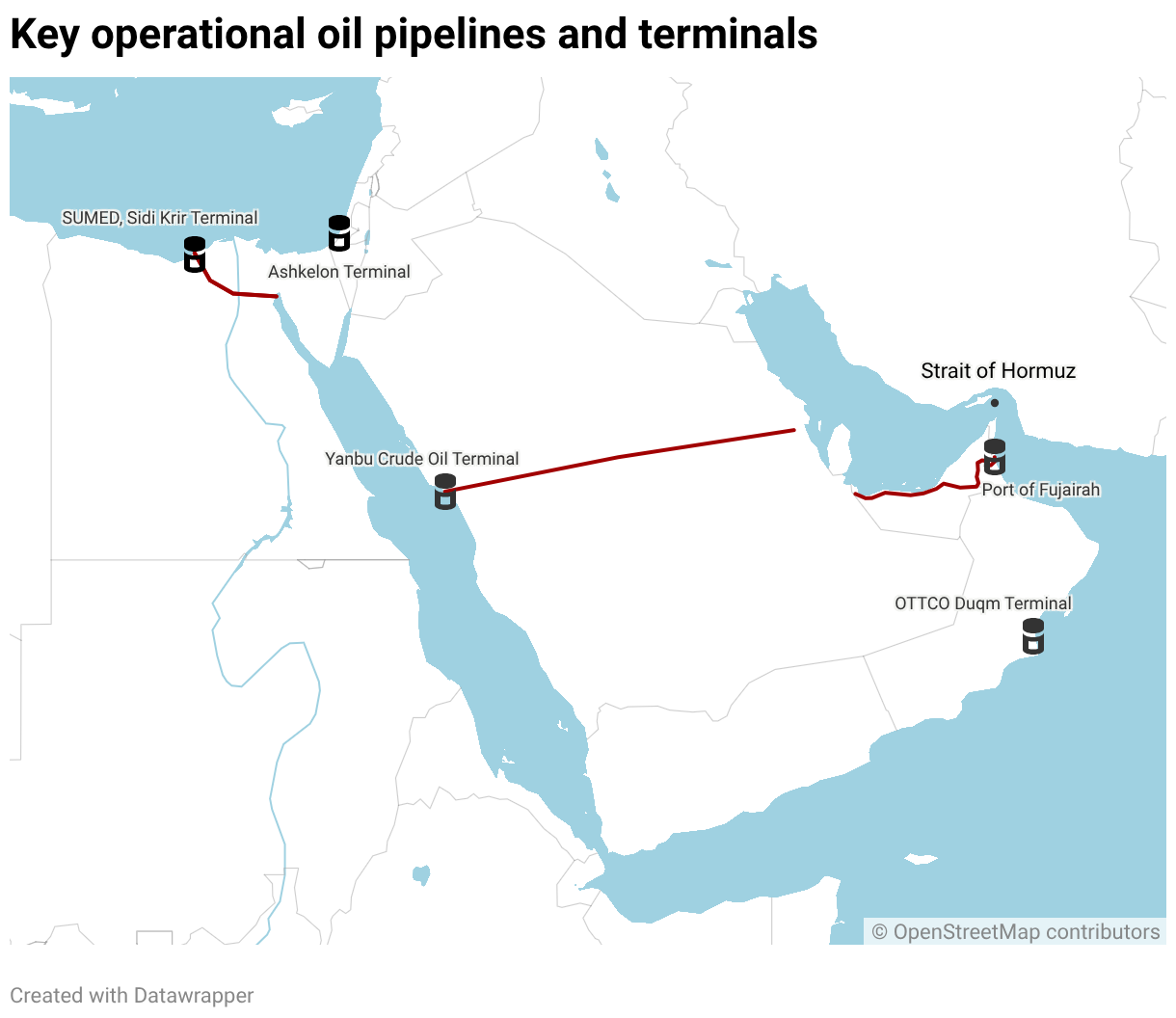
Pipelines should be expanded or constructed to physically tie upstream production and refineries to existing infrastructure in places such as the SUMED system in Alexandria, Egypt as well as coastal areas like Ashkelon in Israel and Duqm in Oman. Export infrastructure should be rapidly expanded in Saudi Arabia’s Red Sea ports and the United Arab Emirates’s Fujairah terminal in the Gulf of Oman. In strategic terms, east-west and north-south corridors should become the central organizing principle of Middle Eastern geoeconomics.
A World War II–sized effort
Such a plan is not unprecedented.
During World War II, following D-Day, the Allies launched Operation Pluto to supply fuel to mainland Europe under the English Channel. Within months, Allied forces were receiving around a million gallons of fuel per day. It was one of the most ambitious engineering efforts of the war—and it helped secure victory.
On the home front, the Big Inch pipeline from Texas to New Jersey was built within fifteen months between 1942 and 1943. Spanning more than 1,200 miles, it shored up New England’s energy security and demonstrated how quickly the United States could mobilize industrial capacity when energy is treated as a wartime priority.
Today’s challenge demands the same scale of thinking.
If the United States is willing to spend upwards of $200 billion on military operations against Iran, imagine what could be accomplished by investing a fraction of that amount in resilient infrastructure that permanently weakens Iranian leverage. Washington has financed large-scale energy projects in the Gulf before. In 2012, the US Export–Import Bank invested nearly five billion dollars in a petrochemical complex in eastern Saudi Arabia. It should now help finance the infrastructure that ensures those investments can never again be held hostage by Iranian coercion in the Strait of Hormuz.
This is fundamentally an engineering problem. And the United States, Israel, and Gulf Arab partners possess unmatched technical expertise. Much progress could be made in a year or less. For example, the Dakota Access Pipeline, which spans 1,172 miles from North Dakota to Illinois, is much longer than the East-West Crude Oil Pipeline in Saudi Arabia, and it was built in just ten months between 2016 and 2017.
A coordinated announcement of these new supply routes—complete with financing, timelines, and coalition participation—would likely reassure global markets and undercut Iran’s leverage before the first pipeline is even complete. Markets would understand the ambition and plan accordingly.
Protecting the pipelines
But this new infrastructure must also be protected.
Iran and allies such as Russia, which has provided Tehran with intelligence to target US interests in the Gulf, will almost certainly attempt to disrupt or destroy new energy corridors. That is why the second pillar of Operation Overflow is essential: Ukrainian-style drone defense deployed at scale.
Ukraine has demonstrated remarkable innovation in counter-drone warfare, protecting critical infrastructure under sustained attack. These lessons should now be applied across the Gulf. Recent diplomatic engagement between Ukraine and Gulf Arab partners—particularly Saudi Arabia and the United Arab Emirates—suggests that such cooperation is already emerging. The United States and Europe should expand this effort into a formal coalition to protect infrastructure.
This strategy would do more than remove Iran’s chokehold over the strait. It would serve as the backbone of a new economic and security architecture linking the Middle East more closely to the West, structurally binding regional partners with the United States for decades to come. It would deepen ties between Gulf states and Israel, opening the door to further progress in US President Donald Trump’s Abraham Accords. It would strengthen European energy security. And it would sustain support for Ukraine as it resists Russian aggression.
Rather than allowing Tehran to squeeze the global economy, the United States and its allies would gradually constrict Iran’s final tool of deterrence—building alternative routes, strengthening alliances, and eroding Tehran’s leverage over time.
