

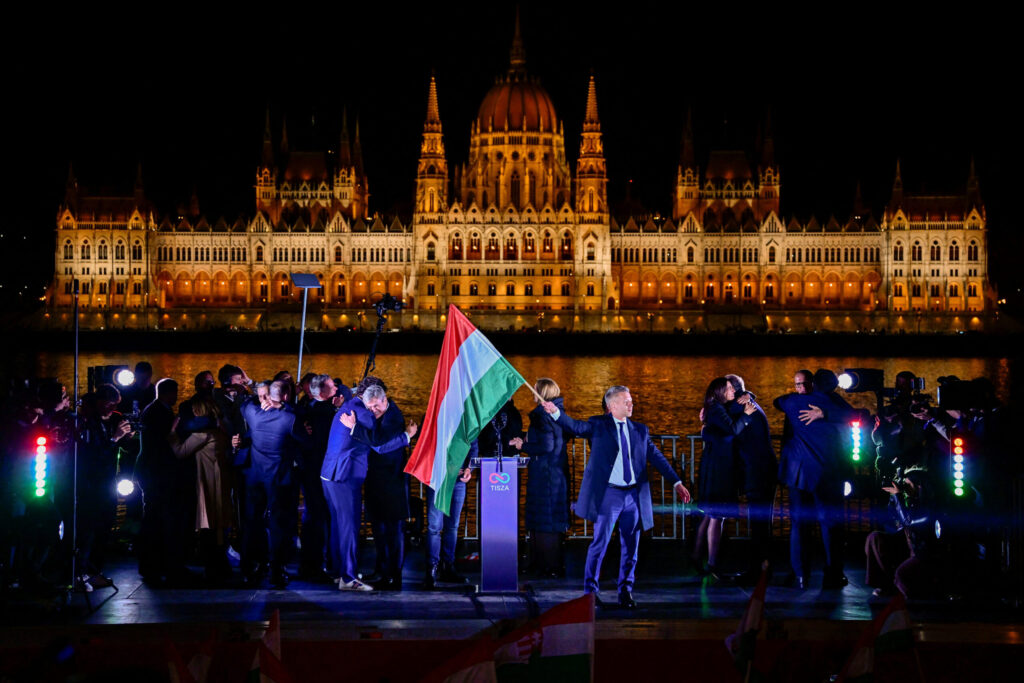
Hungarian Prime Minister Viktor Orbán’s sixteen-year reign came to a spectacular end on Sunday when his Fidesz party suffered a landslide loss in the country’s parliamentary elections. Orbán was defeated by opposition party Tisza led by his former colleague Péter Magyar, who will now form a new government in Budapest.
The scale of Magyar’s victory means he has an unprecedented mandate for sweeping changes inside Hungary. The incoming leader is also expected to realign Hungarian foreign policy. Under Orbán, Hungary was frequently at loggerheads with fellow NATO and European Union member states, and was known for cultivating close ties with US President Donald Trump, China, and the Kremlin.
While the new Hungarian government is initially expected to focus on domestic affairs, Sunday’s landmark election result has potentially important geopolitical implications for Ukraine and Russia. Officials in Kyiv and Moscow were following the recent Hungarian election campaign closely, and will now be anticipating major changes in their respective relationships with Budapest.
Stay updated
As the world watches the Russian invasion of Ukraine unfold, UkraineAlert delivers the best Atlantic Council expert insight and analysis on Ukraine twice a week directly to your inbox.
For Kyiv, the fall of the Orbán government offers hope following an extended period of troubled bilateral ties that saw Hungary consistently block Ukraine’s EU and NATO integration while also obstructing European efforts to support the Ukrainian war effort. Since the onset of Russian aggression against Ukraine in 2014, Viktor Orbán has been viewed by successive Ukrainian governments as Russian President Vladimir Putin’s unofficial representative in Brussels.
Orbán’s role became even more controversial following the start of Russia’s full-scale invasion in February 2022, with the long-serving Hungarian PM routinely opposing aid packages for Ukraine and sanctions measures against Russia. Relations became so strained that Orbán’s recent election campaign was dominated by anti-Ukrainian rhetoric. Images of Ukrainian President Volodymyr Zelenskyy featured on campaign posters across the country amid messaging that only Orbán could prevent Hungary from being dragged into the Russia-Ukraine War.
Unsurprisingly, officials in Kyiv welcomed news of Magyar’s win. “We congratulate the Hungarian people on today’s democratic, transparent, and historic parliamentary elections. The record high turnout reflects a turning point for Hungary,” commented Ukrainian Foreign Minister Andrii Sybiha. “On our part, we stand ready to advance mutually beneficial cooperation, find solutions to old problems, and open a new chapter for the benefit of both nations.”
Ukraine did not have to wait long for evidence of this new chapter in bilateral relations. Speaking in Budapest on Monday, Magyar confirmed he would not stand in the way of a critical $105 billion EU loan to Kyiv that Orbán had previously blocked. The new Hungarian leader was also critical of his predecessor’s approach to the Russia-Ukraine peace process. “We cannot tell any country to give up its territory,” he noted.
While this dramatic change in tone is certainly encouraging, Ukrainians are well aware that Hungary is not likely to become a major supporter. Magyar has previously ruled out arming Ukraine and has also underlined his opposition to fast-tracking the country’s EU accession process. It is also widely recognized in Kyiv that Orbán often served as a convenient scapegoat for other EU member states that shared his skeptical stance on pro-Ukrainian policies. Nevertheless, the fact that the new Hungarian authorities will no longer automatically oppose any attempt to advance Ukraine’s European integration is a very welcome development for the war-torn country.
Eurasia Center events
The fall of Viktor Orbán is a major blow for Russia. While Magyar will not seek to pick a fight with Moscow and has already indicated his willingness to discuss continued energy sector cooperation with the Kremlin, he has also condemned the Orbán government’s relationship with Russia and made clear that he will be adopting a very different approach.
For years, Russia has relied on Orbán to defend its interests in Brussels. This has included thwarting initiatives to aid Ukraine and challenging any steps to restrict Russian energy exports or impose further costs on the Kremlin. Since 2022, the veteran Hungarian politician has been an outspoken critic of European efforts to counter Russian aggression in Ukraine, and has advocated for a Kremlin-friendly peace deal that would grant Putin many of his key demands.
New evidence has recently emerged highlighting the full extent of the collaboration between Moscow and Budapest. According to leaked conversations, Hungarian Foreign Minister Péter Szijjártó offered to send his Russian counterpart Sergei Lavrov internal EU documents detailing confidential discussions on Ukraine’s European accession. Additional recordings showed Hungary’s top diplomat coordinating with the Kremlin to ease sanctions pressure on individual Russian nationals.
This cozy relationship will not continue. Instead, Hungary looks set to seek pragmatic ties with Russia while focusing on repairing its reputation in Brussels. Moscow has other friends it can turn to inside the EU, but none have quite the same the political clout as Orbán, who until his recent election loss was the European Union’s longest-serving leader.
This is the latest in a series of similar foreign policy setbacks for the Kremlin that have seen Russia lose multiple international allies. In late 2024, Syrian leader Bashar Assad was ousted and forced to flee to Moscow. More recently, Venezuelan President Nicolás Maduro was captured by the United States and deposed. Putin now also finds himself without the man he has long relied on to help project Russian influence into the heart of the European Union.
With Orbán gone, Europe is now set to become more united in its support for Ukraine and firmer in its opposition to Russia. Meanwhile, the new government in Budapest is expected to remain cautious on Ukrainian issues, but will no longer play the role of Putin’s proxy. Moscow still has the ability to divide and destabilize Europe, but Orbán’s defeat robs Russia of an important ally.
Peter Dickinson is editor of the Atlantic Council’s UkraineAlert service.
Further reading
The views expressed in UkraineAlert are solely those of the authors and do not necessarily reflect the views of the Atlantic Council, its staff, or its supporters.

The Eurasia Center’s mission is to enhance transatlantic cooperation in promoting stability, democratic values, and prosperity in Eurasia, from Eastern Europe and Turkey in the West to the Caucasus, Russia, and Central Asia in the East.
Follow us on social media
and support our work
Image: Peter Magyar, leader of the opposition Tisza party, holds a national flag following the partial results of the parliamentary election, in Budapest, Hungary. April 12, 2026. (REUTERS/Marton Monus)
