

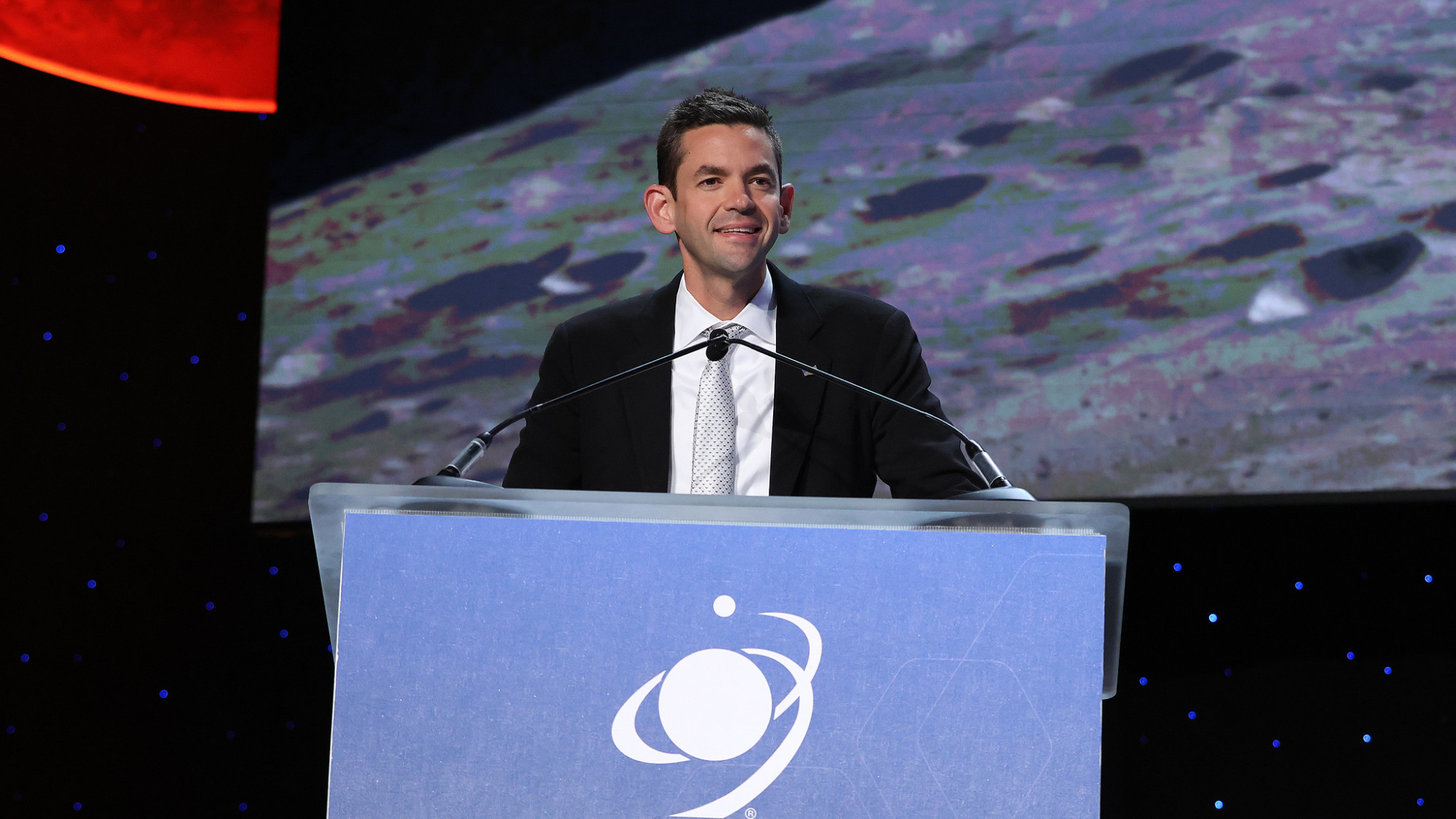
The head of NASA said the agency’s historic Artemis 2 moon mission, which sent the first astronauts around the moon in over 50 years, is only the beginning of a new lunar “relay race” that will ultimately lead to a crewed landing and moon base in the years ahead.
The U.S. space agency chief Jared Isaacman laid out what NASA is trying to make happen after the Artemis 2 mission, which concluded with a safe splashdown on Friday (April 10), in a livestreamed speech and discussion today (April 14) addressing attendees at the 2026 Space Symposium in Colorado Springs, Colorado.
“It was the opening act in America’s return to the moon, and it was a success,” Isaacman said in the speech, paraphrasing the crew’s previous comments that the moon mission is part of a relay race. The mission will be “remembered as the moment people started to believe again, to believe that America can still take on the near-impossible and deliver extraordinary outcomes,” Isaacman added.
Big mission, big changes
With Artemis 2, and its U.S. and Canadian astronauts, now safely back on Earth, Isaacman’s speech at the symposium was widely seen as the next forum where the new administrator could lay out his course for NASA — which saw many changes even before he arrived in December 2025.
Last year, workforce cutbacks and budget worries dominated the conversations around NASA. A White House proposal for a nearly 25% funding cut to NASA in fiscal 2026 was essentially reversed to a $24.4 billion budget passed by Congress. But for fiscal 2027, the White House’s request has almost the same reductions again.

In his talk today, Isaacman noted White House’s new budget propsal,also includes a request for $10 billion funded by “The Working Families Tax Cut Act” (previously known as “The One Big Beautiful Bill“), which he said will serve as a pool of supplemental agency funding over several fiscal years.
Isaacman, a billionaire and two-time astronaut who paid for and commanded his own SpaceX missions, was officially named administrator late in 2025 following a lengthy process in which his nomination was put forward, withdrawn and then put forward again. Sean Duffy, who heads the Department of Transportation, served as interim administrator in the meantime.
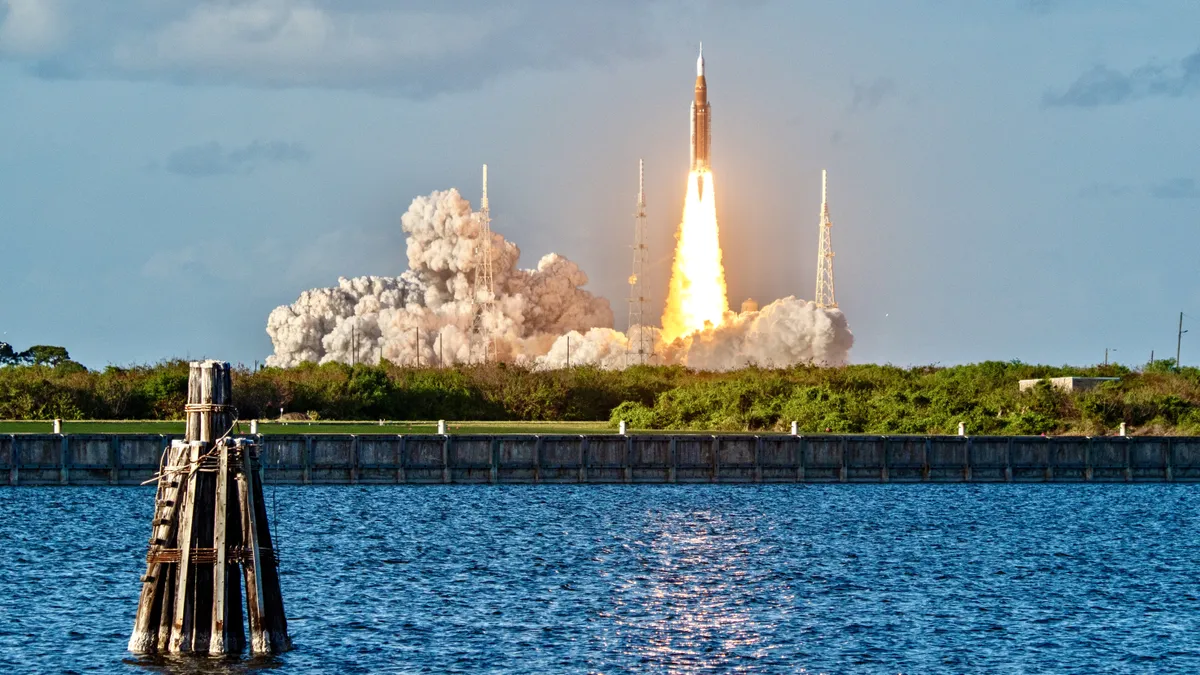
Isaacman’s administration has sought to make a mark since arriving. In a few short weeks, his administration overhauled the Artemis program’s schedule to put the landing as soon as Artemis 4 in 2028, with the previously assigned moonshot of Artemis 3 now a test of the human landing system in 2027.
NASA also paused the Gateway space station, leaving negotiations open with the international consortium—some of whom previously agreed to make components for it under the NASA-led Artemis Accords for space exploration, in exchange for astronaut seats and science—about where their modules and tech would go.
But Isaacman said the new structure would keep American leadership at the forefront while supporting goals in the Trump administration’s space policy. “NASA is no longer in the business of attempting to please everyone,” Isaacman said.
“We have taken on many externally opposed — and many self-inflicted — obligations, many distractions, with the hopes of trying to make everyone happy. But really, this just comes at the expense of the mission that we’ve been entrusted to perform, on behalf of the American taxpayers — and really, the space-loving community from all across the world.”
The changes, he continued, will also be performed collaboratively “alongside the international community, including the more than 60 Artemis Accords partners, to achieve our collective objectives — with urgency, and together.”
Isaacman also emphasized previous statements saying the base would be built a little bit at a time, to support the agency’s goals of having a long-term presence on the lunar surface.
“The early stages will look more like a construction site, or even a junkyard, and that’s okay,” Isaacman said of the moon base.
That vision also includes preparatory work, through robotic landings in the general region of the lunar south pole, targeted to happen as often as once a month starting in 2027.
Space station rethink

Closer to home, another of the agency’s recent sweeping changes was a proposed rethink of its commercial space station program intended to replace the International Space Station (ISS). Instead of funding fully fledged space stations, as was originally proposed, the administration argues industry would be better capable of meeting that need through commercial modules—which would attach to a newly launched ISS core hub module. This proposal is pending industry input in the coming months, however.
Isaacman said these space station changes will bring NASA to “ensuring that America and our partners never abandon this critical microgravity domain” (which is seeing competition from China, although he didn’t mention it directly.) U.S. industry partnerships, he said, will not only make more research, manufacturing and operations available, but will also “build a true economy that will drive innovation, and secure America’s LEO presence well into the future”
But Isaacman said the future of that LEO economy is not fully up to NASA.
“We can’t force an orbital economy, or even a lunar economy to exist, but we can do everything possible to try and ignite one,” the NASA chief said. “So that means supporting more private astronaut missions, more commercial astronaut monetization opportunities, more high commercial potential research to the space station.”
NASA Force and astronaut costumes

As for the workforce, Isaacman pointed to his newly announced “NASA Force” aiming to bring competencies to the agency, by recruiting from companies. “These term-based appointments from industry partners will provide mentorship [and] training, and help season and rebuild expertise in the NASA workforce. Similarly, this program offers exchange opportunities for NASA talent to rotate through industry,” Isaacman said.
Isaacman concluded his speech by saying the agency does its best when “undertaking and achieving the near impossible,” which he argued inspires the next generation. Aside from flying new telescopes and X-planes, NASA missions will “inspire more kids to dress up as astronauts for Halloween, so that they too can grow up and contribute to this great adventure.”
But his time on stage was not over yet, as Isaacman immediately moved into a discussion with Michael Kratsios, director of the White House’s office of science and technology policy (and assistant to the U.S. president in this portfolio).
Here, Isaacman said one of the biggest challenges facing NASA is cadence: with Artemis 2 just back on Earth, Artemis 3 components need to be assembled rapidly as the agency seeks to “establish muscle memory” for more rapid Artemis launches in the coming years.
The gap between Artemis 1 and 2 was roughly 3.5 years. But Artemis 3 will come faster, if all comes to fruition: astronauts will test out a human landing system in Earth orbit as soon as 2027. With robotic landers also potentially reaching the surface every month, and plans for nuclear power on the moon base, Isaacman said this approach should rapidly accelerate mission development on the administration’s long-term moon-to-Mars approach.
“How do we bring them [astronauts] back safely, to tell us about that extraordinary vision or that extraordinary journey? You’re going to need nuclear power and propulsion to be able to do that,” he said of going to Mars. But he noted elsewhere in the discussion that the interim goal is clear: “I will say the technology will be available to us in the not-too-distant future, almost assuredly, when you see astronauts set foot on the moon again.”
Isaacman added that he is seeing NASA where “everybody is really energized right now,” but agency employees are also aware that the long-term moon base plan will take at least a few years. He also said not every robotic mission will likely succeed, at this pace: “We want to land lots of stuff, and it’s okay if some of it breaks. We’re going to learn.”
But pointing to “competition” — that would be China, which wants its own astronauts on the lunar surface by 2030 — Isaacman said success will be measured “in months, not years” on the interim steps for U.S.-led Artemis missions to reach that goal before others.
“We obviously don’t want to lose.”

Lego
Lego Technic Nasa Artemis Space Launch System 42221
