

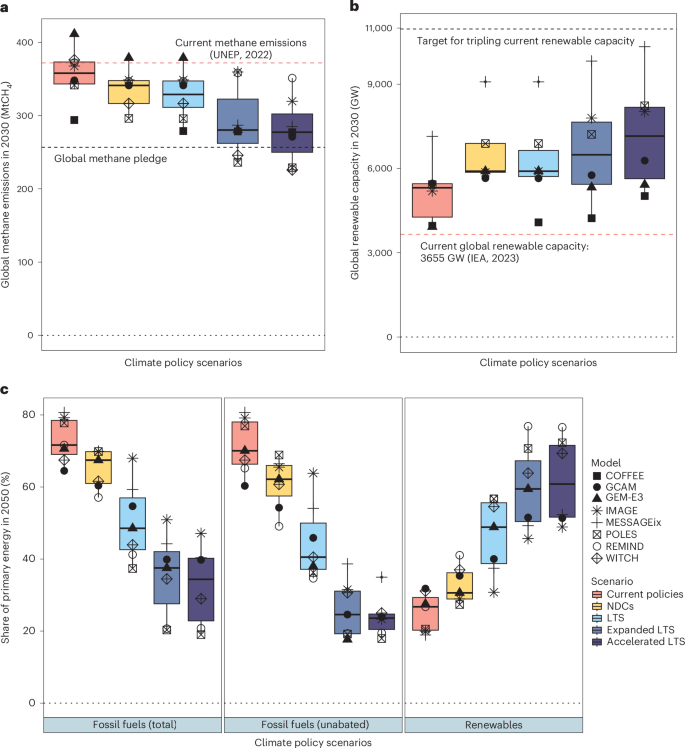
In total, 159 countries (accounting for over 50% of global methane emissions) signed the Global Methane Pledge, agreeing to work together to reduce global methane emissions by 30% (from 2020 levels) by 2030 (https://www.globalmethanepledge.org/). More recently, based on the outcomes of the recent global stocktake, this ambition was revised, with countries agreeing to commit to “tripling renewable energy capacity globally and doubling the global average annual rate of energy efficiency improvements by 2030” (in terms of reduction in energy intensity—that is, the amount of energy required to produce a unit of gross domestic product18), and “to transitioning away from fossil fuels in energy systems, in a just, orderly and equitable manner, accelerating action in this critical decade, so as to achieve net-zero by 2050 in keeping with the science”16. These goals are not directly implemented in our scenarios (for example, we do not ask the models to triple global renewable energy capacity by 2030)—rather, we check if current policies and pledges put forward by countries either domestically (national policies) or in the context of climate negotiations (for example, NDCs and net-zero pledges) lead to (or are on the path towards) reaching them.
As expected, the more ambitious the scenario, the closer it is to reaching the methane and renewable energy goals (Fig. 2). Current policies, NDCs and LTS scenarios show insufficient reductions in methane emissions. Current climate policies and pledges heavily rely on CO2 mitigation. While CO2 mitigation has strong synergies with energy-related methane emissions (which accounts for approximately one third of total methane emissions), direct mitigation is crucial for effectively reducing methane emissions19. Furthermore, modelling of non-CO2 abatement remains limited, particularly due to constraints in the construction of marginal abatement cost curves20. Nonetheless, both expanded and accelerated LTS scenarios are found to be potentially in line with, and considerably closer to, the Global Methane Pledge target (Fig. 2a), suggesting that models account, to some extent, for readily available methane abatement options.

Performance of the climate policy scenarios. a, Global methane emissions in 2030 and the Global Methane Pledge33. b, Global renewable capacity in 2030 and tripling renewable capacity for electricity generation21. c, Share of renewables and fossil fuels in the primary energy mix in 2050, and the phasing down or out of fossil fuels. Renewables include biomass, with and without carbon capture and storage. Centre line of the box plots represents the median, box limits represent the upper and lower quartiles, and points represent the models (n = 8).
For the expansion of renewable energy capacity (Fig. 2b), most of the scenarios do not reach the tripling goals by 2030 (compared to 3,655 GW in 2023)21, despite the fast growth of renewables in all scenarios. Key factors holding back the scaling up of renewables in the shorter term include the feasibility of moving away from fossils, which can delay their phase-out, capacity factors and constraints in the power system that determine how fast technologies can be ramped up and their penetration rates (especially for intermittent sources such as solar and wind), technology costs, different assumptions on electrification of end uses, with some models more optimistic than others, and difficulties in dealing with stranded assets. This highlights the importance of early interventions, which, in this study, were operationalized by anticipating the net-zero commitments of countries. Furthermore, it indicates the need for dedicated interventions, with concrete underlying policies to drive system transformation.
Trends in renewable energy capacity, however, do not fully capture the potential of the transition and the strong contribution renewable energy sources have in the scenarios. A comparison of scenario development up to 2050 (Fig. 2c) displays the proportion of fossil fuels and renewable energy for each scenario. Our results show a substantial expansion of renewables and reduction of fossil fuels, abated or unabated, in their share of primary energy. In the shorter term, current pledges do not exhibit large differences when compared to existing policies (60–80% fossil fuels, 20–40% renewables), while the more ambitious LTS scenarios show considerable changes in the energy mix towards renewable energy (20–50% fossil fuels, 45–80% renewables). REMIND exhibits more optimistic outputs in terms of renewable energy, reaching a share of over 76% of global primary energy in 2050 for both expanded and accelerated LTS, which, as of 2023, was around 30% of global electricity generation22. Other studies show even higher shares of renewables23,24,25, especially for scenarios explicitly aimed at achieving such targets. While different models have different fingerprints26—that is, technological preferences—they all project a large expansion of renewable energy under climate policy scenarios21, and the high end of the range of renewable energy shares in our scenarios illustrates how competitive these sources have become.
By the mid-twenty-first century, unabated fossil fuels are reduced from around 80% (MESSAGEix, IMAGE, COFFEE and POLES), estimated in the current policies scenario to drop below 40% in 2050 when current net-zero pledges are accounted for, and to under 20% with accelerated climate action. Models that favour the deployment of renewables due to decreasing costs of technology tend to achieve steeper reductions in fossil fuel use (for example, REMIND and POLES), while IMAGE shows a delay in dealing with stranded assets (restrictions to early retirement), due to its recursive-dynamic nature. Unabated coal is phased out by nearly all models by the end of the twenty-first century, except for GCAM and GEM-E3, with a substantial reduction by 2050 for the expanded and accelerated LTS scenarios. The remaining unabated fossil sources are split between oil and gas, mostly directed to the hard-to-abate sectors. GCAM, GEM-E3 and IMAGE show higher deployments of gas with carbon capture and storage, while MESSAGEix and WITCH prefer unabated natural gas. The inclusion of bioenergy in the renewable mix, and to what extent bioenergy is coupled with carbon capture and storage, varies per model and region. In 2050, MESSAGEix and REMIND exhibit the lowest employment of bioenergy (70–108 EJ), while the other models range between 158 EJ (POLES) and 250 EJ (GCAM) in the accelerated LTS scenario. These numbers show a substantial increase compared to current bioenergy supply (55 EJ in 2022)27 and to the International Energy Agency’s net-zero emissions scenario28 (100 EJ in 2050). Solar and wind have high agreement across models, expanding considerably by 2050. MESSAGEix, REMIND and WITCH exhibit the highest numbers for solar (3,264–5,292 GW), and GCAM, POLES and REMIND have the highest for wind (2,218–3,517 GW), in both the expanded and accelerated LTS scenarios. Nuclear is an important option for GCAM (8.5% and 9.0% of the energy mix in 2050 for expanded and accelerated LTS, respectively), POLES (9.0% of the energy mix in 2050 for expanded and accelerated LTS) and MESSAGEix (7.3% of the energy mix in 2050 for accelerated LTS). A detailed breakdown of global primary energy consumption for the years 2020, 2030, 2050 and 2100, and the role of different energy carriers, is presented in Supplementary Figs. 3 and 4.
Electrification plays a substantial role in decarbonizing the energy system. For most models in the accelerated LTS scenario, the share of electricity strongly picks up in 2040, accounting for more than 50% of final energy use by 2050 (Fig. 3). This outcome is mostly driven by the transport and building sectors. The more stringent the climate target, the more substantial the transitions towards electrification of the passenger fleet and the switch away from conventional fuels for heating, considerably reducing emissions.

Share of electricity in final energy use (2030–2050). Centre line of the box plots represents the median, box limits represent the upper and lower quartiles, and points represent the models (n = 8). Dashed line represents the 2023 global share of electricity29.
