
LIVE NEWS
  • Automating portfolio trading with AI
  • A Commercial Space Race Prompts a Thorny Question: Who Owns the Sky?
  • Emboldened Senate Democrats block even bipartisan bills in hardball approach to counter Trump
  • Your brain can keep improving into your 90s, study finds
  • Amazon security research reportedly led to the White House’s Anthropic Fable ban
  • What NASA Needs to Stay on Track for the Moon
  • Ex-school district employee jailed for hacks on former employer
  • Social Security benefits and costs are perfectly reasonable — no case exists for massive cuts
Prime Reports
  • Home
  • Popular Now
  • Crypto
  • Cybersecurity
  • Economy
  • Geopolitics
  • Global Markets
  • Politics
  • See More
    • Artificial Intelligence
    • Climate Risks
    • Defense
    • Healthcare Innovation
    • Science
    • Technology
    • World
Prime Reports
  • Home
  • Popular Now
  • Crypto
  • Cybersecurity
  • Economy
  • Geopolitics
  • Global Markets
  • Politics
  • Artificial Intelligence
  • Climate Risks
  • Defense
  • Healthcare Innovation
  • Science
  • Technology
  • World
Home»Science»The earliest evidence of the first stars may lie in a distant gas clump
Science

The earliest evidence of the first stars may lie in a distant gas clump

primereportsBy primereportsApril 25, 2026No Comments4 Mins Read
Share Facebook Twitter Pinterest LinkedIn Tumblr Reddit Telegram Email
The earliest evidence of the first stars may lie in a distant gas clump
Share
Facebook Twitter LinkedIn Pinterest Email

There’s a new contender for the universe’s earliest first-generation stars.

A bright clump seen about 450 million years after the Big Bang has the chemical hallmarks of first-generation stars — notably that it appears to have no elements heavier than helium. This identification, reported in a trio of papers submitted March 20 to arXiv.org, pushes evidence for these pristine stars much earlier than previous candidates.

First-generation stars, known as population III stars, probably would have been massive — up to 1,000 times the mass of the sun — and very bright. These stars were born with only the elements created in the Big Bang: hydrogen, helium and a tiny amount of lithium. The stars we see in the night sky, on the other hand, also contain heavier elements forged by and passed down from previous generations of stars.

Sign up for our newsletter

We summarize the week’s scientific breakthroughs every Thursday.

Astronomers think the earliest of the first-generation stars formed a couple hundred million years after Big Bang — over 13.5 billion years ago. But until now, researchers had seen evidence of such stars only around 1 billion years after the start of the universe. The new report of much earlier candidates increases astronomers’ confidence of finding more such systems in the early universe, says astronomer Seiji Fujimoto of the University of Toronto, who was not involved in the research.

The clump, which the astronomers dubbed Hebe (named partially for the goddess of youth in Greek mythology, partially for the technical name of one of the wavelengths of light it emits), was first spotted in 2024. At the time, astronomers lacked the evidence to determine the object’s nature. So in 2025, they took higher resolution observations with the James Webb Space Telescope.
The earliest evidence of the first stars may lie in a distant gas clump
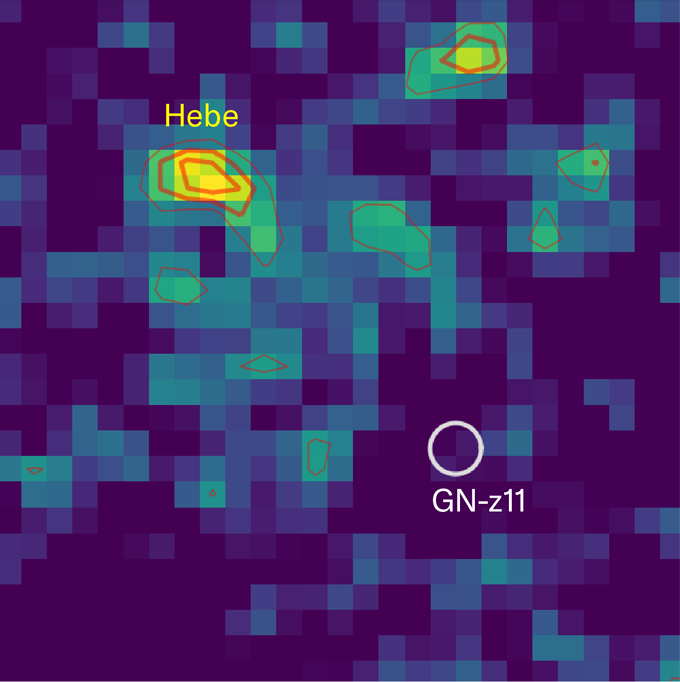
The gas in a clump dubbed Hebe glows brightly (yellow) in this image showing light from a highly energized form of helium. This type of light indicates a powerful and energetic source resides inside the gas cloud. The object sits near a relatively large galaxy, GN-z11, not visible in this light.R. Maiolino et al/arXiv.org 2026, JWST/NASA, ESA and CSA

To determine if a candidate is a first-generation star, astronomers first look for evidence of elements heavier than helium. Hebe not only showed no evidence of heavier elements but also emitted light specific to highly energized helium and hydrogen. This light, emitted by gas clouds, indicates that the clump contains an object or objects that emit extremely high-energy radiation.

“It’s a textbook case for the first generation of stars,” says astronomer Roberto Maiolino of University of Cambridge, a coauthor on the studies. “There’s no other really satisfactory explanations for other kinds of sources.”

The team estimates that Hebe is up to 1,200 light-years across, with two distinct clusters, and contains the mass of between 10,000 and several hundred thousand suns. But since first-generation stars are hefty, the cluster may have no more than a few hundred stars.

Hebe was also discovered near a galaxy, named GN-z11, with the mass of 1 billion suns. Some computer simulations suggest population III stars shouldn’t be found near such galaxies, which are chemically evolved and have therefore polluted their environments with heavy elements. Hebe’s proximity to GN-z11, Fujimoto says, “opens up new questions about how such systems form and survive.”

Other simulations suggest the gravity of these galaxies could pull in pockets of pristine gas from their surroundings, creating the conditions for population III stars to form. The discovery of Hebe, along with future studies of population III candidates, will help astronomers better understand the birthplaces of these pristine stars, Maiolino says.


Share. Facebook Twitter Pinterest LinkedIn Tumblr Email
Previous ArticleIran’s Infowar: Lego, AI and ever tightening control | US-Israel war on Iran
Next Article Augmented reality brings Revolutionary War to life at Army Museum
primereports
  • Website

Related Posts

Science

Calls to restore chalk grassland for rare insects

June 13, 2026
Science

The relationship recession is even bigger for Gen Z than we thought

June 13, 2026
Science

‘This might be the point of no return’: Experts on the current measles outbreak and where we go from here

June 13, 2026
Add A Comment
Leave A Reply Cancel Reply

Top Posts

Paxton’s win over Cornyn sets up high-stakes Texas clash with Talarico

May 28, 202616 Views

Global Resources Outlook 2024 | UNEP

December 6, 202510 Views

Texas Democrat Talarico claims voting laws are rigged ahead of Paxton race

May 28, 20269 Views
Stay In Touch
  • Facebook
  • YouTube
  • TikTok
  • WhatsApp
  • Twitter
  • Instagram
Latest Reviews

Subscribe to Updates

Get the latest tech news from FooBar about tech, design and biz.

PrimeReports.org
Independent global news, analysis & insights.

PrimeReports.org brings you in-depth coverage of geopolitics, markets, technology and risk – with context that helps you understand what really matters.

Editorially independent · Opinions are those of the authors and not investment advice.
Facebook X (Twitter) LinkedIn YouTube
Key Sections
  • World
  • Geopolitics
  • Popular Now
  • Artificial Intelligence
  • Cybersecurity
  • Crypto
All Categories
  • Artificial Intelligence
  • Climate Risks
  • Crypto
  • Cybersecurity
  • Defense
  • Economy
  • Geopolitics
  • Global Markets
  • Healthcare Innovation
  • Politics
  • Popular Now
  • Science
  • Technology
  • World
  • About Us
  • Contact Us
  • Privacy Policy
  • Terms & Conditions
  • Disclaimer
  • Cookie Policy
  • DMCA / Copyright Notice
  • Editorial Policy

Sign up for Prime Reports Briefing – essential stories and analysis in your inbox.

By subscribing you agree to our Privacy Policy. You can opt out anytime.
Latest Stories
  • Automating portfolio trading with AI
  • A Commercial Space Race Prompts a Thorny Question: Who Owns the Sky?
  • Emboldened Senate Democrats block even bipartisan bills in hardball approach to counter Trump
© 2026 PrimeReports.org. All rights reserved.
Privacy Terms Contact

Type above and press Enter to search. Press Esc to cancel.