

LIVE NEWS
  • Underground drug smuggling tunnel discovered from Tijuana to San Diego | US-Mexico Border
  • XRP Is The Clear Winner For Transactions, According To Peter Brandt
  • How AI-Native Security Will Reshape Enterprise Defense
  • Berkshire Hathaway buys Taylor Morrison for $6.8 billion. Buffett touts Abel’s deal-making
  • Learning from the Global South — Global Issues
  • Stocks Close Higher on Hopes for Continued US-Iran Ceasefire Negotiations
  • US court blocks Pentagon from removing transgender troops, for now
  • Paralympian could become first astronaut with disability to live and work in space
Prime Reports
  • Home
  • Popular Now
  • Crypto
  • Cybersecurity
  • Economy
  • Geopolitics
  • Global Markets
  • Politics
  • See More
    • Artificial Intelligence
    • Climate Risks
    • Defense
    • Healthcare Innovation
    • Science
    • Technology
    • World
Prime Reports
  • Home
  • Popular Now
  • Crypto
  • Cybersecurity
  • Economy
  • Geopolitics
  • Global Markets
  • Politics
  • Artificial Intelligence
  • Climate Risks
  • Defense
  • Healthcare Innovation
  • Science
  • Technology
  • World
Home»Cybersecurity»Americans lost over $2.1 billion to social media scams in 2025
Cybersecurity

Americans lost over $2.1 billion to social media scams in 2025

primereportsBy primereportsApril 27, 2026No Comments3 Mins Read
Share Facebook Twitter Pinterest LinkedIn Tumblr Reddit Telegram Email
Americans lost over .1 billion to social media scams in 2025
Share
Facebook Twitter LinkedIn Pinterest Email


Americans lost over .1 billion to social media scams in 2025

The U.S. Federal Trade Commission (FTC) warned of a massive increase in losses from social media scams since 2020, exceeding $2.1 billion in 2025.

According to reports to the FTC’s Consumer Sentinel Network, all age groups (except those 80 and over, who were mainly targeted via phone calls) lost more money to scams originating on Facebook than to any other social media platform.

Reports linked to WhatsApp and Instagram were distant second and third, and people reported losing far more money to Facebook scams alone than to text or email scams combined.

image

In all, as the Commission found, almost one in three Americans who lost money to scammers last year were contacted via a social media platform.

“In 2025, nearly 30% of people who reported losing money to a scam said that it started on social media, with reported losses reaching a staggering $2.1 billion. Social media scams produced far more in losses—an eightfold increase since 2020—than any other contact method used by scammers to reach consumers,” the FTC warned today.

“Social media creates easy access to billions of people from anywhere in the world, making a scammer’s job easier at very little cost. Scammers may hack a user’s account, exploit what a user posts to figure out how to target them, or buy ads and use the same tools used by real businesses to target people by age, interests or shopping habits.”
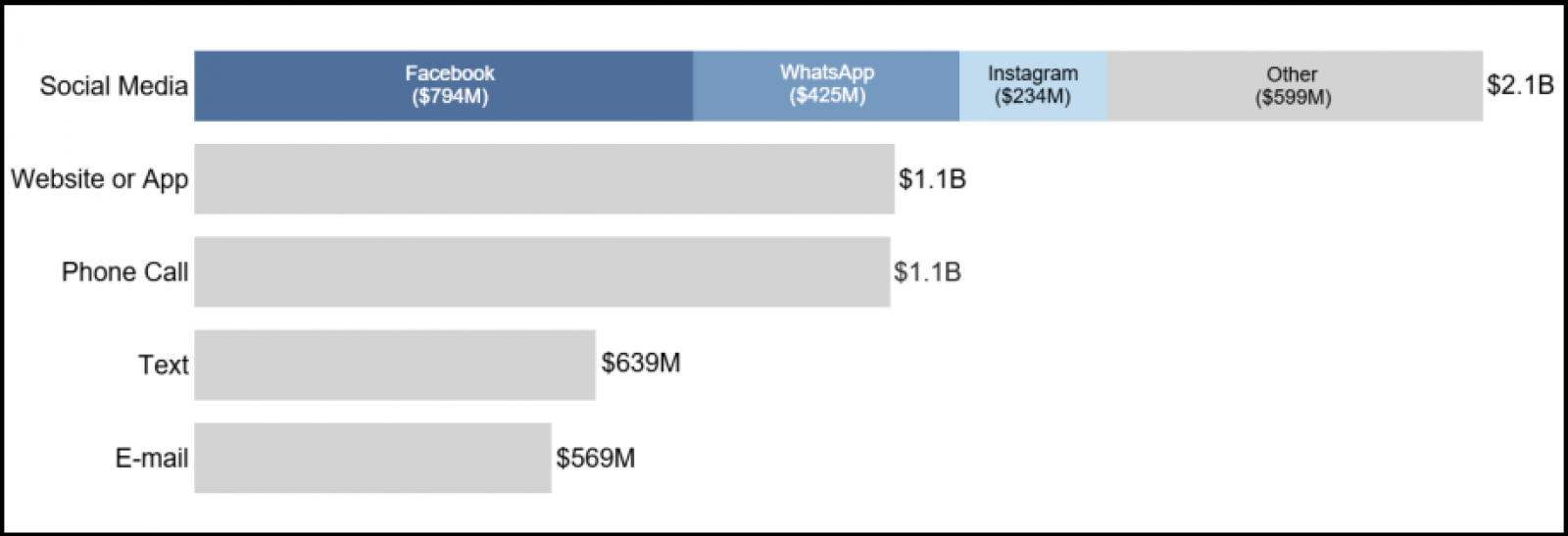
2025 top fraud methods by total reported loss
2025 top fraud methods by total reported loss (FTC)

​In response to this wave of scams targeting social media in general and its users in particular, Meta introduced new anti-scam protections across WhatsApp, Facebook, and Messenger last month. Among these new tools, Meta is testing warnings that flag suspicious Facebook friend requests based on signals such as a profile location that doesn’t match the user’s region or a small number of mutual connections.

It rolled out another set of tools in October to help users detect potential scams more easily, including a more advanced scam-detection system for suspicious chats that will warn when a new contact sends a potentially scammy message. Meta also introduced new WhatsApp warnings that alert users to only share their screen with people they trust when starting video calls with unknown contacts.

​In August, WhatsApp also added a security feature designed to help users spot potential scams when being added to a group chat by unknown contacts.

Meta removed over 159 million scam ads and took down over 10.9 million accounts on Facebook and Instagram linked to criminal scam operations in 2025.

In its 2025 Internet Crime Report, the FBI said it received over 1 million complaints through its Internet Crime Complaint Center (IC3) last year, linked to nearly $21 billion in losses from cyber-enabled crimes such as investment scams, business email compromise, tech support fraud, and data breaches.

To avoid getting scammed online, the FTC recommends limiting who can view your posts and contacts on social media and refraining from allowing someone you’ve only met through social media to influence investment decisions. Additionally, it’s wise to research any company before making a purchase by searching for its name online along with terms like “scam” or “complaint.”


article image

AI chained four zero-days into one exploit that bypassed both renderer and OS sandboxes. A wave of new exploits is coming.

At the Autonomous Validation Summit (May 12 & 14), see how autonomous, context-rich validation finds what’s exploitable, proves controls hold, and closes the remediation loop.

Claim Your Spot

Share. Facebook Twitter Pinterest LinkedIn Tumblr Email
Previous ArticleMelania Trump Takes Aim at ABC’s Jimmy Kimmel After ‘Widow’ Joke
Next Article DeFi Strategies That Actually Make Sense
primereports
  • Website

Related Posts

Cybersecurity

How AI-Native Security Will Reshape Enterprise Defense

June 2, 2026
Cybersecurity

Miasma Supply Chain Attack Compromises Red Hat npm Packages with Credential-Stealing Worm

June 1, 2026
Cybersecurity

Alleged Kimwolf Botmaster ‘Dort’ Arrested, Charged in U.S. and Canada – Krebs on Security

June 1, 2026
Add A Comment
Leave A Reply Cancel Reply

Top Posts

Paxton’s win over Cornyn sets up high-stakes Texas clash with Talarico

May 28, 202616 Views

Global Resources Outlook 2024 | UNEP

December 6, 202510 Views

Texas Democrat Talarico claims voting laws are rigged ahead of Paxton race

May 28, 20269 Views
Stay In Touch
  • Facebook
  • YouTube
  • TikTok
  • WhatsApp
  • Twitter
  • Instagram
Latest Reviews

Subscribe to Updates

Get the latest tech news from FooBar about tech, design and biz.

PrimeReports.org
Independent global news, analysis & insights.

PrimeReports.org brings you in-depth coverage of geopolitics, markets, technology and risk – with context that helps you understand what really matters.

Editorially independent · Opinions are those of the authors and not investment advice.
Facebook X (Twitter) LinkedIn YouTube
Key Sections
  • World
  • Geopolitics
  • Popular Now
  • Artificial Intelligence
  • Cybersecurity
  • Crypto
All Categories
  • Artificial Intelligence
  • Climate Risks
  • Crypto
  • Cybersecurity
  • Defense
  • Economy
  • Geopolitics
  • Global Markets
  • Healthcare Innovation
  • Politics
  • Popular Now
  • Science
  • Technology
  • World
  • About Us
  • Contact Us
  • Privacy Policy
  • Terms & Conditions
  • Disclaimer
  • Cookie Policy
  • DMCA / Copyright Notice
  • Editorial Policy

Sign up for Prime Reports Briefing – essential stories and analysis in your inbox.

By subscribing you agree to our Privacy Policy. You can opt out anytime.
Latest Stories
  • Underground drug smuggling tunnel discovered from Tijuana to San Diego | US-Mexico Border
  • XRP Is The Clear Winner For Transactions, According To Peter Brandt
  • How AI-Native Security Will Reshape Enterprise Defense
© 2026 PrimeReports.org. All rights reserved.
Privacy Terms Contact

Type above and press Enter to search. Press Esc to cancel.