

Welcome to Carbon Brief’s DeBriefed.
An essential guide to the week’s key developments relating to climate change.
Countries chart path away from fossil fuels
SANTA MARTA SUMMIT: Countries attending a first-of-its-kind summit have walked away with plans to develop national “roadmaps” to move away from fossil fuels, along with new tools to address subsidies and carbon-intensive trade. The first conference on “transitioning away” from fossil fuels, held in Santa Marta, Colombia, from 24-29 April, saw 57 countries – representing one-third of the world’s economy – debate practical ways to move away from coal, oil and gas. Carbon Brief has produced an in-depth summary of the talks.
‘REFRESHING’ APPROACH: Against the backdrop of a global oil and gas crisis, ministers and envoys from across the world sat side-by-side in small meeting rooms to have open and frank conversations about the barriers they face in transitioning from fossil fuels to clean energy. This new format – devised by co-hosts Colombia and the Netherlands – was described as “refreshing” (see below).
NEW SCIENCE PANEL: The event also featured a “science pre-conference” attended by 400 academics from around the world. This saw the launch of a new science panel that will aim to provide quick analysis to nations wanting to accelerate their transition away from fossil fuels. In addition, the academics gathered gave their backing to a new scientific report – first covered by Carbon Brief – advising nations to “halt all new fossil-fuel expansion”.
UAE QUITS OPEC: The United Arab Emirates (UAE) on Tuesday said it was quitting OPEC, “dealing a blow to the oil producers’ group as an unprecedented energy crisis caused by the Iran war exposes discord among Gulf nations”, said Reuters.
IMO TENSIONS: With talks still ongoing today at the International Maritime Organization in London, the Guardian reported that “pressure” on the negotiations “appears to be linked to countries that have invested heavily in gas”.
OUTPOWERING TRUMP: US clean-energy installations are on track to hit “another record” this year and account for the vast majority of new power additions, despite facing policy opposition from the Trump administration, reported Bloomberg.
FOREST LOSS SLOWS: The loss of tropical forests slowed last year, “largely due to Brazil’s efforts to curb deforestation in the Amazon”, according to World Energy Institute and University of Maryland data covered by BBC News.
The proportion, at most, that global coal-power output is expected to increase this year – tempering claims made by some that the energy crisis could cause a “return to coal”, according to new Carbon Brief analysis.
- Mass incarceration can be viewed as a “climate justice issue”, as “incarcerated individuals are at a heightened risk of experiencing multiple climate-related events and “carceral infrastructure and policies worsen these impacts” | Environmental Research Letters
- Climate finance can promote stability in “conflict-affected” countries, through “the alleviation of water scarcity and the reduction of fossil-fuel dependence” | Climate Policy
- Land vertebrates will be increasingly exposed to heatwaves, wildfires, drought and river floods over the coming century due to climate change | Nature Ecology and Evolution
(For more, see Carbon Brief’s in-depth daily summaries of the top climate news stories on Monday, Tuesday, Wednesday, Thursday and Friday.)
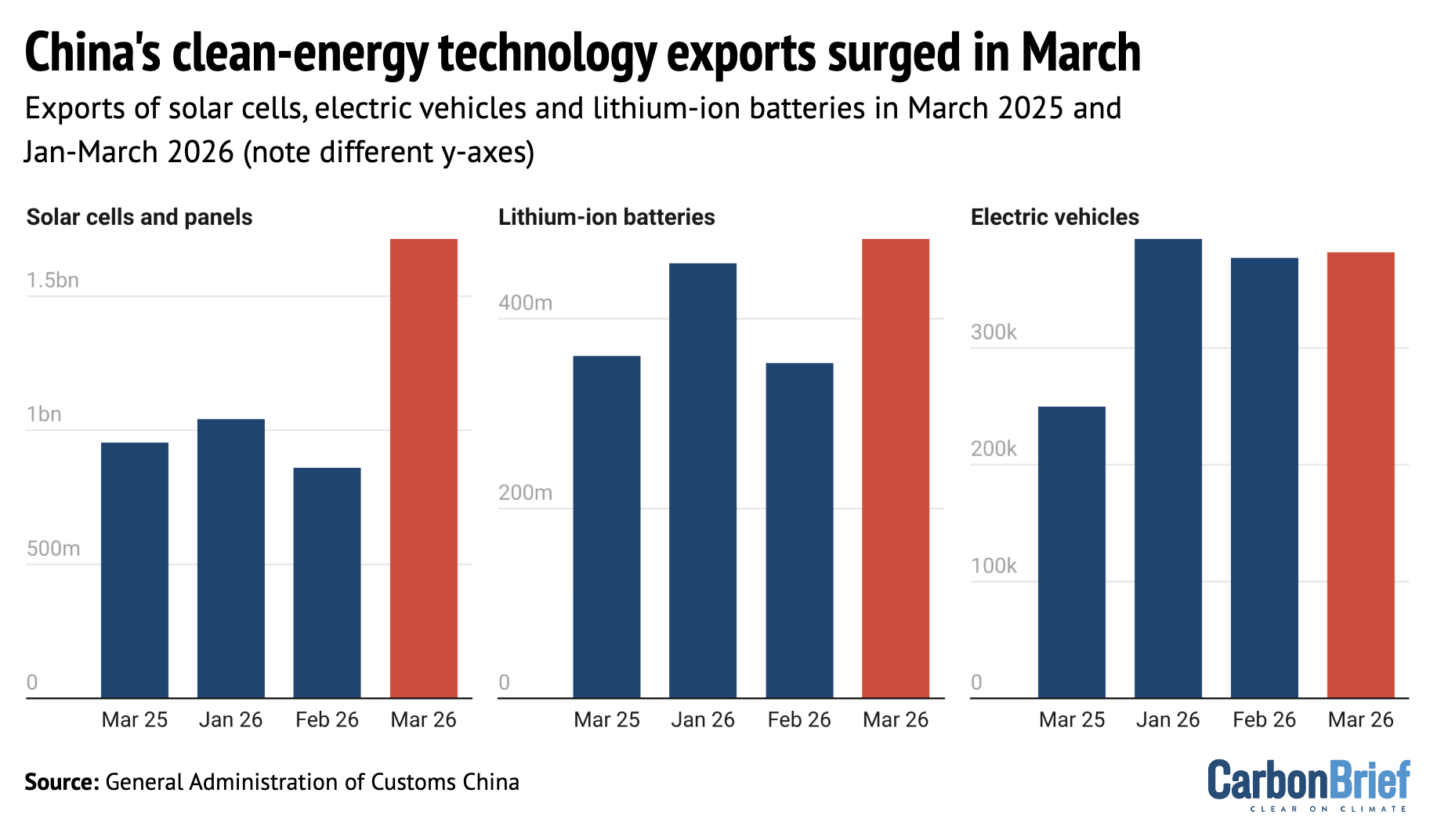
China’s exports of the “new three” clean-energy technologies surged by 70% year-on-year in March 2026, reaching $21.6bn, according to new analysis for Carbon Brief’s China Briefing newsletter. Exports of the three technologies – solar cells and panels, electric vehicles (EVs) and lithium-ion batteries – were also up 37% from February, the month before the Iran war. The conflict is one explanation for the surge, as it has caused several countries to emphasise the need to increase non-fossil energy supplies. However, a domestic policy deadline and falling silver prices were also behind solar exports almost doubling, analysts told Carbon Brief.
The inside story of how countries came together in Colombia
This week, Carbon Brief reports on how a new “informal” approach helped countries to make progress on “transitioning away” from fossil fuels at talks in Santa Marta, Colombia.
Over the past few days, ministers and climate envoys from 57 countries have been gathering in Santa Marta, a city along the Caribbean coast of Colombia, in a beach hotel that would not look far out of place in HBO’s White Lotus.
For the first time, only one topic was up for conversation: how to “transition away” from fossil fuels, the main driver of human-caused climate change.
The end result – new plans for national fossil-fuel “roadmaps”, new tools to address subsidies and carbon-intensive trade, and a renewed commitment for countries to keep cooperating on energy transition – has been hailed as a “historic breakthrough”.
From the outset, the summit’s co-hosts – Colombia and the Netherlands – were keen to stress that the meeting would not be a space for more negotiations, but rather a forum for countries and other stakeholders to discuss practical steps to move away from fossil fuels.
This format was widely praised by countries in attendance, who described the conversational atmosphere at the conference as “refreshing”, “highly successful” and a “safe space for discussion”.
Closed-door discussions
The “high-level segment” of the conference was held from 28-29 April.
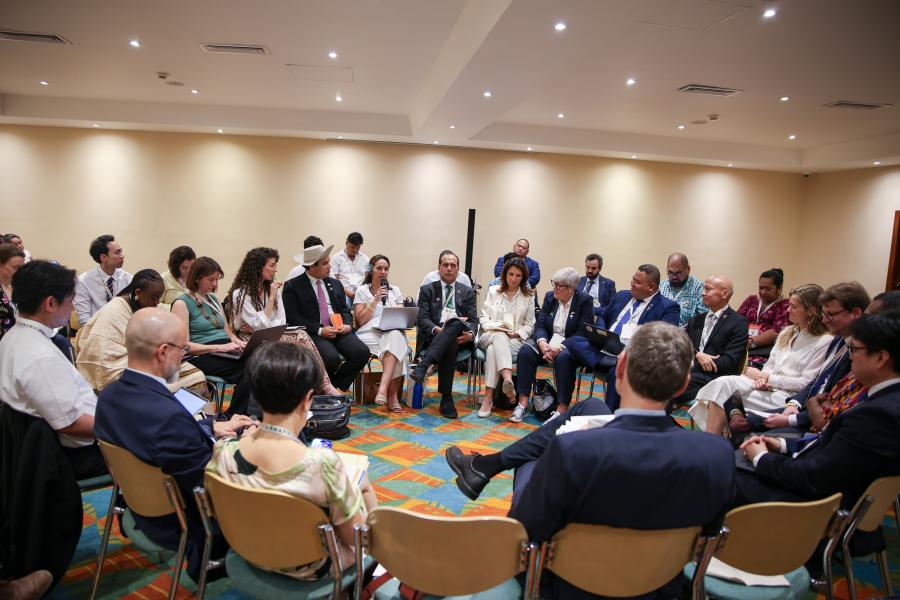
Following the opening plenary, ministers and climate envoys spent much of the two days in closed-door “breakout sessions”, discussing issues ranging from “planned phase down and closure of fossil-fuel extraction” to “closing gaps in financial and investment systems”.
Carbon Brief understands that each session featured 12 ministers and envoys representing different countries sitting in an inner circle, with an outer circle made up of civil society members and other stakeholders. Each session was led by a different minister, appointed by the co-hosts.
In a departure from UN climate negotiations, the conversations that took place were free-flowing, with ministers and stakeholders given equal opportunities to contribute, observers told Carbon Brief.
All of the sessions were held under the Chatham House rule, meaning discussions were not attributable to individual speakers to encourage more open debate.
UK special representative on climate, Rachel Kyte, was among policymakers praising the informal format, telling a huddle of journalists there was “real value” in speaking freely with other country officials. She added:
“I have to say that it is really nice to sit in a small circle…In a negotiation, it’s very, very fast-moving and transactional. But now we have had two days to think about [fossil-fuel transition issues] and this only.”
Speaking to Carbon Brief, Panama’s special representative on climate change, Juan Carlos Monterrey Gómez, said the format was “groundbreaking”, adding:
“I’m going to be honest. [At] first I was like: ‘What the f*ck am I doing here? I don’t know where this is going.’
“But then, as the workshop started, I realised there were ministers, envoys, civil society leaders and Indigenous people. They put us in a format where we could not open our computers, so we had to speak from our minds and our hearts. That completely flipped my perception. That kind of space I haven’t seen in my 10-year history with the UNFCCC.”
Road to COP31
The findings of this conference are now due to be delivered to the Brazilian COP30 presidency, which is currently preparing a global fossil-fuel roadmap to present at COP31 in Turkey this November.
A large question mark remains over how the outcomes will affect proceedings at COP31, particularly among the more than 130 countries that were not in attendance in Santa Marta.
Co-hosts Colombia and the Netherlands deliberately chose not to invite some countries to Santa Marta, saying the aim of this was to try to keep conversations focused on transitioning away from fossil fuels. (This approach split opinions among country officials and observers.)
During the summit’s final plenary, Dutch climate minister Stientje van Veldhoven stated that, going forward, it was the co-chairs’ wish to create an “open coalition”, including by extending an “invitation for others to join us” in the future.
NATIONS TO WATCH: A comment piece in Climate Home News by decarbonisation analyst Christopher Wright named “six nations” present at the Santa Marta talks that could “shape fossil-fuel futures”.
REFORM’S FOSSIL LINKS: A new investigation by DeSmog detailed how more than two-thirds of the total income of the hard-right Reform UK party comes from fossil fuels.
ARCTIC REPORT: Climate journalist Alec Luhn has won a National Headliner Award for his piece on plans to “refreeze” the Arctic, during which his “right thumb got frostnip from hitting the record button”. Read Luhn’s original article in Scientific American.
- Lighthouse Reports, editor, climate and environment | Salary: €70,000-€80,000. Location: Amsterdam, Netherlands or remote
- Center for Strategic and International Studies, research associate or associate fellow – climate change and energy security | Salary: $63,000-$70,000. Location: Washington DC
- Quaker United Nations Office, programme assistant, human impact of climate change | Salary: CHF4,262 per month. Location: Geneva, Switzerland
DeBriefed is edited by Daisy Dunne. Please send any tips or feedback to [email protected].
This is an online version of Carbon Brief’s weekly DeBriefed email newsletter. Subscribe for free here.
