
LIVE NEWS
  • Democrats try to defeat candidate expressing antisemitic views in Texas runoff on Tuesday
  • Democrats mount new attempt to end Medicare AI prior authorization pilot
  • Research shows educational institutes must not put too much faith in AI text detectors
  • Trump says ‘there won’t be escalation’ with Cuba after US indictment of former president Raúl Castro – US politics live | Cuba
  • Alibaba’s AI Agent Chip Strategy Goes Beyond Nvidia
  • Electrification emerges as COP31 priority
  • Anthropic Is Paying SpaceX $1.25 Billion a Month for AI Compute
  • The Trump-Xi Summit: What Happened in Beijing?
Prime Reports
  • Home
  • Popular Now
  • Crypto
  • Cybersecurity
  • Economy
  • Geopolitics
  • Global Markets
  • Politics
  • See More
    • Artificial Intelligence
    • Climate Risks
    • Defense
    • Healthcare Innovation
    • Science
    • Technology
    • World
Prime Reports
  • Home
  • Popular Now
  • Crypto
  • Cybersecurity
  • Economy
  • Geopolitics
  • Global Markets
  • Politics
  • Artificial Intelligence
  • Climate Risks
  • Defense
  • Healthcare Innovation
  • Science
  • Technology
  • World
Home»Defense»Navy F/A-18Gs over Iran, Venezuela show rise in aerial electronic attack
Defense

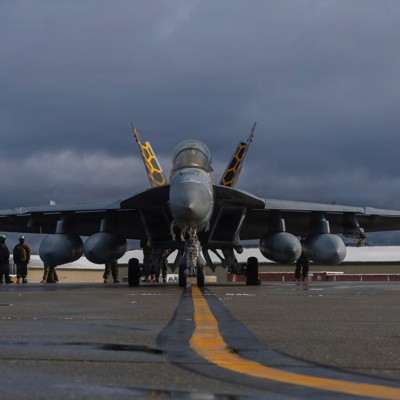
Navy F/A-18Gs over Iran, Venezuela show rise in aerial electronic attack

primereportsBy primereportsMay 4, 2026No Comments3 Mins Read
Share Facebook Twitter Pinterest LinkedIn Tumblr Reddit Telegram Email
Navy F/A-18Gs over Iran, Venezuela show rise in aerial electronic attack
Share
Facebook Twitter LinkedIn Pinterest Email


The Pentagon is using the Navy’s EA-18G Growlers more than ever in the war on Iran, suggesting more development and a bigger role for aerial electronic attack are on the way.

Flying from the carriers Abraham Lincoln and USS Gerald R. Ford, the Growlers have used jammers and missiles to confuse, suppress, and destroy communications and radar systems and surface-to-air missile batteries. 

They were also key to January’s seizure of Venezuelan President Nicolas Maduro, when they suppressed and destroyed Russian and Chinese-derived air defenses and other infrastructure to allow the abduction team to reach their Caracas target with virtually no resistance. As usual in these types of operations, Venezuelan air defense operators learned of the attack only when their radar screens went dark.

Development of the electronic warfare variant of the F/A-18F began in earnest in late 2003, when Super Hornet maker Boeing received the system development and demonstration contract. The first Growler was delivered on schedule in 2006. The Navy, which originally planned to buy 90 Growlers, increased its buy to 114, then 135, then 160. The last of the aircraft was delivered in 2018.

Plans call for developing the heart of the aircraft’s electronic attack, the ALQ-249 Next-Generation Jammer pod, in three variants: Increment 1 (Mid-Band), Increment 2 (Low-Band), and Increment 3 (High-Band). 

In 2023, Mid-Band prime contractor Raytheon received a $650.4 million contract to make Lot III NGJ-MBs, including a low-rate initial production order for 15 pairs of the pods—including four pairs for the Royal Australian Air Force, which operates a dozen Growlers. Two years later, Raytheon received a three-year, $580 million contract to continue production, including covering pods, spare parts, and support equipment, for the two operators.

Work on development of the Low-Band version is moving ahead. In 2020, L3Harris won a $495.5 million contract award to make and deliver 10 NGJ-LB pod simulators, eight operational prototype pods, four jettison mass model pods, two captive mass models, and other support systems. The company received a further $587.3 million for Low-Band development in 2024. Last year, L3Harris hired Honeywell for undisclosed help in developing the Low-Band variant.

Two months ago, the Navy awarded Boeing a four-year, $489.3 million order for jamming upgrades: four ALQ-264(V) Beowulf A-Kits, four Gunbay Pallet A-Kits, 12 Beowulf B-Kits, 15 sensor control unit B-Kits, and nine power control unit B-Kits, as well as various support equipment.

AI and machine-learning algorithms are said to be a growing element of the aircraft’s electronic attack, enabling faster analysis of hostile signals and production of tailored noise to degrade enemy air defenses. The aircraft’s active electronically scanned arrays, powered by gallium nitride transmitters, can shoot precise, high-powered beams of electronic noise at several targets at once.

The Navy has already spent more than $5 billion to develop the NGJ. The new budget proposal requests $428.6 million for fiscal 2027.

Australia is also working on upgrades for its Growlers. In February 2023, Project AIR 5349 Phase 6 – Advanced Growler awarded CEA Technologies, an Australian radar company, a $277 million contract to improve some fixed and portable emitters.

Andrew Dardine is lead analyst for Forecast International’s Defense Electronic Systems group.


Share. Facebook Twitter Pinterest LinkedIn Tumblr Email
Previous ArticleEstrogen in both the male and female brain shapes responses to trauma, study suggests
Next Article GeneDx plummets on lower 2026 guidance, Q1 misses
primereports
  • Website

Related Posts

Defense

‘Everybody is going underground’: CENTCOM head calls for new tech to hit buried targets

May 20, 2026
Defense

More risk and cost: de-scoped Collins LOTE strengthens case for looking to Japan

May 20, 2026
Defense

Pentagon policy isn’t keeping pace with autonomous weapons, senators argue

May 20, 2026
Add A Comment
Leave A Reply Cancel Reply

Top Posts

Global Resources Outlook 2024 | UNEP

December 6, 20258 Views

The D Brief: DHS shutdown likely; US troops leave al-Tanf; CNO’s plea to industry; Crowded robot-boat market; And a bit more.

February 14, 20265 Views

German Chancellor Merz faces difficult mission to Israel – DW – 12/06/2025

December 6, 20254 Views
Stay In Touch
  • Facebook
  • YouTube
  • TikTok
  • WhatsApp
  • Twitter
  • Instagram
Latest Reviews

Subscribe to Updates

Get the latest tech news from FooBar about tech, design and biz.

PrimeReports.org
Independent global news, analysis & insights.

PrimeReports.org brings you in-depth coverage of geopolitics, markets, technology and risk – with context that helps you understand what really matters.

Editorially independent · Opinions are those of the authors and not investment advice.
Facebook X (Twitter) LinkedIn YouTube
Key Sections
  • World
  • Geopolitics
  • Popular Now
  • Artificial Intelligence
  • Cybersecurity
  • Crypto
All Categories
  • Artificial Intelligence
  • Climate Risks
  • Crypto
  • Cybersecurity
  • Defense
  • Economy
  • Geopolitics
  • Global Markets
  • Healthcare Innovation
  • Politics
  • Popular Now
  • Science
  • Technology
  • World
  • About Us
  • Contact Us
  • Privacy Policy
  • Terms & Conditions
  • Disclaimer
  • Cookie Policy
  • DMCA / Copyright Notice
  • Editorial Policy

Sign up for Prime Reports Briefing – essential stories and analysis in your inbox.

By subscribing you agree to our Privacy Policy. You can opt out anytime.
Latest Stories
  • Democrats try to defeat candidate expressing antisemitic views in Texas runoff on Tuesday
  • Democrats mount new attempt to end Medicare AI prior authorization pilot
  • Research shows educational institutes must not put too much faith in AI text detectors
© 2026 PrimeReports.org. All rights reserved.
Privacy Terms Contact

Type above and press Enter to search. Press Esc to cancel.