

Observational data
To explore the absorption properties of wildfire-derived BrC and its contribution to total aerosol absorption, we collected and analysed wildfire-derived aerosol observational data covering global regions, including observations from aircraft campaigns (DC3, SEAC4RS, FIREX-AQ and ORACLES), ground stations (GoAmazon and Welgegund), ground-based remote sensing network (AERONET) and satellite retrievals (POLDER/GRASP). Detailed information on observational datasets can be found in Supplementary Fig. 1 and Supplementary Table 1.
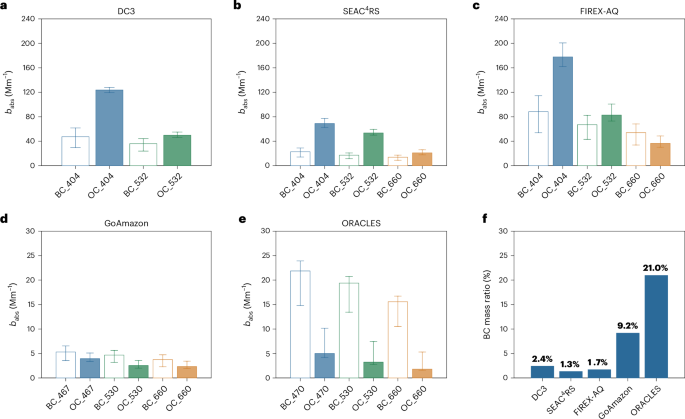
Among these observational data, five field campaigns—DC3 (conducted over Colorado, Oklahoma–Texas and Alabama during May–June 2012)45, SEAC4RS (southeastern United States during August–September 2013)46, FIREX-AQ (western United States during July–September 2019)47, GoAmazon (Manaus, Brazil during September–October 2014)48 and ORACLES (southern Africa during August–September 2016)49—can simultaneously provide total aerosol absorption measurements at multiple wavelengths and carbonaceous aerosol mass information. These campaigns employed sophisticated airborne instrumentation including photoacoustic spectrometers (PAS), single-particle soot photometers (SP2) and aerosol mass spectrometers (AMS) to measure light absorption at three wavelengths (ranging from 404 to 660 nm depending on the campaign) along with BC and organic aerosol (OA) mass concentrations. Through these measurements, we can not only quantify the contribution of wildfire-derived BrC to total aerosol absorption but also derive the key optical properties of wildfire-derived BrC.
Complementary data from the AERONET global network of ground-based sun photometers (operating at eight sites from 2018 to 2021)50,51,52, multi-wavelength in situ aerosol absorption measurements from the Welgegund atmospheric monitoring station in South Africa53 and POLDER/GRASP satellite retrievals (providing global coverage for 2012)54,55 supply additional aerosol optical property information. The Welgegund absorption data is obtained from a 7-wavelength Aethalometer AE-31, which is corrected according to Collaud Coen et al.56 based on comparison with a co-located Multi-Angle Absorption Photometer at Welgegund. While these datasets do not provide carbonaceous aerosol mass concentration measurements, they offer valuable geographical and temporal coverages that we use to supplement our analyses of BrC absorption around the globe and validate our findings across different scales and environments.
Isolating biomass burning data points
To obtain the absorption properties of wildfire-derived BrC and its contribution to the total aerosol absorption, we applied different screening approaches tailored to the available measurements from each observation platform.
Aircraft and ground in situ measurements
Following the methodology of Brown et al.57, we applied a dual-threshold screening approach to isolate data points dominated by biomass burning emissions while excluding interference from dust aerosols and other combustion sources: (1) BC mass concentration threshold: for aircraft observation samples (DC3, SEAC4RS, FIREX-AQ, ORACLES), we used BC > 0.9 µg m−3; for ground station observation samples (GoAmazon), we used BC > 0.3 µg m−3. The lower threshold for ground observations accounts for lower-background BC concentrations and reduced dilution effects near the surface compared to elevated plumes sampled by aircraft. (2) Aerosol composition threshold: on the basis of multi-model simulation results from Brown et al.57, regions dominated by biomass burning are characterized by BC and OA comprising more than 85% of the total aerosol mass. We therefore required that BC and OA from biomass burning sources comprised more than 85% of the total submicron aerosol mass:
$$\frac{\mathrm{OA}+\mathrm{BC}}{\mathrm{Total\_Aerosol}}\ge 0.85$$
(1)
$$\mathrm{Total\_Aerosol}=\mathrm{OA}+\,\mathrm{BC}+\mathrm{Tot\_Inorg}$$
(2)
where Tot_Inorg = ammonium (NH4 +) + sulfate (SO4 2−) + chloride (Cl−) + nitrate (NO3 −). BC was measured by SP2 (Single Particle Soot Photometer), a laser-induced incandescence instrument for measuring refractory BC (rBC) mass content of individual accumulation-mode aerosol particles. OA and inorganic salts (Tot_Inorg) were measured by AMS (Aerosol Mass Spectrometer). All measurements were limited to aerosol particles with diameters < 1 μm (PM1), which effectively excludes the majority of sea salt and dust aerosol masses that are predominantly found in the coarse mode (> 1 μm). The combination of both criteria, applied to submicron aerosols where biomass burning emissions dominate, effectively distinguishes biomass burning aerosols from other anthropogenic combustion sources.
Welgegund station data
Due to the lack of BC and OA aerosol mass concentration observations, we selected the typical biomass burning season (August–September) as the analysis period based on regional fire activity patterns.
AERONET ground-based data
For AERONET observations, we utilized the biomass burning period identification from Tanada et al.52, who identified intense fire periods at seven stations in wildfire-prone areas between 2018 and 2021 (Supplementary Table 4) based on aerosol optical property products including aerosol optical depth (AOD), single scattering albedo and Ångström exponent (AE). To exclude dust contamination from the selected biomass burning periods, we applied the criteria of AAE > 1.0 and AE < 1.5 following Cazorla et al.58 and removed data points that meet the criteria.
POLDER/GRASP satellite retrievals
For POLDER/GRASP satellite retrievals, biomass burning periods were identified based on the GFED (Global Fire Emissions Database) global wildfire carbon emission inventory. Similar to AERONET data, dust contamination was excluded by applying the criteria of AAE > 1.0 and AE < 1.5 following Cazorla et al.58, and data points that meet the criteria were removed.
Deriving BrC light absorption
After completing data screening, we further separated the absorption of BrC and BC from the observed total aerosol absorption data. Depending on the availability of observational data, we employed two different separation methods.
Combined mass-optical approach
For processes with synchronous observations of total aerosol absorption and carbonaceous aerosol concentrations, including DC3, SEAC4RS, FIREX-AQ, GoAmazon and ORACLES, we referenced the separation method in Chakrabarty et al.22 to derive the absorption of OC (BrC) and BC:
$${b}_{\mathrm{abs},\mathrm{BC}}(550)={{\mathrm{Mass}}_{\mathrm{BC}}\times \mathrm{MAE}}_{\mathrm{BC},\,550}$$
(3)
$${b}_{\mathrm{abs},\mathrm{BC}}(\lambda )={b}_{\mathrm{abs},\mathrm{BC}}(550)\times ({\lambda /550)}^{-{\mathrm{AAE}}_{\mathrm{BC}}}$$
(4)
$${b}_{{\rm{abs}},{\rm{OC}}}(\lambda )={b}_{{\rm{abs}}}(\lambda )-{b}_{{\rm{abs}},{\rm{BC}}}(\lambda )$$
(5)
where MAEBC,550 is the mass absorption efficiency of BC at 550 nm; MassBC is the mass concentration of BC; AAEBC is the absorption Ångström exponent of BC; babs, BC(λ) is the light absorption coefficient of BC at wavelength λ; babs(λ) is the total light absorption of aerosol at wavelength λ; and babs, OC(λ) is the light absorption coefficient of OC at wavelength λ.
Normally, measured MAE values for freshly generated BC at 550 nm were 7.5 m2 g−1 (refs. 13,59). The co-emission of BC and organic matters from biomass burning can additionally lead to internal mixing, which can enhance BC absorption by serving as a radiation lens60. Given that ambient BC particles are typically aged and coated during atmospheric transport, we applied an absorption enhancement factor to account for the presence of coatings on ambient aged BC60,61. Following Beerler et al.62, who reported a mean enhancement factor of 1.5 for BC in wildfire plumes, we adopted this value for our analysis, yielding a most likely MAEBC of 11.25 m2 g−1 (7.5 m2 g−1 × 1.5) for ambient BC at 550 nm. Additionally, we considered the broader atmospheric variability of enhancement factors ranging from 1.0 to 1.8, accounting for variations in particle size and mixing state60,61,63,64. This range corresponds to MAEBC values of 7.5 ~ 13.5 m2 g−1 for fresh to heavily coated BC in the atmosphere.
The absorption Ångström exponent of BC (AAEBC) is difficult to derive directly from field observations and is typically obtained through numerical calculations65,66,67,68,69. Following Chakrabarty and Heinson68, who applied the dipole–dipole approximation electromagnetic theory to simulate fractal BC aggregates with varying degrees of coating, we adopted AAEBC of 1.0 for our most likely value. Their simulated BC morphologies—including bare aggregates with point-contacting monomers, partially coated aggregates and heavily embedded aggregates—are representative of typical wildfire BC particles70, making their findings particularly applicable to our study. Their calculations demonstrated that MAEBC maintains an inverse wavelength dependency (λ−1) regardless of coating amount, which supports the use of AAEBC = 1.0 across the visible spectrum for both bare and coated BC aggregates. Additionally, we considered the influence of BC particle size on AAEBC by setting the lower and upper bounds at 0.8 and 1.2 (ref. 67), respectively.
For the DC3, SEAC4RS, FIREX-AQ, GoAmazon and ORACLES campaigns, we used MAEBC,550 of 11.25 m2 g−1 and AAEBC of 1.0 as the BASE case. Beyond this base configuration, we examined the lower and upper bounds by varying MAEBC,550 (7.5 and 13.5 m2 g−1) and AAEBC (0.8 and 1.2), which generated eight additional combinations (Supplementary Table 2). These parameter combinations encompass the variabilities in BC mixing state, size distribution and coating sampled across different instruments and locations. The results from these eight combinations were used to represent the range of calculated BC and OC light absorption. Uncertainties in the derived OC absorption, propagated from instrumental measurement errors, were calculated via error propagation analysis (Supplementary Material 1), resulting in combined uncertainties of 31.6–36.1% (Supplementary Table 3).
Using these derived absorption values, we can then calculate the two critical parameters that characterize the optical properties of OC: (1) the mass absorption efficiency of OC (MAEOC), which represents how efficiently each unit mass of OC absorbs light (units: m2 g−1), indicating the ‘darkness’ or light-absorbing strength per unit mass of material and (2) the absorption Ångström exponent of OC (AAEOC), which describes how rapidly the absorption efficiency changes with wavelength—a parameter that helps distinguish different types of light-absorbing particles, with values typically ranging from 1 (for BC) to 6–7 (for strongly wavelength-dependent BrC):
$${\mathrm{MAE}}_{\mathrm{OC},\lambda }=\,{b}_{\mathrm{abs},\mathrm{OC}}\left(\lambda \right)/{\mathrm{Mass}}_{\mathrm{OC}}$$
(6)
$${\mathrm{AAE}}_{\mathrm{OC}}=\mathrm{ln}({b}_{\mathrm{abs},\mathrm{OC}}\left({\lambda }_{1}\right)/{b}_{\mathrm{abs},\mathrm{OC}}\left({\lambda }_{2}\right))/\mathrm{ln}({\lambda }_{2}/{\lambda }_{1})$$
(7)
where MassOC is the mass concentration of OC.
Optical-only approach
For observational datasets from the AERONET network, Welgegund station and POLDER/GRASP satellite retrievals where aerosol mass concentration measurements were unavailable, we employed a method that independently separates BrC and BC absorption by using total absorption data at three wavelengths:
$$\begin{array}{l}{b}_{\mathrm{abs}}({\rm{\lambda }})={b}_{\mathrm{abs},\mathrm{BC}}({\rm{\lambda }})+{b}_{\mathrm{abs},\mathrm{OC}}({\rm{\lambda }})={b}_{\mathrm{abs},\mathrm{BC}}({{\rm{\lambda }}}_{\mathrm{ref}})\times {({\rm{\lambda }}/{{\rm{\lambda }}}_{\mathrm{ref}})}^{-{\mathrm{AAE}}_{\mathrm{BC}}}\\ \,\,\,\,\,\,\,\,\,\,\,\,\,\,\,\,\,\,\,+{b}_{\mathrm{abs},\mathrm{OC}}({{\rm{\lambda }}}_{\mathrm{ref}})\times {({\rm{\lambda }}/{{\rm{\lambda }}}_{\mathrm{ref}})}^{-{\mathrm{AAE}}_{\mathrm{OC}}}\end{array}$$
(8)
$$\begin{array}{l}\mathrm{AAOD}({\rm{\lambda }})={\mathrm{AAOD}}_{\mathrm{BC}}({\rm{\lambda }})+{\mathrm{AAOD}}_{\mathrm{OC}}({\rm{\lambda }})={\mathrm{AAOD}}_{\mathrm{BC}}({{\rm{\lambda }}}_{\mathrm{ref}})\\ \,\,\,\,\,\,\,\,\,\,\,\,\,\,\,\,\,\,\,\,\,\,\,\,\,\,\,\times {\left({\rm{\lambda }}/{{\rm{\lambda }}}_{\mathrm{ref}}\right)}^{-{\mathrm{AAE}}_{\mathrm{BC}}}+\,{\mathrm{AAOD}}_{\mathrm{OC}}({{\rm{\lambda }}}_{\mathrm{ref}})\times {({\rm{\lambda }}/{{\rm{\lambda }}}_{\mathrm{ref}})}^{-{\mathrm{AAE}}_{\mathrm{OC}}}\end{array}$$
(9)
where λ is the wavelength observed, λref is the reference wavelength we want to calculate; babs, BC(λref) and babs, OC(λref) are light absorption coefficients of BC and OC at λref, respectively; AAODBC(λref) and AAODOC(λref) are AAOD of BC and OC at λref, respectively.
To maintain consistency throughout the study, the default AAEBC value was kept at 1.0 in equations (8) and (9). Additionally, we considered AAEBC values of 0.8 and 1.2 as the lower and upper bounds to determine the range of retrieved OC light absorption. In equation (8), AAEOC, babs, BC(λref) and babs, OC(λref) are three unknowns to be determined. Given the measured total absorption coefficients babs(λ) at any three wavelengths, we can establish a system of three equations with three unknowns, which can be solved to determine AAEOC, babs, BC(λref) and babs, OC(λref). Similarly, equation (9) can be solved using the same approach, where AAEOC, AAODBC(λref) and AAODOC(λref) are the three unknowns that can be determined from satellite measured AAOD(λ) at any three wavelengths.
Following the same wavelength selection as in the aircraft observation analysis, we analysed AERONET and POLDER/GRASP satellite data at three reference wavelengths (404, 532 and 660 nm), which were retrieved from their respective observed wavelength data using equations (8) and (9). We tested the calculations with different combinations of observed wavelengths (λ) (for example, 443, 670 and 865 nm versus 490, 565 and 1,020 nm) for POLDER/GRASP satellite data, and the calculated AAEOC, AAODBC(λref) and AAODOC(λref) are close to each other (Supplementary Fig. 18).
We validated our AAE separation methods through two independent approaches: comparison with field observations and inter-comparison among methods (Supplementary Section 4). These validations provide confidence in applying these methods globally to quantify d-BrC radiative effects.
Model simulations
To accurately estimate the impact of wildfire-derived BrC aerosols on solar shortwave radiation, we modified the optical properties of primary organic aerosol in the Community Earth System Model (CESM), with the coupled Community Atmosphere Model version 5.4 (CAM5.4) and Community Land Model version 4 (CLM4). The model employs the four-mode version of the Modal Aerosol Module (MAM4), which treats aerosol species of sulfate, mineral dust, sea salt, BC, primary organic aerosol (POA) and secondary organic aerosol in the Aitken, accumulation, coarse and primary carbon modes42. BC and POA are emitted into the primary carbon mode and subsequently transferred to the accumulation mode through ageing processes.
Following Brown et al.28, we separated POA emissions into three distinct sources to enable targeted modification of biomass burning organic aerosol optical properties: biomass burning (BB) from wildfires using the Global Fire Emission Dataset Version 4.1 s (GFED4.1 s), biofuel (BF) combustion from residential and agricultural burning and fossil fuel (FF) combustion from anthropogenic energy and transport sectors. This source separation allows us to assign wavelength-dependent absorbing properties specifically to biomass burning POA (BB-POA) while maintaining default optical properties for other organic aerosol sources. We assigned wavelength-dependent absorption properties to BB-POA based on the MAEOC values derived from our observational analyses. The imaginary part of the complex refractive index (k) for BB-POA was calculated from the measured MAEOC values using the Mie theory, assuming spherical particles with a real refractive index of 1.65 and a particle density of 1.569 g cm−3 for BB-POA15,25. The relationship between MAEOC and k is given as:
$${\mathrm{MAE}}_{\mathrm{OC}}\left(\lambda \right)=\frac{4\pi k(\lambda )}{\rho \lambda }$$
(10)
where λ is wavelength, ρ is particle density. We derived k(λ) values at three key wavelengths (404 nm, 530 nm and 660 nm) corresponding to our observational data to capture the characteristic spectral dependence of BrC absorption. Because MAEOC values were derived from ambient atmospheric observations that already reflect the effects of photochemical ageing and atmospheric processing on the BrC absorption, we did not apply additional bleaching parameterizations in the model. This approach differs from previous studies that used laboratory-derived optical properties requiring subsequent ageing treatments.
We conducted three sets of model experiments with the derived MAEOC values from our observational analyses (DC3, SEAC4RS, FIREX-AQ, GoAmazon and ORACLES campaigns) to explore the range of BrC radiative effects: (1) BRC_BASE with campaign-averaged MAEOC derived from MAEBC = 11.25 m2 g−1 and AAEBC = 1.0, representing the moderate BrC absorption with wavelength-independent characteristics; (2) BRC_MIN with MAEOC assigned as the minimum value derived from all nine parameter combinations (MAEBC = 7.5, 11.25, 13.5 m2 g−1 and AAEBC = 0.8, 1.0, 1.2) across all campaigns, representing the lower bound of BrC absorption; and (3) BRC_MAX with MAEOC assigned as the maximum value derived from all nine parameter combinations across all campaigns, representing the upper bound of BrC absorption. Each experiment was initialized with a 1-year spin-up period and conducted from 2012 to 2016 with prescribed monthly sea surface temperature and sea ice at a horizontal resolution of 0.9° latitude by 1.25° longitude with 30 vertical levels.
The direct radiative effect (DRE) of an individual species (BC, BrC) was calculated as the difference between the total radiative flux at TOA and the flux without that specific species71, while keeping all other aerosol species unchanged. This approach isolates the contribution of BrC absorption to the Earth’s energy balance, allowing us to quantify the climatic impact of light-absorbing organic aerosols from biomass burning sources. Unlike previous BrC modelling studies that rely on optical properties derived from laboratory experiments or localized field observations23,24,27,28,29, our method utilizes BrC optical properties obtained from global ambient measurements across diverse atmospheric conditions. Furthermore, the derived range of BrC optical properties accounts for variations in particle mixing state and size distribution, providing a more representative characterization of real-world aerosol absorption.
