

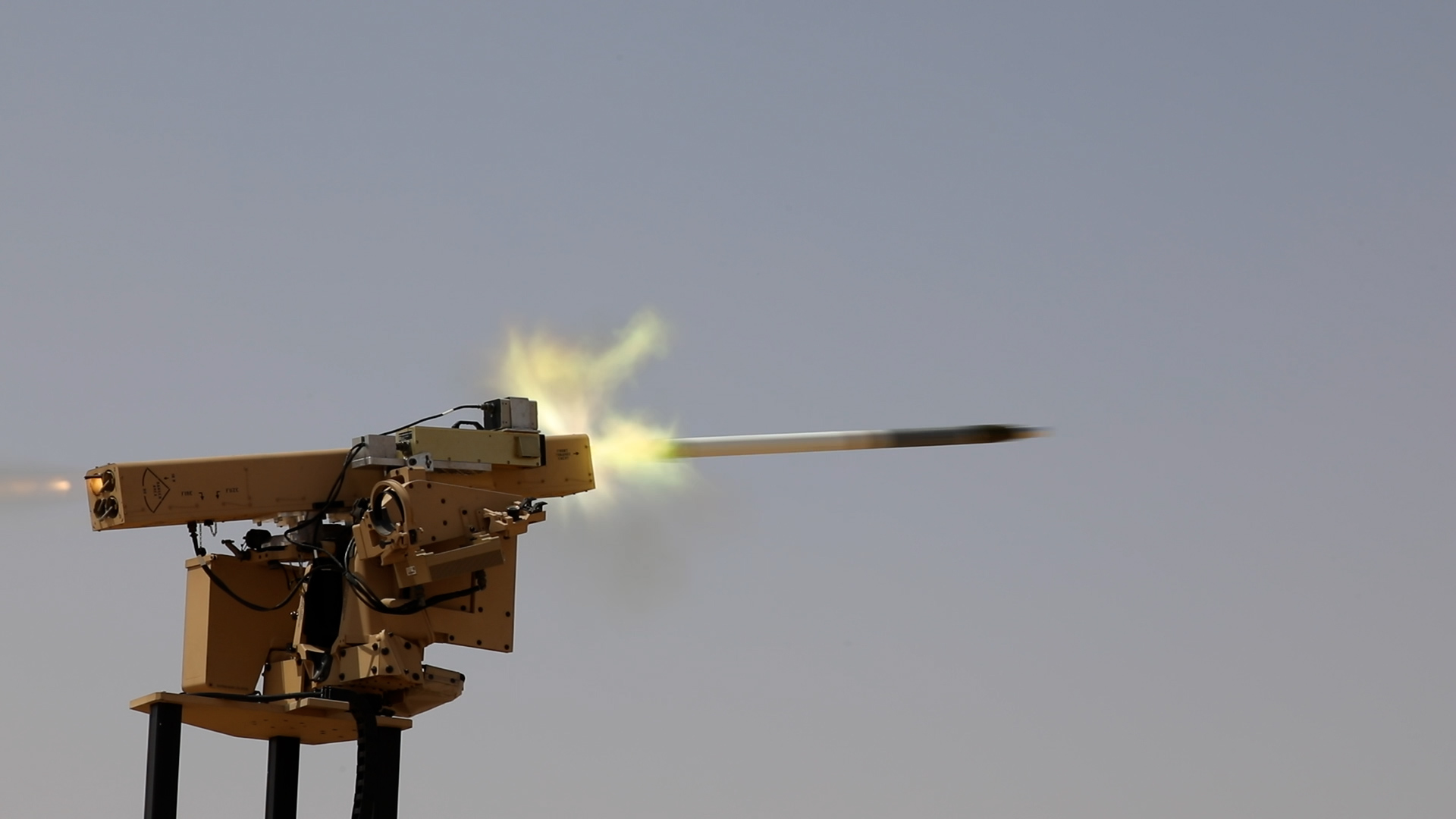
The Pentagon announced new long-term agreements with four defense companies May 13 to develop and produce large numbers of low-cost cruise missiles. And while the effort will focus mostly on the Army to start, it pairs with Air Force efforts to find more affordable munitions.
The Low-Cost Containerized Missile program is looking first for ground-launched missiles that the Army can use to knock down aerial threats. But missiles being developed for this program will have the capability to be launched from the air, ground, or maritime platforms depending on adjustments made to boosters and other technologies.
Undersecretary of War for Research and Engineering Emil Michael said in a release that the deals give industry a clear signal, which commits the federal government to affordable, on-time delivery and investment in munitions research and manufacturing.
Four “new entrant” companies—Anduril, CoAspire, Leidos, and Zone 5—will participate in the program, according to release.
“We are moving beyond the traditional prime contractors to expand our industrial base, accelerating testing timelines, and sending a clear, long-term demand signal to innovative new entrants,” Michael Duffey, Undersecretary for Acquisition and Sustainment, said in a statement.
The program seeks to procure more than 10,000 missiles in three years, starting in 2027. The Pentagon did not reveal the value of the four contracts or its projected budget for LCCM.
Though initially focused on the Army’s effort, the Pentagon program is coordinating with the Air Force’s program acquisition executive for weapons, headed by Brig. Gen. Robert Lyons III, whose office focuses on air-delivered munitions.
The Air Force could not immediately provide more details on its involvement with LCCM, but the program has potential across the services, and its objectives fit within the Air Force’s goals for the Family of Affordable Mass Munitions. The FAMM program covers a range of missiles, with recent efforts have focused on cruise missiles.
Lyons touted recent successes in cruise missile development during a Senate Armed Services Committee hearing on March 24.
He singled out the Extended Range Attack Munition, which entered production 14 months after the first contract was awarded. Both CoAspire and Zone 5 Technologies won contracts for the ERAM in 2024.
FAMM started in fiscal 2026 and is already seeking a major spike in projected funding in the 2027 presidential budget request: the Air Force is asking Congress for more than $12 billion over the next five years. That figure would acquire 28,000 units, according to budget documents.
The affordable options are one piece of a two-pronged approach by which the Air Force will continue to buy expensive “exquisite” weapons for specific, precision-driven missions such as the Joint Air-to-Surface Standoff Missile-Extended Range, which can cost $1.5 million a round.
But cheaper options are crucial in today’s combat environment.
Over the first 40 days of Operation Epic Fury, U.S. forces struck more than 13,000 targets, Chairman of the Joint Chiefs of Staff Dan Caine said. Tactically, targets often require more than one munition per strike.
Early stages of an air campaign against China could call for 100,000 target strikes, experts say.
Historically, expensive precision munitions take a long time to buy and build due to material and workforce shortages and inconsistent government funding. And some experts have worried that the conflict with Iran has reduced U.S. stockpiles of those munitions.
While Secretary of Defense Pete Hegseth has insisted munitions stockpiles are sufficient for U.S. needs across the globe, he and other Pentagon leaders have pushed hard to ramp up production of both low-cost and expensive munitions. They have touted new approaches such as industry investments, technologies such as additive manufacturing, and multiyear procurement contracts as ways to increase production.
Existing Missiles
All four companies selected for LCCM already have cruise missiles in development:
- Leidos: “Black Arrow,” designated AGM-190A by the Air Force
- CoAspire: “GHOST” or Rapidly Adaptable Affordable Cruise Missile-Extended Range, RAACM-ER
- Anduril: “Barracuda”
- Zone 5: “Rusty Dagger”
A May 13 Leidos release stated that the company will produce 3,000 munitions for the LCCM program using technology tested for Black Arrow.
The Leidos LCCM offering is twice the size of the Black Arrow with greater fuel capacity to maximize range, though the release did not state that range.
CoAspire’s RAACM-ER’s predecessor, the RAACM, was selected as one of the Air Force’s Extended Range Attack Munitions in late 2024 and conducted long-range test flights in mid-2025. The 8-foot long RAACM is comparable in size to the existing 500-pound JDAM, which is used on a range of bombers and fighters including the B-52, B-1B, F-16, F-22A and F-35A.
The company showcased its new RAACM-Extended Range recently, which features a stronger booster to increase its range.
CoAspire’s release announced its GHOST cruise missile, the new program name for the RAACM-ER, which is planned for test flights this year to support LCCM.
“The inclusion of CoAspire’s GHOST missile in this groundbreaking program and framework agreement underscores CoAspire’s potential to revolutionize ground-launched strike capabilities, offering a boosted, extended-range solution that can be deployed across multiple platforms,” said CEO Doug Denneny.
Anduril’s release noted it will deliver 3,000 of the Barracuda-500 as part of the LCCM program over three years.
The Barracuda carries a 100-pound payload and can travel 575 miles, according to company data.
In April, the Air Force tested Zone 5’s Rusty Dagger, one of the Air Force’s two types of ERAMs, on an F-16 at Eglin Air Force Base, Florida.
