

WASHINGTON — The sponsor of a bipartisan, three-bill package that would greenlight multiyear procurement for the F-35 and F-15EX told Breaking Defense he is hopeful that the bills will be incorporated into the fiscal 2027 National Defense Authorization Act.
Taking a standalone bill to the floor “is not necessary if it’s incorporated in the NDAA,” Sen. Ted Budd, R-N.C., told Breaking Defense in a May 14 interview. “I think it will be, [but] you never take anything for granted.”
Late last month, Budd and Sen. Jeanne Shaheen, D-N.H., introduced three bills centered around boosting the US fighter inventory and improving pilot retention.
The RETAIN Act increases bonus and incentive pay for experienced pilots, while the Fighter Aircrew Career Flexibility Act establishes an Air Force pilot program that would allow aviators to take a “career intermission” for up to one year.
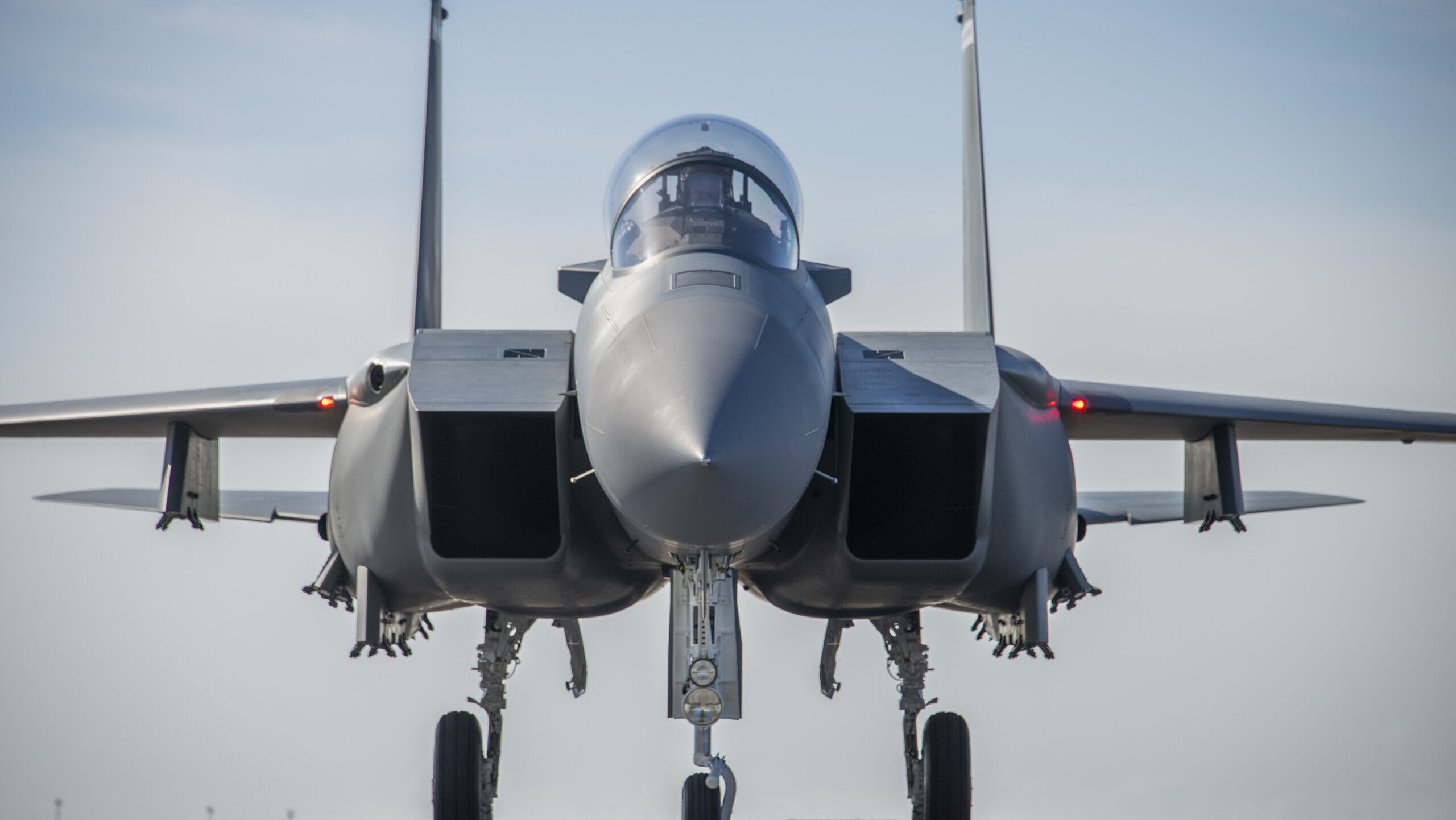
But most consequential for the defense industry is the Airpower Acceleration Act, which would authorize the Pentagon to purchase F-15EXs and F-35s through multiyear contracts, while also allowing for advance procurement of key F-35 and F-15EX components that could be bought in economic order quantities.
Committing to multiyear contracts would drive down the cost per aircraft and help set a stable demand signal to the defense industry, Budd said.
“We’re buying big, expensive things in one-year tranches,” he said. “And I just don’t think that’s fair to the taxpayer. I don’t think that’s fair to our war fighters, and I really don’t think that’s fair to the vendors and those that we’re buying from.”
Budd added that providing multiyear contracts could also provide the stability needed for Boeing to stand up a second production line for the F-15EX, similar to current Pentagon multiyear munitions deals that are incentivizing industry investment.
“If you give them a longer term, multiyear procurement contract and a vision for the future, then they might do capex [capital expenditures] to invest in increased production at a second line. It’s not an incremental increase, it’s an exponential increase to do that,” he said.
Beyond allowing multiyear F-35 and F-15EX buys, the bill sets the stage for the Air Force to buy and maintain a larger fighter inventory. It would mandate that the service maintain at least 1,369 combat-coded fighters by 2030 and 1,558 jets in 2035.
It would also push the Air Force to boost the F-15EX program of record even further by authorizing procurement of 329 aircraft. (The service announced during its budget rollout this year that it would be doubling its planned F-15EX procurement from 129 to 267.)
In testimony before the Senate Armed Services airland subcommittee May 12, Air Force Lt. Gen. Luke Cropsey acknowledged discussions with Boeing are underway to ramp up F-15EX production, but noted the plane maker is struggling to meet rates they’re currently signed up for.
“There is an ongoing conversation with Boeing right now about just getting to two [aircraft] a month. They’re not currently at their contracted number for production rate,” said Cropsey, the Air Force’s military deputy for acquisitions. The general added that Boeing showed Air Force officials “a well thought-out plan with regards to how to get the existing line to two a month,” and “additional plans” for how to get to three or four.
Budd characterized the F-15 as “a combination between a Corvette and a Chevy Suburban” that couples high-performance flying with the ability to haul large amounts of weapons. Although the F-15 isn’t stealthy, the Air Force will continue relying on it for “day two” operations, and will need more of the newer F-15EXs as it phases out legacy F-15C/Ds, he said.
“It’s here for another generation,” he said. “We need a lot of these. We need to replace those older birds that are just taking so much time, energy, [and] maintenance.”
On the House side, former F-22 pilot Rep. August Pfluger, R-Texas, told Breaking Defense he planned to champion similar legislation as Budd. Pfluger said a top priority would be expanding bonuses to help retain experienced pilots, and that other legislative provisions like career intermissions would provide more options to try to hold on to aviators.
“We are short over 2,000 pilots, and this will help us to triage that decline and get us to a point where we can provide flexibility, but also maintain that end strength,” Pfluger said in a May 15 interview.
The congressman said greater investments would reverse a similar trend of shrinking fighter fleets, arguing that airpower is core to modern warfare.
“Airpower is being asked to do more than any other … domain, and yet, I don’t believe that it’s been a fair distribution, a proportional distribution of funding to acknowledge that reality,” he said.
