

A Congressional Research Service report released this month tallied 42 U.S. aircraft lost or damaged during Operation Epic Fury, the 40-day campaign against Iran that began Feb. 28. It is the most complete public accounting of a war the Pentagon has yet to assess on its own terms.
The May 13 report, “U.S. Aircraft Combat Losses in Operation Epic Fury: Considerations for Congress,” draws on news accounts and statements by the Defense Department and U.S. Central Command to compile the list.
The CRS, the nonpartisan research arm of the Library of Congress, works from open sources and has no access to classified damage assessments.
The CRS authors note their count “may remain subject to revision due to multiple factors, which may include classification, ongoing combat activity, and attribution.”
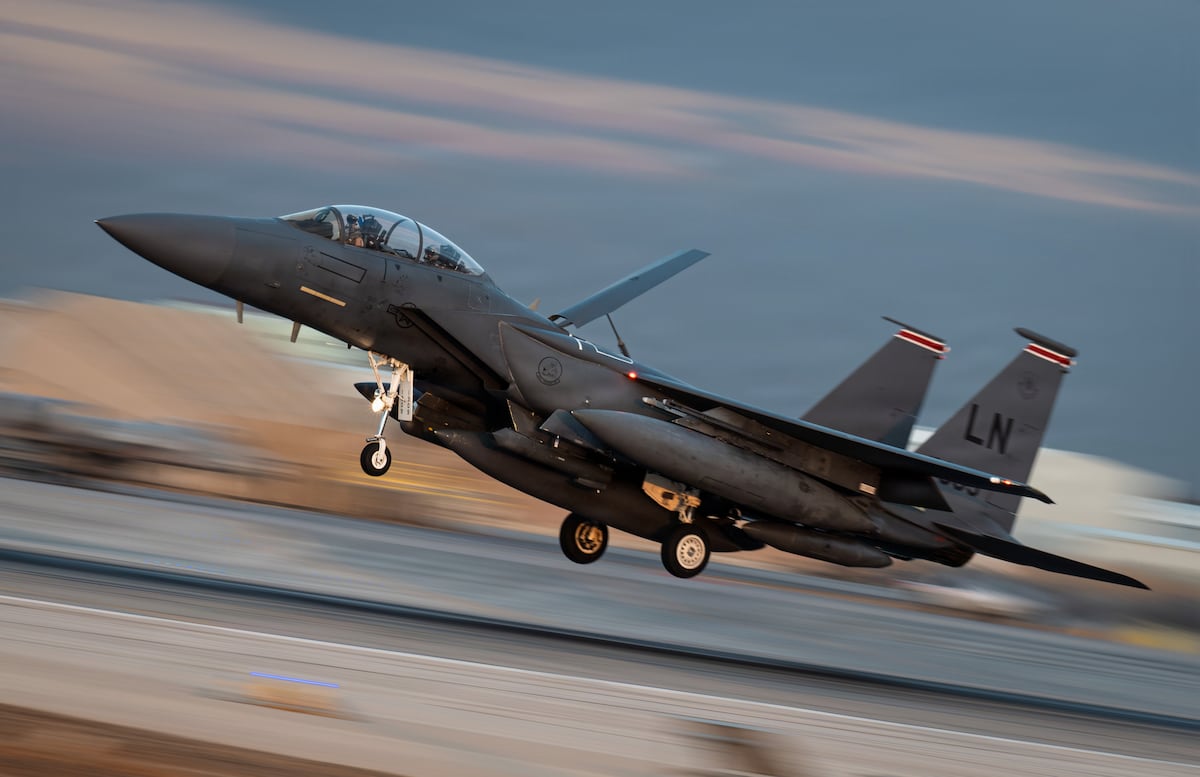
The first losses came March 1-2, when a Kuwaiti Air Force F/A-18 Hornet mistakenly shot down three F-15E Strike Eagles over Kuwait. All six aircrew ejected and were recovered. The shoot-down occurred during active combat that included attacks from Iranian aircraft, ballistic missiles and drones, CENTCOM said.
A fourth F-15E was shot down over Iran on April 3, with both crew members recovered in separate search-and-rescue operations.
A KC-135 Stratotanker went down over western Iraq on March 12 during a refueling sortie, killing all six aircrew. The crew members are the only fatalities on the CRS list. The loss was not the result of hostile or friendly fire, CENTCOM said. A second KC-135 involved in the same incident landed safely at Ben Gurion Airport in Israel.
The toll on the tanker fleet grew two days later, when Iranian missiles and drones struck Prince Sultan Air Base, Saudi Arabia, damaging five more KC-135s on the ground and bringing total tanker losses to seven.
An F-35A Lightning II took Iranian ground fire over Iran on March 19 and returned to base.
Iran hit Prince Sultan again on March 27, damaging an E-3 Sentry airborne warning and control aircraft. A May 7 Washington Post report cited by CRS said the E-3 had been parked on an unprotected taxiway.
An A-10 Thunderbolt II went down April 3 after taking enemy fire during a search-and-rescue mission. The pilot ejected and was recovered.
Two days later, U.S. forces blew up two MC-130J Commando II special operations aircraft on the ground in Iran during the broader rescue effort for the downed F-15E weapon systems officer, after the transports couldn’t fly out of a forward airstrip. All aircrew were evacuated. An HH-60W Jolly Green II combat search-and-rescue helicopter took small-arms fire during the same mission.
Drones, meanwhile, took the heaviest hit, accounting for 25 of the 42 losses. The list includes 24 MQ-9 Reapers and one MQ-4C Triton lost in a mishap reported April 14.
Air Force Chief of Staff Gen. Kenneth Wilsbach told the House Armed Services Committee on May 20 that the Reaper had been the campaign’s standout platform despite the losses.
“Perhaps maybe the most valuable player was unmanned,” Wilsbach said. “No other platform is even close to the MQ-9.”
Notable gaps and omissions
Multiple outlets reported the E-3 was not just damaged but destroyed. Photos of tail 81-0005 published days after the March 27 strike showed the rear fuselage burned through, with debris scattered around the airframe.
The Jerusalem Post and Air & Space Forces Magazine both called the airframe a write-off. The Air Force operated only 16 E-3s before the war began, six of them deployed to Prince Sultan.
The HH-60W count is also likely low. At his April 6 news conference, Joint Chiefs Chairman Air Force Gen. Dan Caine described two helicopters in the rescue flight taking fire, with a crew member on the trailing aircraft suffering a minor injury. The Aviationist noted the account suggests both airframes were hit, not one.
The report does not list any AH/MH-6 Little Birds. Between two and four Little Birds operated by the U.S. Army’s 160th Special Operations Aviation Regiment were intentionally destroyed at the same Iranian airstrip where the two MC-130Js were demolished in place, The War Zone reported in early April, and photos geolocated by open-source analysts showed the burned-out helicopters next to the C-130 wreckage.
The 160th SOAR operates under U.S. Special Operations Command, and the absence of a DoD or CENTCOM statement on the Little Birds may explain why none appear in the CRS list.
Cost of war continues to climb
Acting Pentagon Comptroller Jules Hurst told the House Appropriations defense subcommittee on May 12 that the cost of operations in Iran has risen to $29 billion, up from the $25 billion figure he provided April 29.
“So, at the time of testimony from the ask, it was $25 billion, but the joint staff team and the comptroller team are constantly looking at that estimate, and so now we think it’s closer to $29 [billion],” Hurst told Rep. Pete Aguilar, D-Calif.
Hurst blamed the increase on “updated repair and replacement of equipment costs and also just general operational costs keep people in theater.”
The figure does not include the cost of repairing damaged air bases and other U.S. installations in the region.
Michael Scanlon is a defense journalist covering air and space warfare. A former U.S. Air Force A-10 crew chief, he has supported land and sea programs for the U.S. Army, Navy, Marine Corps and Coast Guard.
