

Amna Nawaz:
President Trump proved his political power in Texas last night, as his endorsed candidate in the state’s U.S. primary run-off won in a landslide.
Geoff Bennett:
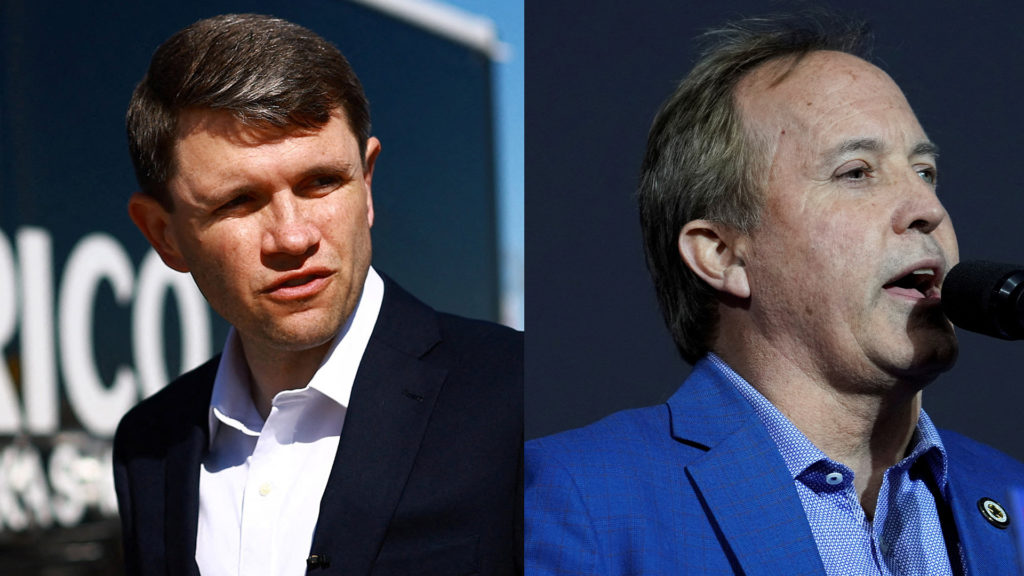
Attorney General Ken Paxton secured the Republican nomination in Texas, beating incumbent Senator John Cornyn by nearly 30 points.
Ken Paxton (R), Texas Senatorial Candidate: President Trump is the leader of our party, and his endorsement is the most powerful force in politics.
(Cheering)
Ken Paxton:
And I’m honored to have his support and I look forward to working with him in the Senate to deliver for Texas.
Geoff Bennett:
Cornyn, who has represented Texas in the Senate for more than 20 years, said he would support Paxton in the general election.
Sen. John Cornyn (R-TX):
There’s a simple rule in elections. You have heard me say it before. And that is the candidate who gets the most votes wins. The party in the majority gets to govern. And my hope is to keep my party in power for generations.
Geoff Bennett:
Paxton will face Democratic nominee James Talarico in the fall in what’s set to be one of the nation’s marquee midterm races.
For analysis of last night’s results in Texas, we’re joined now by Brandon Rottinghaus. He’s a professor of political science at the University of Houston and co-host of Houston Public Media’s “Party Politics.”
It’s great to have you here. Thanks for being with us.
Brandon Rottinghaus, University of Houston: Yes, my pleasure.
Geoff Bennett:
So I saw you described John Cornyn’s loss last night as the end of Bush era Republican model politics in Texas. Is this primarily about Donald Trump or is there a deeper realignment of what’s happening inside the GOP?
Brandon Rottinghaus:
It’s a good question.
I think it’s a little bit of both. Obviously, John Cornyn symbolized the traditional Texas GOP that came to power in the 1990s. They were able to convince voters that small government with low taxation was the way to go. That changed Texas and, frankly, changed the country.
The emergence of Donald Trump definitely exacerbated some of what was already happening in Texas, which was that it was a very conservative place and the model in Texas is adapt or die. And essentially Republicans are following that mantra, attempting to find the more conservative wing of the party, embrace them and ride that to victory.
Geoff Bennett:
Ken Paxton, as you well know, he has survived impeachment, indictment, FBI scrutiny, repeated ethical controversies and yet he has emerged politically stronger. What does that say about how Republicans view character and define electability?
Brandon Rottinghaus:
I think this is really kind of a front of the times, where you’re seeing scandals not matter as much as they used to.
Effectively, Ken Paxton turned surviving impeachment into a loyalty test. It was not just for this race, but also for races downballot. His legal troubles essentially solidified his image as an outsider, instead of destroying his political career, as it might have, say, decades ago.
Donald Trump’s support on this, I think, really kind of wrap them together politically because they have both been political survivors. They have both used these scandals as a way to decide and talk about how they’re the fighters that the country needs, and their partisans very much back them on it.
Geoff Bennett:
Ken Paxton is a structurally weaker general election candidate by any conventional measure as compared to John Cornyn.
But Democrats have not won a statewide race in Texas since 1994. So what’s your honest read of what this might mean for November?
Brandon Rottinghaus:
There’s no question that Ken Paxton is among the weaker of the nominees and Republicans nationwide are definitely worried about having to stretch their dollars to defend Texas.
That has never been a major issue. And the fact that it’s happening definitely reflects that they’re worried Ken Paxton’s ethical and legal baggage is going to be a problem going into November. For a lot of voters, the first thing they will know about Ken Paxton will be something negative, and that’s not a great stepping-off point.
Ken Paxton’s trying to bring Talarico’s numbers down too. We have seen that even today. And obviously this is going to be a battle where we’re going to see all the rocks getting thrown. So the scandals are going to matter, for sure. But for Texas voters, the question is, who can better deliver on these promises?
This is going to be an election that’s really pocketbook-focused, but it’s also going to be a mobilization election. So if it’s a straight-up fight between Republicans and Democrats, Republicans have the edge. Texas is a big state. It’s an expensive state. The structural advantage that Republicans have here is significant.
But if Talarico can find the right messaging and he can mobilize not only his voters, but also nonvoters or reluctant voters, sometimes crossover voters, then there’s a chance Texas could flip.
Geoff Bennett:
On the Democratic side we saw several Democrat-versus-Democrat run-offs in Texas this year because of redistricting, including in Houston with Congressman Christian Menefee beating longtime Congressman Al Green in their run-off and in Dallas with former Congressman Colin Allred beating Congresswoman Julie Johnson.
Several of these House run-offs have turned into proxy battles between different wings of the Democratic Party. Are there lessons to take away from the results?
Brandon Rottinghaus:
I think so.
I think you’re right that redistricting has really worked as a serious disrupter in the Democratic side. And there’s no doubt that that’s been complicated and controversial. But in a way it’s exposed a kind of new generation of Democrats.
This is a generational transition we’re seeing in a place like Houston and in places like Dallas. Democrats are considering what their future looks like. And they’re looking to a new generation to be able to figure that out. Now, sometimes, that new generation has already been in power and they have been effective at it.
But that’s what the voters are looking for. It seems like they’re interested in finding those fighters who can work the inside and who can use that leverage to be able to make things better. So that type of politics really is, I think, a kind of new model for the way the center of gravity is for the Republican Democratic Party now.
Geoff Bennett:
Brandon Rottinghaus of the University of Houston and co-host of Houston Public Media’s “Party Politics,” thanks again for your time.
Brandon Rottinghaus:
Hey, appreciate it. Thanks.
