

In a Q&A session with journalists and analysts at the recent Dell Technologies World 2026, Jeff Clark, vice chairman and chief operating officer with Dell, said he didn’t feel that executives at enterprise companies yet fully appreciated the critical, central role data plays in the burgeoning world of AI, both generative and agentic.
If the more than 8,000 attendees at the Dell gathering in Las Vegas weren’t aware of this fact when they got to the show, they left with a better understanding. Data – and the technology needed to store, manage, and protect it – were front and center in the messages the vendor put out over the three days and were included among the many new offerings that were introduced.
Data and storage are critical in several ways, according to Travis Vigil, senior vice president of product management at Dell.
“One, storage is what keeps the GPUs fed, and given the massive investment in the GPUs, keeping them fed is a pretty important thing,” Vigil told The Next Platform. “And with every architectural generation from Nvidia, storage has to keep up. Two, especially if you get into the enterprise customer, the ability to take really smart models that are trained on the internet and make them knowledgeable about your specific enterprise is a data management, a data curation, a data cleansing, a data pipelining issue. The knowledge and the differentiation that enterprises can get from generative AI or agentic AI resides largely on unstructured data that resides on-premises.”
The Need For Speed
There also is the speed with which organization need some of the storage to function to keep the GPUs fed with data, he said. Given that, they are going to need multiple tiers of storage, some of it in the cluster, some near the cluster, and some in the data lake outside of the cluster, Vigil added.
David Noy, vice president of product management, took the view from AI training and inferencing perspectives. For those running training operation, cleaning and preparing the data is critical for ensuring the models are as accurate as possible. For training, that means driving performance to ensure data is streaming into GPU. For inferencing, curating the right dataset is key to make sure the model returns the required answers.
“Both of those things are super-critical, but at the end of the day, GPUs without data are just hardware burning electricity,” Noy said. “There’s no value to it. The data is actually what folks want to operate on. We’re not buying infrastructure for the sake of our industry. We want business outcomes. Business outcomes mean you have to have something that goes in and comes out the other side.”
Infrastructure Is Cool Again – And Also Hot
Throughout the show, founder and chief executive officer Michael Dell and other top executives made the argument that the AI era is fueling ongoing shift in enterprise datacenters, with the trend toward hybrid environments, an emphasis on on-premises systems – in the datacenter or other areas, like the edge and co-location facilities – and the need to bring the AI to where the data is being created and stored. As we noted earlier, Michael Dell said that “AI is fueling a renaissance in enterprise hardware, a shift from bits back to atoms,” and pointed to a Dell survey that found that 67 percent of AI workloads run outside the cloud, which is unlikely to change over concerns about data security and sovereignty.
“We have long said that there’s gravity to data, and that the vast majority of data exists on-premises,” Vigil said. “The change that we’ve seen in the last two to three years is that with the ability to obtain intelligence from that data utilizing generative AI or agentic, it was a step function change in terms of needing infrastructure to help them. The data existed on-premises, but it was difficult to figure out what it was and what it contained and if you removed the personally identifiable information and things like that. Generative AI, agentic AI made it imperative for customers to do it much more easily, and thus the imperative to have infrastructure and support that’s based on enterprises’ prioritized use cases is the big change.”
Dell for has been building out the capabilities of its datacenter hardware offerings to better help organizations to run and scale their increasingly AI-fueled operations. At Nvidia’s GTC 2026 conference in March, Dell – which is seeing rapid adoption of its AI Factory with Nvidia, with the number of customers topping 5,000 – introduced its AI Data Platform, a unified stack used to organize and manage data from diverse sources to fuel AI workloads and that includes high performance storage, modular data engines, the Data Orchestration Engine, and Nvidia accelerated technologies.
Also unveiled at GTC were the Lightning File System, a parallel file system with performance of as much as 150 GB/s per rack, with the goal being to keep a high flow data into the GPUs at scale, and Dell Exascale Storage, a 3-in-1 storage system that delivers file, object, and parallel file software on the vendor’s PowerEdge servers.
Dell grew its storage capabilities again at Dell Technologies World. That includes PowerStore Elite, which supports block, file, virtual machines, and container workloads in a 3U form factor. When released next month, PowerStore Elite – essentially the brand given to PowerStore Gen 3 – will come in three models, the 1500, 5500, and 9500, on TLC or QLC media and offer 50 percent more processing capacity based on Intel Xeon CPUs.
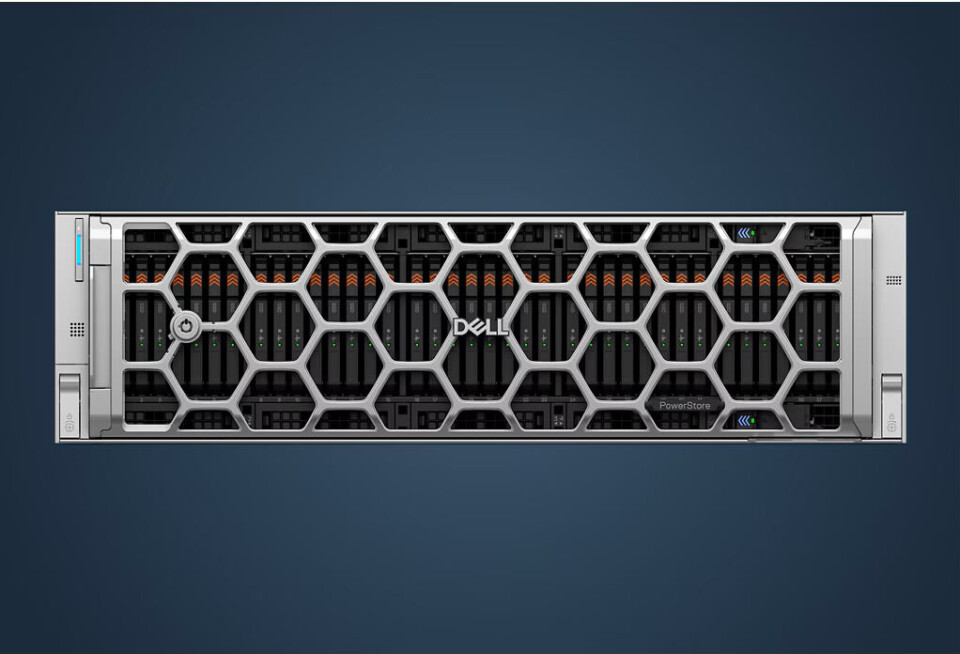
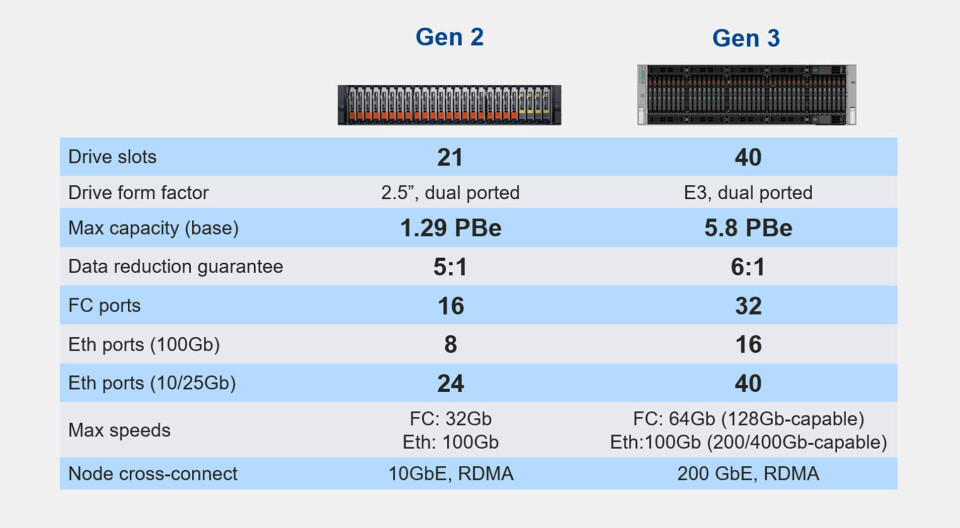
Density comes from up to 40 drives and 5.8 PB of capacity in a 3U chassis. There is DDR5 memory, support for PCI-Express 5.0 support, and a new 200 Gb/sec RDMA node interconnect for better load balancing and failover. The device has 40 network ports, twice the number as its predecessor, and support for 64 Gb/sec Fibre Channel and 100 Gb/sec Ethernet, and an internal fabric designed for 128 Gb/sec Fibre Channel and 200 Gb/sec and 400 Gb/sec Ethernet speeds. According to Dell, PowerStore Elite delivers three times the performance and a 6:1 data reduction, better than the 5:1 in the previous generation.
Every little bit helps when flash is very expensive and hard to come by.
Comparisons to PowerStore Gen 2 can be seen below:
There also were improvements to the Dell AI Data Platform, including enhanced orchestration and search capabilities for indexing unstructured files and connecting them to governed pipelines to speed up data discovery and dataset creation for AI. In addition, Dell added it PowerFlex software defined infrastructure to its Exascale Storage to support PowerFlex block, PowerScale and Lightning File System file storage, and ObjectScale object storage.
Dell isn’t the only IT vendor making an infrastructure push driven by AI innovation. HPE is making similar efforts with its hardware portfolio and GreenLake hybrid cloud platform, and Cisco Networks is pushing enhancements to its networking lineup. Others are doing the same.
It’s how Dell is putting it together that differentiates it, according to Noy. He pointed to Dell building its AI data platform to the specifications laid out by Nvidia last year and its orchestration platform that takes a storage system-agnostic approach.
“Every storage vendor understands that being an infrastructure vendor alone is not good enough. They have to actually provide a means by which you can actually extract value of that,” he said, zeroing in on the orchestration layer. “We’ve said that we made an architectural decision to build that above the storage layer because we know that not all of your data is going to live necessarily in our storage products. Some of it will live in the cloud, some of it live in structured databases, which might still be on Dell storage, but not necessarily in the unstructured. We want to be able to bring everything together so that you can have a much more holistic view of what you have.”
