

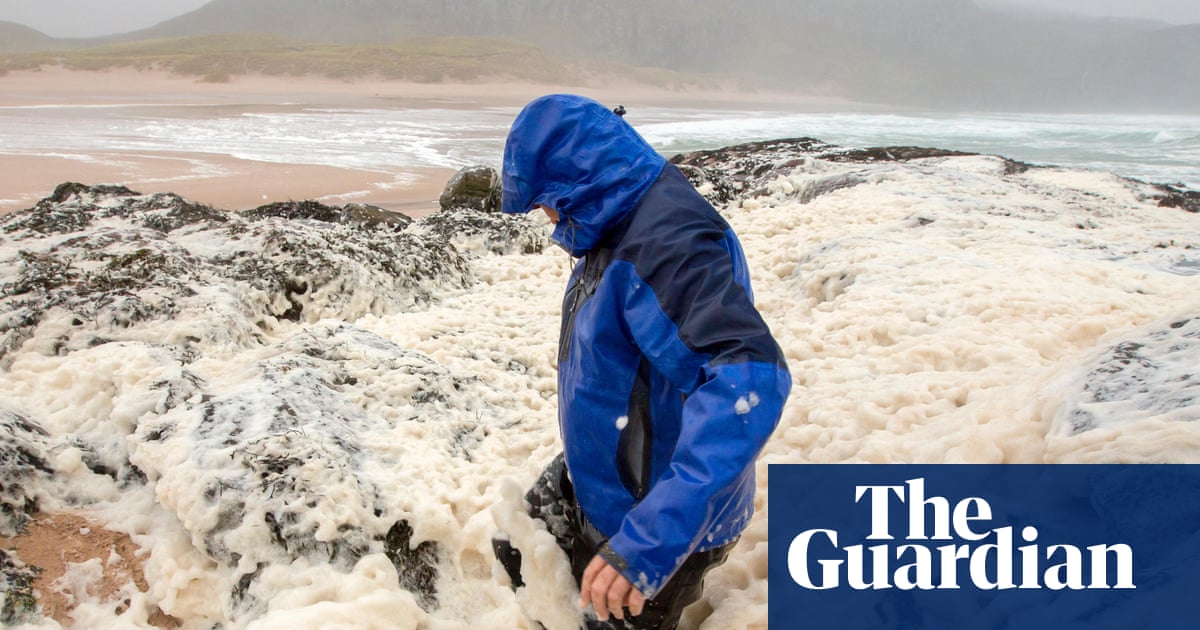
When the wind picks up on Fair Isle, Britain’s most remote inhabited island, puffs of seafoam start to drift across fields like tumbleweed. The pale yellow blobs are ubiquitous enough to hold their own place in the island’s mythology: known as the butter churned by a local troll, Lukki Minni.
“When the Atlantic gets going, foam covers the whole island,” says Tommy Hyndman, an artist who moved to the Fair Isle from upstate New York two decades ago. “Your windows get caked and your plants all die from the salt.”
As well as a familiar feature of rough weather, scientists now think seafoam and seaspray might hold the answer to a Fair Isle mystery. In 2024, utility data revealed that the wild outpost known for knitting and rare birds has higher levels of toxic Pfas – “forever chemicals” – than any other public drinking water in Scotland, despite there being no obvious industrial sources on the island.
The Guardian obtained readings for the individual Pfas behind that record, as well as documents from Fair Isle’s airstrip and community fire station. Half a dozen scientists – from Stockholm to Texas, by way of Liverpool and Aberdeen – reviewed the Guardian’s water data and agreed that Fair Isle’s forever-chemical fingerprint matched the mix of individual Pfas that probably arrived in seaspray and foam.
Pfas are often found near factories, fire stations, military bases and airports. Now scientists are finding them in remote coastal areas – not from any individual source but, they think, carried thousands of miles in seaspray and foam.
All Scotland’s public drinking water remains below official Pfas thresholds for safe consumption. But scientists say the data from Fair Isle and other coastal areas represents an alarming indication of our mark on the world’s seas, and of how ill-equipped the UK’s current monitoring system is to record its accumulation.
“We think of the ocean as the ultimate sink: the only really effective way to remove persistent pollutants,” says Bo Sha, an environmental chemist at Stockholm University who began researching how seaspray can collect and transport Pfas over vast distances almost a decade ago. “But with Pfas it’s like a pump that keeps pushing chemicals to the surface.”
That’s because, unlike other persistent pollutants such as PCBs and DDT, Pfas are highly surface active: attracted to the interface between water and air. A bubble travelling through seawater “harvests” Pfas towards it, Sha says, and in any given sample of seawater the seafoam floating above it would be expected to contain more Pfas than the water itself.
“Once airborne in bubbles or spray, the chemicals can then travel hundreds of kilometres in days,” says Sha. Pfas used far away could, once in the ocean, accumulate in Fair Isle – in such high proportions because the island is often exposed to stormy seaspray and is so small.
In a statement, Scottish Water suggested a fire at the island’s bird observatory in 2019 and fire-fighting foam at the small airstrip could be responsible for the high readings. Records from the fire show that no foam was used to extinguish the blaze, just seawater, and the National Trust for Scotland says it uses only a Pfas-free foam at the airport.
Fair Isle is not unique. Across Scotland, remote lochs from Orkney to the Western Isles would fail a proposed EU threshold for safe environmental levels of Pfas. On the other side of the North Sea, recent Danish studies have found Pfas accumulating in groundwater and lichens near the coast from seaspray and foam. Last year, scientists found Pfas had blown against the grain of prevailing ocean currents into Antarctic seabirds living in some of the most remote parts of the world.
Fair Islanders shared mixed reactions to the possible source of the chemicals. Kathy Coull, a traditional knitter and textile-maker, has been filtering her water each night since Pfas results were first published in 2024. Now she wants Scottish Water to do more to address what she calls “alarming” pollution at the island’s treatment facility.
“Water is one thing you can’t live without. To actively ingest something that’s not particularly good for you – it just makes sense to filter it out,” she says, adding that given the island’s levels she would support a programme of blood testing among local people. “Nobody wants to highlight it because of the negative effect it could have on tourism. But if we’ve got these high levels, do a trial on it.”
Dave Brackenbury, a retired engineer living at the island’s southern lighthouse, says he is “sceptical” about the dangers of Pfas, but that the Scottish environment protection agency (Sepa) should be monitoring Fair Isle more closely.
Sepa has not published any Pfas data since 2018, and has yet to release analysis from a programme of testing in 2025 despite promising those results would be available before the end of the year. “There’s nothing you can do about it but keep an eye on it,” says Brackenbury. “Sepa are a disappointment.”
A Sepa spokesperson says the agency is still undergoing “validation and verification checks” for that data, adding that it does not monitor airborne Pfas. This is in line with the rest of the UK, according to Andrew Sweetman, an environmental chemist at Lancaster University who helps run the Department for Environment, Food and Rural Affairs’ (Defra) official air monitoring network.
“There is no organised monitoring for Pfas in air; I’m hoping this year that will change,” says Sweetman, who plans to add airborne Pfas monitors into some of the network. Few of Defra’s sites were chosen in the 1990s with the oceans in mind. Only one, on the north coast of Norfolk, could begin regularly measuring levels of Pfas coming to the coast in seaspray.
“We are trying to think of a quick and dirty way of collecting that data,” Sweetman says. “And if you drew a straight line from that site there’s nothing between it and the Arctic Circle.”
Understanding exactly how much Pfas is arriving in seaspray on UK coastlines, is still only one part of the puzzle, he adds. “The question is then: does that matter, and what can you do? Because it’s too late – there are no pristine parts of our environment any more, anywhere. We have contaminated just about everywhere.”
In December the UK government promised to prioritise “work on a long-term plan”. Kimo, an environmental network of local authorities in Scandinavia, the Netherlands, Belgium and the UK, called this “inadequate” and published its own plan. Identify coastal areas at risk of seaspray, it told local governments, and start moving livestock, farms and wells inland.
Sitting in the old laird’s house on Fair Isle, Hyndman is only a few hundred metres away from the coast. He is not surprised that pollution could arrive somewhere so remote; he sees plastic wash up most days. Still, for someone who moved to Fair Isle “to get away from it all”, the reach of our impact on the natural world has made an impression.
“We all live within the environment, and that’s being attacked by pollution wherever you are,” he says. “That’s the world we live in and it’s scary as shit.”
