

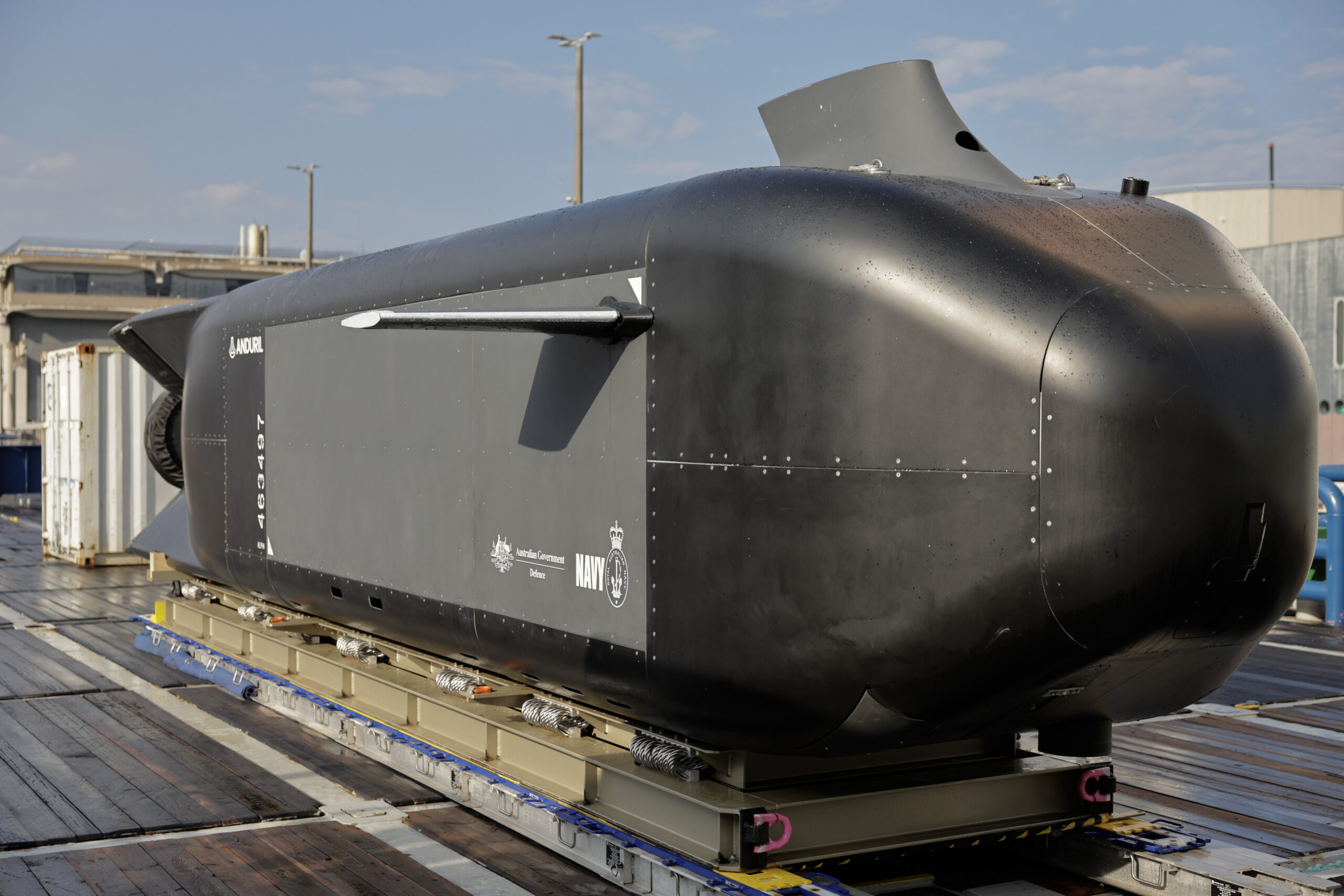
With the ‘signature project’ on payloads for uncrewed undersea vehicles (UUVs) announced by Australia, Britain and the United States on 30 May at the Shangri-La Dialogue, AUKUS Pillar Two transitions from scientific potential to realising operational military capabilities.
If the partners meet their announced capability delivery target of 2027 – a big if – AUKUS Pillar Two will not only step out of the shadows of Pillar One’s nuclear-propelled submarines but increase confidence in those vessels. It will also improve interoperability of the three countries in undersea warfare.
The project isn’t about new uncrewed underwater craft: each AUKUS partner is already working on its own. Rather, it focuses on developing shared technology that will enable such vessels to navigate, detect and attack. So, it’s about progressing from just testing autonomous submarines, such as the Anduril Ghost Shark and C2 Robotics Speartooth, to ensuring they can work together to protect critical underwater infrastructure and counter undersea warfare threats.
Australia’s deputy prime minister and defence minister, Richard Marles, told the Dialogue that for too long nations had not recognised that the seabed was a ‘strategic target’ for adversaries – by which he no doubt meant China and Russia. British Defence Secretary John Healey acknowledged that ‘for too long on AUKUS we have talked too much and delivered too little.’
The AUKUS partners were making it clear that they were working together to both identify threats and deliver capabilities needed to ‘detect, deter and deal with’ them.
Marles highlighted the maritime domain as where strategic contest is most acute. Significantly, he identified the seabed and subsea critical infrastructure as a key concern. Australia had to defend fifteen submarine cables through which almost all Australia’s internet traffic flowed, he said. Some smaller Pacific nations rely on just one cable. Without the cables, digital connectivity is lost, and so are the ways our modern economy and society work.
The best way to do this is to patrol submarine cables with swarms of uncrewed autonomous vessels, freeing up crewed submarines to operate forward in our maritime approaches and beyond.
To do this, it also makes sense to invest in networked undersea sensors, such as seabed sonar arrays, and uncrewed surface vessels, such as the Ocius Bluebottle, which can be bought cheaply in great numbers and act as communications gateways to uncrewed underwater vessels below. These can be the enablers of a networked undersea battlespace.
An ability to effectively undertake undersea warfare demands assured underwater situational awareness, presence and connectivity. The announcement last year that the government was pursuing acquisition of Ghost Shark uncrewed submarines was a first important step towards a new paradigm for undersea operations. The payloads project announced at Shangri-La is that next step.
Such craft are essential in a more complex and challenging undersea battlespace. But to defend undersea infrastructure they must have sensors, weapons and resilient connections to command-and-control networks.
The Australian Strategic Capabilities Accelerator tested necessary technologies for this in its Maritime Big Play exercise this year. The new announcement likely means testing will accelerate to ensure that UUVs can connect with networks ashore, so humans can oversee, manage and, if necessary, directly control them.
This demands such UUV payloads as sonars (passive and active) and other sensors. Objectives would include using such sensors near the surface. Periscopes may gather optical pictures; radio sensors could pick up signals from communications and radars. Payloads could also include weapons – mines and torpedoes – which the UUV would use only under human control, consistent with Australia’s obligations under international humanitarian law. Again, resilient connectivity would be a must.
Enablers could include resilient satellite communications networks that connect through nodes in aircraft or surface vessels, not necessarily crewed, to a UUV below the waves. High bandwidth radio communications are not possible underwater, which is why crewed submarines often rely on low-bandwidth, very low frequency (VLF) transmissions. That’s not suitable for managing groups of UUVs working together on a task such as countering a threat to a submarine cable.
But laser communications can connect with crewed or uncrewed submarines down to around 70 metres. Another possibility might be quantum communications technologies. It’s notable that quantum technology is also an AUKUS Pillar Two focus.
This first signature project under AUKUS Pillar Two will make us more secure under the sea, keep us resilient on land and future proof the partnership for when our nations need it most.
The Pillar Two announcement followed a meeting at Shangri-La between the Australian, British and US defence ministers. In previous years, such a defence technology announcement at Shangri-La might have seemed overly provocative. The establishment of AUKUS in 2021 was initially met with concern in much of Southeast Asia, aided by Chinese propaganda.
The overwhelming message from many nations at this year’s dialogue was that, while they didn’t want simmering tensions to boil over into regional conflict, deterrence of aggression needed collective action, not inaction. This was the partners in AUKUS expressing its value as a mechanism for regional security, not instability – aided perhaps by China’s absence and therefore inability to interfere. As Philippines Secretary of National Defence Gilberto Teodoro noted, what was needed was ‘more convergence partners for deterrence’.
