

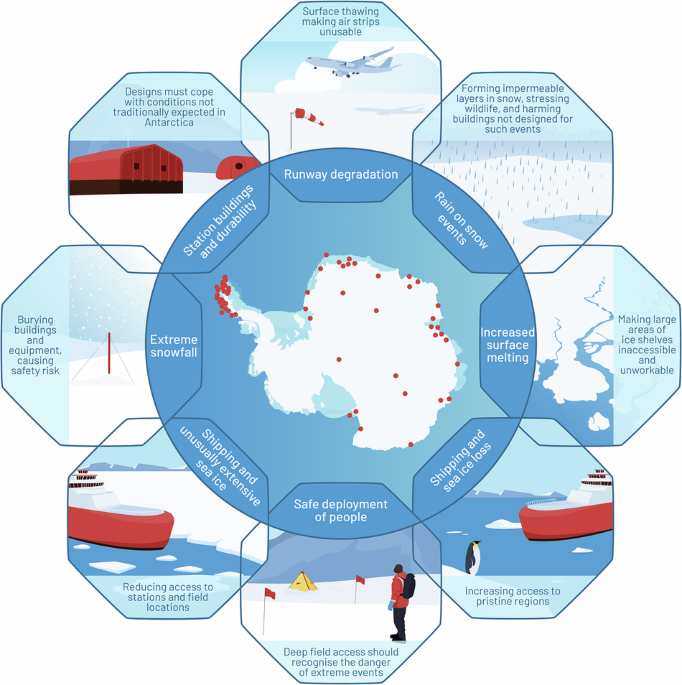
Science in Antarctica has until now largely escaped serious disruption due to extreme events – with the obvious exception of COVID-1915—but that is not to say it has been unaffected or that increased effects are unlikely in future.
Risks to station buildings
The first period of substantial continent-wide Antarctic station construction occurred in the build up to the International Geophysical Year (1957/58), when some of the largest Antarctic stations were built. In the following decades further stations were established by nations often associated with their efforts to attain consultative status under the Antarctic Treaty, which gives them voting rights in Antarctic governance. Today, more than 80 stations are operated by c. 31 Antarctic Treaty Parties, with around 50% located on the Antarctic Peninsula and Scotia Arc South Shetland Islands and South Orkney Islands16. Most are pragmatically located on climatically less extreme and accessible coastal and ice-free locations, facilitating resupply by sea, although a small number are located inland and constructed on permanent ice. National governments are increasingly taking climate change and extreme events into consideration as they construct new or redevelop existing stations. In a 2018 survey of the Council of Managers of National Antarctic Programs (COMNAP) member countries, 73% were undertaking station modernisation works and, of them, 22% cited climate change as the main reason17. More recently, COMNAP, an ideal forum for sharing information on building design and for disseminating lessons that can be learnt from experience both in Antarctica and from the Arctic, has provided an assessment of infrastructures in a changing Antarctica, where national Antarctic programmes were encouraged to continue to share their technical and practical expertise18.
Buildings in Antarctica have always needed to cope with the extreme conditions that exist there. In recent decades, however, the impacts of warmer, wetter and more humid conditions mean buildings (bar those on the ice sheet plateaux) must now be able to deal with flooding events, heavy rainfall or snow melt, large snow loads, and be constructed of materials that are resistant to wet rot. Under EEEs this problem will be exacerbated. For example, coastal stations may even need to be protected from the possibility of lightning strikes—an issue that has seldom been considered in Antarctica. Designers and managers must solve the problem of stabilising buildings located on thawing permafrost19 and select locations that are not vulnerable to sea level rise impacts (although isostatic rebound and reduced gravitational influences may reduce the risk in some locations)20. Increasing temperatures have reduced the stability of the ice-piers constructed annually at McMurdo Station, that has now been replaced by a barge pier21,22. At some stations, extreme weather conditions have accelerated the degradation of building materials such as insulation and sealants23. Shoreline erosion resulting from more frequent storms and reduced ice cover has resulted in modernisation work and construction of coastal defences at a number of stations, including beach reinforcement with eco-friendly blocks to reduce the erosion18,23. Furthermore, altered precipitation patterns and hydrography may mean stations can no longer rely upon freshwater lakes and streams for their water supplies24. Climate change and changing EEEs may result in the emergence of once-buried station buildings and abandoned waste dumps, which can result in further dispersal of waste and/or mobilisation of pollutants25,26,27.
Conditions of airstrips
Access to Antarctica and to deep field locations often requires the use of aircraft. While some airstrips are prepared using a crushed rock surface on solid ground, others are on either floating or grounded ice. Remote operations relying on ski-equipped aircraft (generally smaller types such as the de Havilland Twin Otter, Basler BT-67 or Dornier 228) commonly land on unprepared and unsurveyed locations. EEEs can affect each of these runway types through snow accumulation, strong (cross) winds and poor visibility, all of which can reduce the operational window. At the Rothera Research Station rock airstrip, the formation of a solid ice layer on the runway surface has delayed planned aircraft movements by up to 6 weeks, with serious consequences for programme operations. The British Antarctic Survey is currently undertaking an environmental impact assessment on use of de-icer on the runway, but this will need to adhere to the Antarctic Treaty’s strict environmental protection guidelines (relating to the release of chemicals into the environment) before use. On ice, McMurdo Station has previously relied on an operational runway on sea ice; however, although still commissioned, it has remained unused since the 2010s due to limitations in sea ice stability28. Flights were moved to its Pegasus airstrip—an established compacted snow runway on a nearby ice shelf—which itself ceased operations in 2016 due to excessive summer melting. Flights are now more regular at Williams Field, which currently has a more robust season-long schedule. At Wilkins Aerodrome, serving Casey Station, another compacted snow runway, this time on grounded ice, excessive summer melt has reduced the number of flights possible. Initially planned at one flight per week (around 20 per season), this number is seldom reached. In fact, from 2011 the runway has been temporarily unusable each season due to melting. Summer surface snow melt and exposure of crevasses have halted use of the snow airstrip near Teniente Carvajal station at the southern edge of the Fuchs Ice Piedmont, Adelaide Island, necessitating the search for possible new locations of crevasse-free runways at higher elevations29. While on-ice runways are essential for Antarctic research, they are vulnerable to extreme weather and climate conditions and, as temperatures and extreme events increase in intensity and frequency, they are likely to suffer further vulnerability and restrictions. With increasing EEEs, an inability to predict accurately snow and ice mechanics at temperatures around melting point, as well as greater variability in snow temperature and thickness, may increasingly comprising runway stability and use30.
Surface water and field operations
Away from established runways and stations, summer snow melt leading to slush accumulation on ice/snow surfaces provides a further challenge to remote air-supported deep field operations, as well as to ground travel relying on vehicles such as snowmobiles. At the extreme, considerable ‘ponding’ of water can occur on ice shelves, as seen in recent years on Larsen A, B and C, in ways associated with sudden shelf collapse31. Extensive melting on George VI Ice Shelf12 presents an added danger through being connected by an extensive network of sometimes deep and fast-flowing drainage systems, including sink holes draining through the ice. Extensive summer snow melt has increasingly temporally limited operational aircraft landing access for operators supporting field parties in the South Shetland Islands and northern Antarctic Peninsula since at least the late 1990s (e.g. the closure of the Damoy Point transit facility near Port Lockroy in 1993).
In terms of operational ability to support the required regular maintenance of key long-term scientific activities, a pertinent example is provided by the British Antarctic Survey’s inability to land aircraft in order to access Mars Oasis on southern Alexander Island since the mid-2010s. The site has since 2000 been the location of one of very few year-round long-term biological microenvironmental monitoring stations anywhere in Antarctica, and the furthest south location at low altitude in the Antarctic Peninsula32. However, it has suffered from the combination of increasingly early and rapid snow melt on the adjacent Mars Glacier surface, and the increasing extent of ponding and melt stream activity on the nearby part of George VI Ice Shelf. Consequently, Mars Oasis had not been successfully visited since the 2015/16 season, with the decision being taken in 2025 to abandon and clear the site (achieved in November 2025), and intention to redeploy at a location close to Fossil Bluff in a subsequent season. However, Fossil Bluff itself, while a long-established British Antarctic Survey ‘forward operational support facility’, also relies on an unprepared snow skiway that faces periods of extensive slush formation. Furthermore, access to its small station building located on the lateral moraine on eastern Alexander Island has faced periods of severe obstruction by the formation of extensive and deep seasonal melt lakes along the edge of the moraine. The disruption to, and ultimately loss of, such a substantial long-term monitoring programme through rapidly increasing operational constraints caused by climate change and EEEs constitutes a serious scientific programme impact. More work is needed to understand the development of, and gradients in, slush in order to plan field operations in future.
The switch of summer precipitation from snow to rain in the northern and central Antarctic Peninsula and Scotia Arc archipelagos compound these melt-related challenges. Further impacts are provided by thaw events occurring with more frequency in winters. Thaw events can lead to hard but potentially brittle ice layers forming within the snowpack and/or on the underlying ground surface. At the extreme, this can lead to the replacement of snow cover with an impenetrable ice layer that can strongly affect the thermal regime of the underlying soil/habitats and restrict/stop oxygen transfer. In the Arctic, these processes are compounded by increasing frequency and intensity of winter ‘rain-on-snow’ (RoS) events, which can lead to rapid and extensive loss of snow cover and formation of thick ground surface ice layers33. As well as potentially wide-ranging and negative consequences for soil ecosystems and their contained and dependent organisms, such events also generate travel safety risks for human communities and operations. While such winter RoS events are yet to be documented in the Antarctic Peninsula region, winter thaws and ice layer formation have long been documented at Signy Island (South Orkney Islands)34 and are likely increasing in frequency.
Ships and ocean access
Changes in sea ice thickness, duration and extent are having substantial impacts upon Antarctic shipping activities, affecting national Antarctic programmes and the tourism and fishing industries. Sea ice decline may facilitate access to Antarctic research stations and visitor sites for more of the year, as has been modelled for tourist landings in the western Antarctic Peninsula under different climate scenarios35. Growing levels of Antarctic ship traffic may increase environmental impacts, including through the introduction of marine non-native species36,37, additional ship emissions38,39 and black carbon40, and the potential for shipping accidents, especially from non-ice strengthened vessels that may encounter sea ice conditions with which they are not equipped to deal. Sea ice decline may facilitate access of ship-borne tourists and researchers to new remote locations with associated increases in human footprint41,42 and environmental impacts such as trampling, pollution, wildlife disturbance and the introduction or dispersal of non-native species and wildlife pathogens43,44.
Changes in sea ice can also impact Antarctic ship operations. For example, low sea ice has recently facilitated operations in winter with, for example, the UK’s RRS Sir David Attenborough and Chile’s Almirante Viel having undertaken Antarctic research station visits and oceanographic and marine biological research during the early and late 2025 winter period, respectively. Conversely, late sea ice breakup can delay ship access to research stations45. These impacts depend strongly on local sea ice conditions, and while recent declines have been marked by relative homogeneity46, sea ice anomalies often have strong compensating regional signals, with even recent low years marked by temporary, locally extensive sea ice conditions, such as in the western Amundsen Sea in July 202347.
Furthermore, unexpected changes in ice shelf and multi-year sea ice extent have resulted in the loss of depoted fuel and equipment, as well as hindering station resupply48,49. Sea ice extent also affects where and when fishing occurs. For example, in many years sea ice has restricted krill fishery operations around the South Orkney Islands, leading to relocation of the fishing fleet50. Conscious of the potential environmental risks associated with sea ice decline, policymakers within the Antarctic Treaty System (ATS) have tasked the Subsidiary Group on Climate Change Response to consider the issue further51.
Assurance on health and safety
EEEs have substantial consequences for the health and safety of those engaging in Antarctic science and operations, and indeed on tourism and fishing. Increasingly unpredictable sea ice conditions mean that the risks associated with travel over sea ice, including by over-ice vehicles, have increased and the practice is often now prohibited for safety reasons. Access by shipping to new uncharted waters as a consequence of sea ice decline and ice shelf collapse increases the risk of shipping incidents and associated pollution events. Furthermore, national Antarctic programmes may have reduced confidence in the reliability of what were routinely used off-load sites on ice shelves; greater monitoring efforts are now made to provide assurance that sites are sufficiently safe with ship times alongside being kept to a minimum. Changing temperature regimes, particularly during earlier periods of the summer season, may result in increased risks of rock/ice fall and avalanches at sites that were previously considered stable and predictable. Variable precipitation patterns and increasing air temperatures may reduce snow fall and increase ice melt, respectively, resulting in the elimination of once safe over-ice travel routes due to crevasse risk. This has occurred at Rothera Research Station where the route linking the coastal research station with a snow skiway on the adjacent inland ice piedmont has become temporarily (possibly permanently) impassable due to the opening of crevasses, and the ice ramp adjacent to the station becoming too steep and icy for vehicles to use safely for large parts of the year52,53. This also has important implications for station personnel morale as the skiway provides a means to ‘get away’ from the station, and its closure represents a loss of recreation options, especially for those who are on station for several months or more.
The risks and mitigations of ensuring deep field access
Understanding key glacial processes requires access to extremely remote locations. Numerous examples of deep-field sites have delivered outstanding scientific advances, but such science relies on the ability to safely deploy, operate and recover staff (including in unplanned situations such as requirement for medevac), equipment and fuel. Such work can be considered as being at the end of the logistics chain, involving ships, aircraft and stations, all of which – as we note above – have been and are likely to be increasingly impacted by future EEEs. Planning deep-field activities is complex under normal circumstances but, with the challenges of extreme weather and the (in)ability to supply specific sites, further complexity is added. There is no doubt that science will continue to demand access to remote field locations in future, but planning such research is likely to be impacted by EEEs in ways that may make such work ever more challenging to accomplish.
Some mitigations exist, however. For example, use of longer-range aircraft and drones, rather than types that require deep-field fuel caches, could de-risk airborne observations. Reduced human presence in general, if the science can be achieved through remote means, is likely to be encouraged in future. Use of remotely operated and autonomous devices is likely to become an increasingly major theme of investigation, where these are practically applicable. When it is necessary to deploy personnel, international collaboration for field access is a further means to reduce uncertainty, through increased routes and services, although bringing other challenging practical constraints, such as compatibility of operational and health and safety procedures, and the prevalence of post-COVID protectionism through lack of confidence in the ability to rely on other operators15.
