
LIVE NEWS
  • Women’s T20 World Cup: Danni Wyatt-Hodge on scoring ‘mummy’ hundred
  • Google unveils DiffusionGemma, an AI model that breaks free of left-to-right processing
  • Alaska’s glaciers have a startling response to rising temperatures
  • Blue state Dems accused of putting sanctuary policy over migrant child welfare checks
  • New proposal would close Medicare drug price negotiation loophole
  • Nvidia preps to sell its Vera CPUs into China as its GPU sales stay frozen — customers encouraged to place orders for CPU shipments as early as August
  • U.S. citizen arrested in China ID’d as Min Zin, Myanmar analyst : NPR
  • SPCX Solana Launch Same Day
Prime Reports
  • Home
  • Popular Now
  • Crypto
  • Cybersecurity
  • Economy
  • Geopolitics
  • Global Markets
  • Politics
  • See More
    • Artificial Intelligence
    • Climate Risks
    • Defense
    • Healthcare Innovation
    • Science
    • Technology
    • World
Prime Reports
  • Home
  • Popular Now
  • Crypto
  • Cybersecurity
  • Economy
  • Geopolitics
  • Global Markets
  • Politics
  • Artificial Intelligence
  • Climate Risks
  • Defense
  • Healthcare Innovation
  • Science
  • Technology
  • World
Home»Science»Scientists reveal surprising mechanism behind Venus flytrap’s rapid snap | Biology
Science

Scientists reveal surprising mechanism behind Venus flytrap’s rapid snap | Biology

primereportsBy primereportsJune 11, 2026No Comments3 Mins Read
Share Facebook Twitter Pinterest LinkedIn Tumblr Reddit Telegram Email
Scientists reveal surprising mechanism behind Venus flytrap’s rapid snap | Biology
Share
Facebook Twitter LinkedIn Pinterest Email


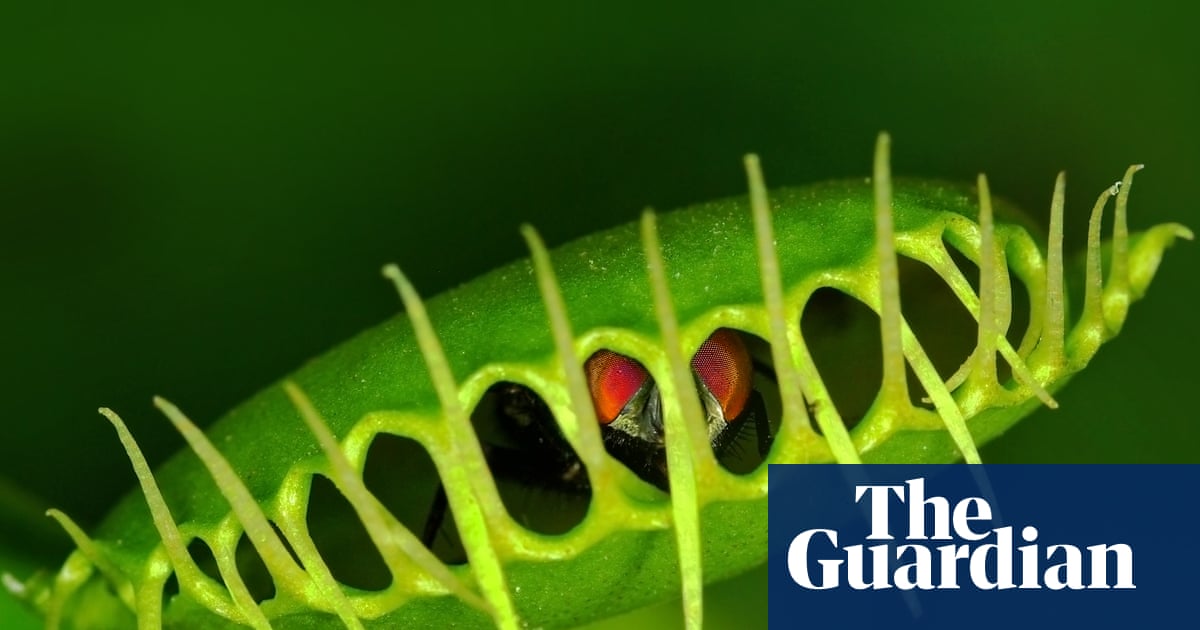
The Venus flytrap is one of nature’s most impressive predators, luring insects with the intoxicating scent of nectar before capturing them with a snap of its jaw-like leaves.

Now, scientists have revealed the mechanism that allows the carnivorous plant to react with lightning speed, resolving a problem that stumped Charles Darwin and many researchers after him.

In an intricate series of experiments, scientists found that a hair-trigger detection causes the cells on the outer surface of the leaf to soften. This prompts the flytrap to flip into a closed position within a second of a bug landing on the leaf.

“When Darwin saw these plants move so fast, he was convinced that the plant had a muscle inside, but plants do not have muscles and they do not have nerves,” said Dr Yoël Forterre, a physicist at the French National Centre for Scientific Research (CNRS) and Aix-Marseille University and senior author of the research. “For more than a century there have been many hypotheses. It’s very surprising that plant cell walls can tune their mechanical properties so fast.”

A key challenge, Forterre said, was making physical measurements of such a finely tuned system that moves incredibly quickly. “As soon as you perturb it, it closes,” he said. “If you close it accidentally with a drop of water, it will close and then reopen the next day. If it catches an insect, it has to digest it and dissolve the skeleton, which will take several weeks.”

Forterre and colleagues performed a series of experiments in which the plant’s leaves were carefully immobilised using dental glue, meaning the trap could be triggered to shut but remained stationary. Venus flytraps typically have three trigger hairs on each lobe of their trapping leaves, and previous work has shown that bending the hairs prompts an electrical signal to spread across both sides of the trap within one-tenth of a second.

The latest research used a device called a nanoindenter, a metal tip, to poke the outer surface of the leaf to measure its pressure. “It gives you the same feeling of stiffness as if you poke a balloon with your finger,” Forterre said.

This showed that the leaf’s outer surface softened immediately after the trap was activated. Measurements of the leaf’s topology showed that this was due to the cells becoming more flexible rather than them deflating due to the movement of water within the leaf, which had previously been the leading hypothesis. The mechanism is similar to how a dome-shaped rubber popper toy spontaneously flips when placed on a surface.

“I’m not aware of any other plants with this kind of very rapid change of mechanical properties of the cells,” Forterre said.

Forterre first became intrigued by the mechanics of Venus flytraps when a former colleague brought one into the lab. “As a physicist, I thought we should understand the motor, the forces,” he said. “I’ve been obsessed by this for 20 years.”

He added: “Plants are just amazing. It makes you realise how all plants can sense their surroundings, transport information, react, defend themselves, feed.”

The findings are published in the journal Science.

Share. Facebook Twitter Pinterest LinkedIn Tumblr Email
Previous ArticleDemocrats demand Trump ‘guarantee’ Bill Pulte will not serve as acting intelligence director after Clayton nomination – US politics live | US politics
Next Article An obesity drug deep-dive, and peptides move mainstream
primereports
  • Website

Related Posts

Science

A popular sunscreen ingredient can finally be sold in the United States

June 12, 2026
Science

These tiny holes could change how the world cleans water

June 12, 2026
Science

My quiet obsession with satellites — and how they’re ruining everything

June 12, 2026
Add A Comment
Leave A Reply Cancel Reply

Top Posts

Paxton’s win over Cornyn sets up high-stakes Texas clash with Talarico

May 28, 202616 Views

Global Resources Outlook 2024 | UNEP

December 6, 202510 Views

Texas Democrat Talarico claims voting laws are rigged ahead of Paxton race

May 28, 20269 Views
Stay In Touch
  • Facebook
  • YouTube
  • TikTok
  • WhatsApp
  • Twitter
  • Instagram
Latest Reviews

Subscribe to Updates

Get the latest tech news from FooBar about tech, design and biz.

PrimeReports.org
Independent global news, analysis & insights.

PrimeReports.org brings you in-depth coverage of geopolitics, markets, technology and risk – with context that helps you understand what really matters.

Editorially independent · Opinions are those of the authors and not investment advice.
Facebook X (Twitter) LinkedIn YouTube
Key Sections
  • World
  • Geopolitics
  • Popular Now
  • Artificial Intelligence
  • Cybersecurity
  • Crypto
All Categories
  • Artificial Intelligence
  • Climate Risks
  • Crypto
  • Cybersecurity
  • Defense
  • Economy
  • Geopolitics
  • Global Markets
  • Healthcare Innovation
  • Politics
  • Popular Now
  • Science
  • Technology
  • World
  • About Us
  • Contact Us
  • Privacy Policy
  • Terms & Conditions
  • Disclaimer
  • Cookie Policy
  • DMCA / Copyright Notice
  • Editorial Policy

Sign up for Prime Reports Briefing – essential stories and analysis in your inbox.

By subscribing you agree to our Privacy Policy. You can opt out anytime.
Latest Stories
  • Women’s T20 World Cup: Danni Wyatt-Hodge on scoring ‘mummy’ hundred
  • Google unveils DiffusionGemma, an AI model that breaks free of left-to-right processing
  • Alaska’s glaciers have a startling response to rising temperatures
© 2026 PrimeReports.org. All rights reserved.
Privacy Terms Contact

Type above and press Enter to search. Press Esc to cancel.