

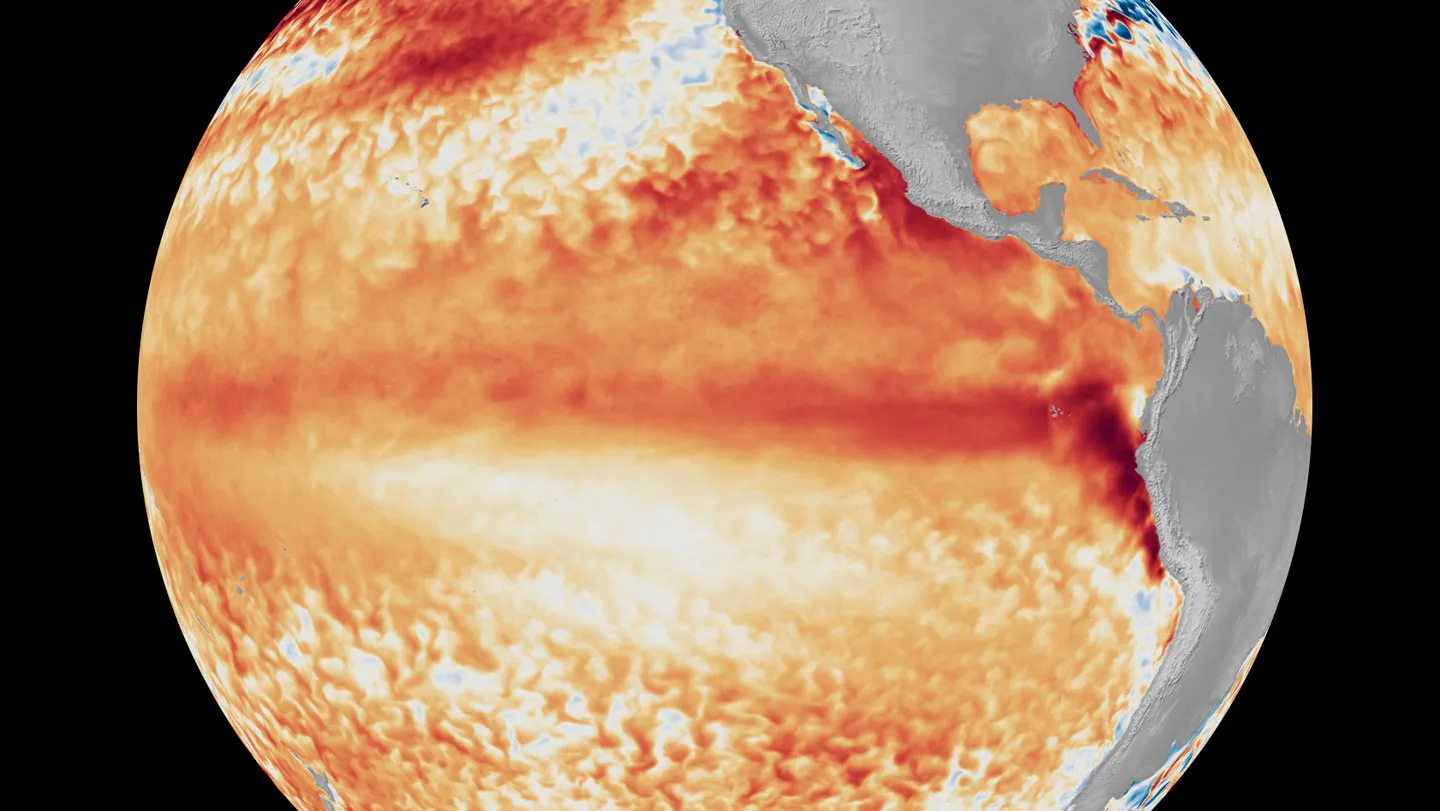
El Niño is here. And buckle up for a bumpy ride, scientists say: By the end of 2026, this might become the strongest El Niño on record.
On June 11, the U.S. National Oceanic and Atmospheric Administration confirmed that Earth has officially entered the “warm” El Niño phase of a roughly two- to seven-year ocean-climate pattern known as the El Niño Southern Oscillation, or ENSO.
El Niño events affect weather patterns globally — and the stronger they are, the more disruptive they can be to human health, agriculture and infrastructure. Forecasters currently predict a 63 percent chance that by the winter, this event will become a “very strong” El Niño, sometimes called a “super El Niño”.
Here are three things to know as this climate pattern takes hold.
What’s an El Niño?
The El Niño phase of ENSO (in contrast to a neutral or La Niña phase) is characterized by months of warmer than normal sea surface temperatures in the eastern equatorial Pacific. Peruvian fishermen in the 1600s noticed this warming often occurring around Christmas time, and dubbed the phenomenon “El Niño,” which means “little boy” or “the Christ child” in Spanish.
“Southern Oscillation” refers to a seesaw between zones of high atmospheric pressure and low atmospheric pressure over the eastern Pacific Ocean and western Pacific Ocean. That seesawing triggers changes in atmospheric circulation, air temperature and precipitation on a global scale.
Scientists track these air pressure changes at two main weather stations — in Darwin, Australia (in the west) and French Polynesia’s Tahiti (in the east). During the neutral and La Niña phases, the high-pressure zone is in the east, so that prevailing winds blow westward across the equatorial Pacific Ocean. The winds push the warm surface waters of the Pacific westward, away from the coast of the Americas, allowing cold, nutrient-rich water to well up from the deep ocean. That keeps the eastern equatorial Pacific waters cold.
But every few years, there’s a flip, with high pressure over the western Pacific, and lower pressure over the eastern Pacific. That weakens or even reverses the direction of the prevailing winds, allowing the warm surface waters to stay in place — and effectively suppressing the upwelling cold water. Sea surface temperatures warm rapidly in the eastern Pacific, signaling the onset of an El Niño phase.
No two El Niño events are exactly alike, says Tom Di Liberto, a climate scientist with the nonprofit climate news organization Climate Central who is based in Washington, D.C. But what they all have in common is that they transfer a huge amount of heat from the tropical Pacific to the atmosphere. And that burst of heat can dramatically raise global temperatures during the event.
What would make this year’s event “super”?
An El Niño phase officially starts when sea surface temperatures in the eastern equatorial Pacific Ocean are persistently at least 0.5 degrees Celsius above average for several months. The warmer the waters are, the stronger the impacts are likely to be. Waters warmer than 2 degrees C above average signal the onset of a very strong, or “super” El Niño.
Since April, researchers have been observing persistently above-average temperatures over the eastern equatorial Pacific Ocean, and dozens of forecasts around the world predicted that El Niño was imminent. By June, as the ocean continued to warm, those forecasts began to predict that it would be a strong event.
Climate change has made detecting temperature anomalies that signal an El Niño’s onset and strength more difficult, due to uneven warming from region to region. So in May, NOAA’s Climate Prediction Center adopted a new tool for its El Niño forecast called the Relative Ocean Niño Index that adjusts for climate change–related warming.
Using this new metric, NOAA predicts that this winter, sea surface temperatures in the eastern tropical Pacific are 63 percent likely to be more than 2 degrees Celsius higher than average this winter, signaling the onset of a super El Niño.
Climate simulations are forecasting “shockingly high” global temperatures for November and December, Di Liberto says. Such heat can have deadly consequences, not only due to heat-related illnesses, but also upticks in pest-borne diseases such as cholera, typhoid and malaria.
In addition to raising global temperatures, El Niños alter the position of the Pacific jet stream, meaning some areas become drier, while others become wetter. For the United States, one of the most significant impacts is on tropical cyclones: While El Niño years typically can mean more numerous and intense cyclones in the Pacific, changing wind regimes can hamper hurricane formation in the Atlantic.
That said, the life cycle of an El Niño is relatively short: The events typically form in the summer, strengthen into the winter, then die out in the spring.
How will this year stack up to past powerful El Niños?
The most recent strong El Niños happened in 2015–2016, 1997–1998 and 1982–1983.
The 1997–98 event was the strongest on record. It raised the average global temperature for that period by 1.5 degrees Celsius, and led to devastating extreme weather events. Those included torrential rains and floods in Peru and East Africa that in turn triggered an outbreak of Rift Valley fever in the region; droughts that kicked off deadly wildfires in Southeast Asia; powerful storms that resulted in catastrophic flooding and landslides in California. Soaring ocean temperatures caused bleaching in about 16 percent of the world’s coral reefs.
Such strong El Niños leave a long mark on the global economy, researchers reported in 2023 in Science. Global economic losses attributed to the 1997–98 event are estimated to be about $5.7 trillion. The 1982–83 event cost the world an estimated $4.1 billion.
Whether this year’s event will reach super status is not yet certain. But because the event is occurring on top of already rapidly warming global temperatures due to human-caused climate change, its impacts will likely be dramatic even if the event turns out only to be moderately strong, Di Liberto says. “It would not take a very strong El Niño to see records broken this year.”
