LIVE NEWS
  • Fleet of Vespas swarms Rome’s historic center to mark 80 years of the iconic scooter
  • Wall Street’s Next Tokenization Test: BlackRock-Backed Securitize’s Market Debut
  • AI Decline? Confidence Falls in Autonomous Penetration Testing
  • SpaceX will join Nasdaq-100
  • Childhood interrupted: Family awaits justice 8 years after baby was raped | Sexual Assault
  • Strong growth but rising inflation risks – HSBC
  • US strikes Iranian missile, drone, radar sites
  • Science news this week: Life on Mars, weird water and a curious human cousin
Prime Reports
  • Home
  • Popular Now
  • Crypto
  • Cybersecurity
  • Economy
  • Geopolitics
  • Global Markets
  • Politics
  • See More
    • Artificial Intelligence
    • Climate Risks
    • Defense
    • Healthcare Innovation
    • Science
    • Technology
    • World
Prime Reports
  • Home
  • Popular Now
  • Crypto
  • Cybersecurity
  • Economy
  • Geopolitics
  • Global Markets
  • Politics
  • Artificial Intelligence
  • Climate Risks
  • Defense
  • Healthcare Innovation
  • Science
  • Technology
  • World
Home»Science»Science news this week: Life on Mars, weird water and a curious human cousin
Science

Science news this week: Life on Mars, weird water and a curious human cousin

primereportsBy primereportsJune 27, 2026No Comments7 Mins Read
Share Facebook Twitter Pinterest LinkedIn Tumblr Reddit Telegram Email
Science news this week: Life on Mars, weird water and a curious human cousin
Share
Facebook Twitter LinkedIn Pinterest Email


This week, we’ve taken one tantalizing step closer to finding out if there really was life on Mars, after NASA‘s Perseverance rover uncovered the highest concentration of organic molecules on the Red Planet to date.

The data comes from mudstones in Jezero crater, which once hosted a deep lake. Last year, researchers described a piece of rock with patterns resembling those left by microorganisms on Earth as one of the clearest signs yet of past Martian microbes.

Now, scientists have confirmed the widespread presence of complex carbon-based molecules in this area of the crater, which they suggest indicate the presence of fossilized microbes.

Going even further back in history, new observations from the James Webb Space Telescope (JWST) have revealed how early galaxies lived fast and died young, offering a possible preview of our own galaxy’s death.

Elsewhere in space, JWST captured the formation of a distant star, 1,280 light-years away in the constellation Orion, while the Euclid space telescope snapped the most detailed photo of the Milky Way ever taken.

Weird human cousin gets even weirder

Science news this week: Life on Mars, weird water and a curious human cousin

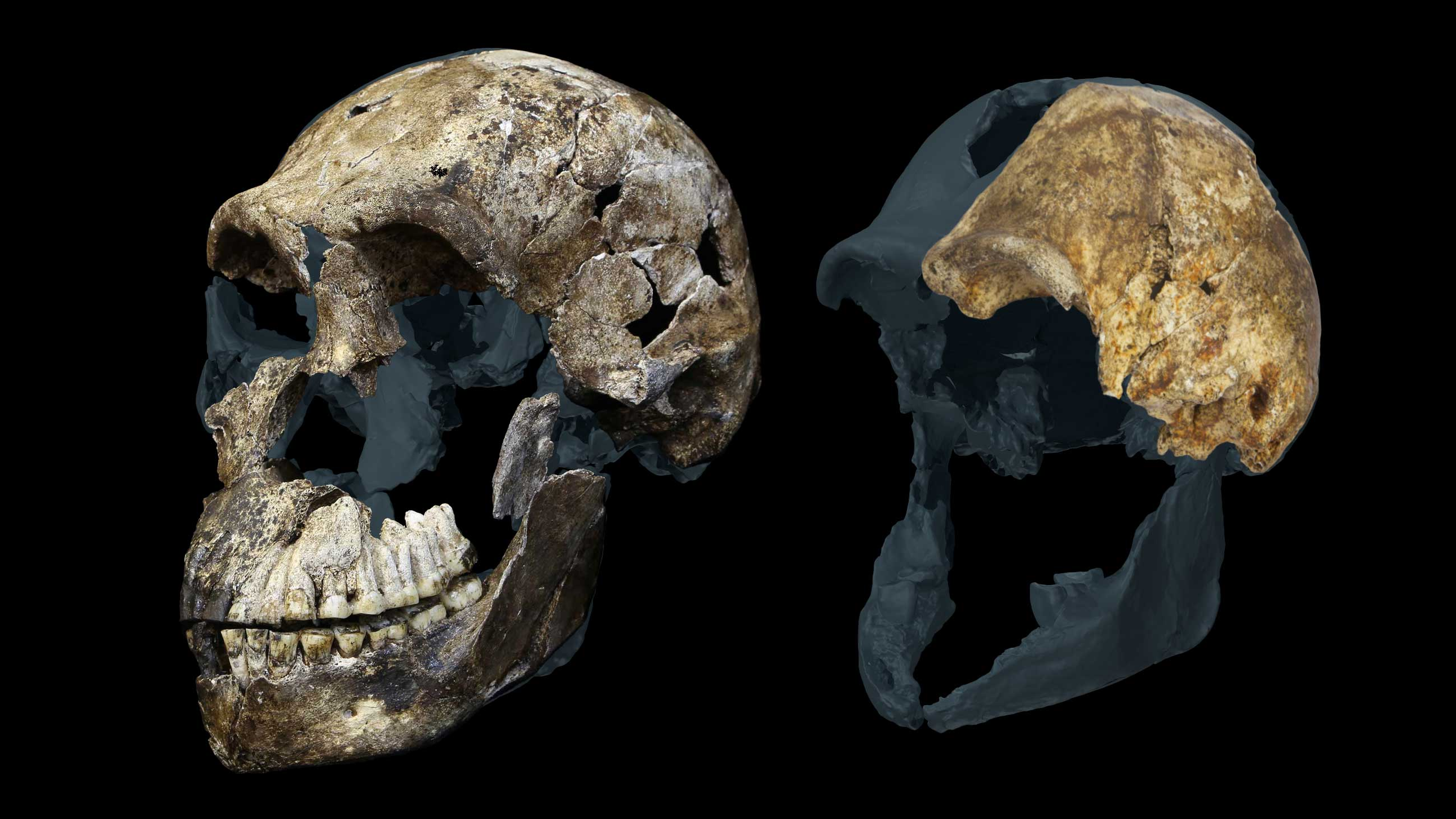
The largest (left) and the smallest (right) skulls of Homo naledi found in the Rising Star cave system in South Africa. All specimens of H. naledi have been shown to be female.

(Image credit: Rising Star Program)

Homo naledi surprised scientists once again this week. Found in a South African cave in 2013, the small-brained, two-legged relative to modern humans is thought to have lived around 300,000 years ago. Since its initial discovery, the enigmatic hominin has shocked scientists with a string of baffling revelations. In 2023, researchers found evidence that H. naledi may have used fire in the cave. This early hominin may also have buried its dead. Now, archaeologists have analyzed genetic material in the enamel of nearly two dozen skeletons at the site and found that they are all female.

“The bottom line is this is a weird result from an already weird hominin,” Elizabeth Sawchuk, curator of human evolution at the Cleveland Museum of Natural History, who was not involved in the study, told Live Science in an email.

Get the world’s most fascinating discoveries delivered straight to your inbox.

Discover more archaeology news

—Hanging lamp in the form of a sandaled right foot: A 1,600-year-old bronze lamp with multilayered Christian symbolism

—Early Homo sapiens may have lived in rainforests, new clues suggest — and it could overturn our understanding of human evolution

—Some of the last surviving Neanderthals were remarkably diverse ‪—‬ suggesting inbreeding didn’t doom them

Life’s Little Mysteries

A group of people walking through a forested tunnel

The remarkably straight Stane Street in southern England was built by the Romans.

(Image credit: Tim Stocker Photography via Getty Images)

The Romans are known for their transport systems that enabled travel and trade across their enormous empire. Many of these centuries-old streets had a reputation for being extremely straight. Nowadays, building straight roads requires advanced surveying using GPS networks and lasers, as well as careful engineering to flatten the terrain. So how did the Romans do it about 2,000 years before these things were invented?

—If you enjoyed this, sign up for our Life’s Little Mysteries newsletter

Water might be 2 liquids

A series of ball-and-stick shaped transparent molecules against a blue background

An illustration of a water molecule. New research adds credence to a controversial theory that water actually switches between two chemical structures.

(Image credit: Yaroslav Kushta via Getty Images)

Most of us discount water as the most basic of beverages, but if you look at it at a molecular level, water is actually rather exciting. Think about it: While most liquids are denser in their solid form, water ice floats. That’s weird. Water also resists temperature changes better than similar liquids do, and its viscosity decreases under certain pressures.

Some scientists have hypothesized that these weird behaviors come about because water consists of not one, but two liquids ‪—‬ a dense one and a less-dense one that constantly switch places. Now, with the help of AI, we have proof of this weirdness.

Discover more weird news

—We’ve spent decades looking for the wrong type of alien radio signals, new paper claims — and there’s an easy way to fix it

—‘Weirdos of the sperm whale world’ appear to be evolving 2 different dialects, audio recordings suggest

—China’s Einstein Probe detected a mysterious cosmic explosion — and scientists have no idea what caused it

Also in science news this week

—The US just approved bemotrizinol, a sunscreen ingredient long used in Asia and Europe. Here’s how it works.

—‘You can’t patch your way out of it’: Cheap AI worm can spread between devices without human guidance — but how did scientists create it?

—Water shortages could prevent the US from mining more lithium, deepening reliance on foreign imports

—Diagnostic dilemma: After taking a medicine for years, a man suddenly had weird changes in his taste that made food disgusting

Science Spotlight

An illustration showing Chinese politicians and scientists around a glass container filled with dams, clouds, hills and water

People in China’s northern megacities have 74 times less fresh water than the average American — so the Chinese government has built the world’s largest water diversion project.

(Image credit: Xinmei Liu for Live Science)

People in China‘s northern megacities have 74 times less fresh water availability than the average American. But China boasts some of the largest rivers in Asia that flow farther south, along with massive water reserves in glaciers in the west. To address this imbalance, the Chinese government has built the world’s largest water diversion project, ferrying water from the Yangtze River in the country’s center and south over thousands of miles through a complex system of canals, pipes, dams, reservoirs and pumps.

And yet, this is still not enough to satisfy the water needs of the country’s thirsty North. Now, China is expanding these routes and planning a third, western route for the project, which will be the most dangerous and ambitious route yet.

Beyond diverting the country’s rivers, China is also building the world’s largest dam in an earthquake-prone region in Tibet and has invested heavily in creating a permanent “sky river” to help solve the country’s water crisis.

Something for the weekend

If you’re looking for things to keep you busy over the weekend, here are some of the best news analyses, crosswords, interviews, opinion pieces and quizzes published this week.

—9 of the best technology conspiracy theories [Countdown]

— AI companies don’t want to be legally responsible for their chatbots. US courts should make them. [Opinion]

—Live Science crossword puzzle #49: ‘Short’ tempered French emperor — 13 across [Crossword]

— Ancient empires quiz: Can you match these lands to the historical powers that ruled them? [Quiz]

—60 million stars: Euclid space telescope snaps the most detailed photo of the Milky Way ever taken [Skywatching]

Science in pictures

A heatmap of the Earth showing sea surface heights with red areas around the equator.

A wave of warm water and higher-than-usual sea surfaces (red) stretches across the Pacific, a few days before El Niño was declared.

(Image credit: Data for the map were acquired by the Sentinel-6 Michael Freilich satellite and processed by scientists at NASA’s Jet Propulsion Laboratory (JPL).NASA Earth Observatory/Lauren Dauphin)

New satellite imagery shows a wave of warm water stretching across the Pacific Ocean in a dramatic illustration of the newly declared El Niño. The image shows a red wave as it streaks across the equator and piles up around the west coast of South America.

Ocean patterns like this are known as Kelvin waves. They occur when winds in the Pacific Ocean near the equator temporarily reverse and blow from west to east. This enables warm water to gradually build up in the east,preventing cold waters from rising below.

The wave was spotted by NASA’s Sentinel-6 Michael Freilich satellite, which measures ocean temperatures through radar scans of changes in sea surface height, caused by heat’s expansionary effects upon water. The satellite has already observed several other Kelvin waves this year in anticipation of El Niño.

Follow Live Science on social media

Want more science news? Follow our Live Science WhatsApp Channel for the latest discoveries as they happen. It’s the best way to get our expert reporting on the go, but if you don’t use WhatsApp we’re also on Facebook, X (formerly Twitter), Flipboard, Instagram, TikTok, Bluesky and LinkedIn.

TOPICS


Science news this week


Share. Facebook Twitter Pinterest LinkedIn Tumblr Email
Previous ArticleThe 37 Best Outdoor Deals From the REI 4th of July Sale
Next Article US strikes Iranian missile, drone, radar sites
primereports
  • Website

Related Posts

Science

How big a cybersecurity threat are the latest AI models, really?

June 26, 2026
Science

FDA-approved drug may finally help immunotherapy defeat rare liver cancer

June 26, 2026
Science

NASA is paying $30 million for a 1st-of-its-kind rescue mission to save its aging Swift telescope from falling from space Here’s why

June 26, 2026
Add A Comment
Leave A Reply Cancel Reply

Top Posts

Paxton’s win over Cornyn sets up high-stakes Texas clash with Talarico

May 28, 202616 Views

Global Resources Outlook 2024 | UNEP

December 6, 202510 Views

Texas Democrat Talarico claims voting laws are rigged ahead of Paxton race

May 28, 20269 Views
Stay In Touch
  • Facebook
  • YouTube
  • TikTok
  • WhatsApp
  • Twitter
  • Instagram
Latest Reviews

Subscribe to Updates

Get the latest tech news from FooBar about tech, design and biz.

PrimeReports.org
Independent global news, analysis & insights.

PrimeReports.org brings you in-depth coverage of geopolitics, markets, technology and risk – with context that helps you understand what really matters.

Editorially independent · Opinions are those of the authors and not investment advice.
Facebook X (Twitter) LinkedIn YouTube
Key Sections
  • World
  • Geopolitics
  • Popular Now
  • Artificial Intelligence
  • Cybersecurity
  • Crypto
All Categories
  • Artificial Intelligence
  • Climate Risks
  • Crypto
  • Cybersecurity
  • Defense
  • Economy
  • Geopolitics
  • Global Markets
  • Healthcare Innovation
  • Politics
  • Popular Now
  • Science
  • Technology
  • World
  • About Us
  • Contact Us
  • Privacy Policy
  • Terms & Conditions
  • Disclaimer
  • Cookie Policy
  • DMCA / Copyright Notice
  • Editorial Policy

Sign up for Prime Reports Briefing – essential stories and analysis in your inbox.

By subscribing you agree to our Privacy Policy. You can opt out anytime.
Latest Stories
  • Fleet of Vespas swarms Rome’s historic center to mark 80 years of the iconic scooter
  • Wall Street’s Next Tokenization Test: BlackRock-Backed Securitize’s Market Debut
  • AI Decline? Confidence Falls in Autonomous Penetration Testing
© 2026 PrimeReports.org. All rights reserved.
Privacy Terms Contact

Type above and press Enter to search. Press Esc to cancel.