

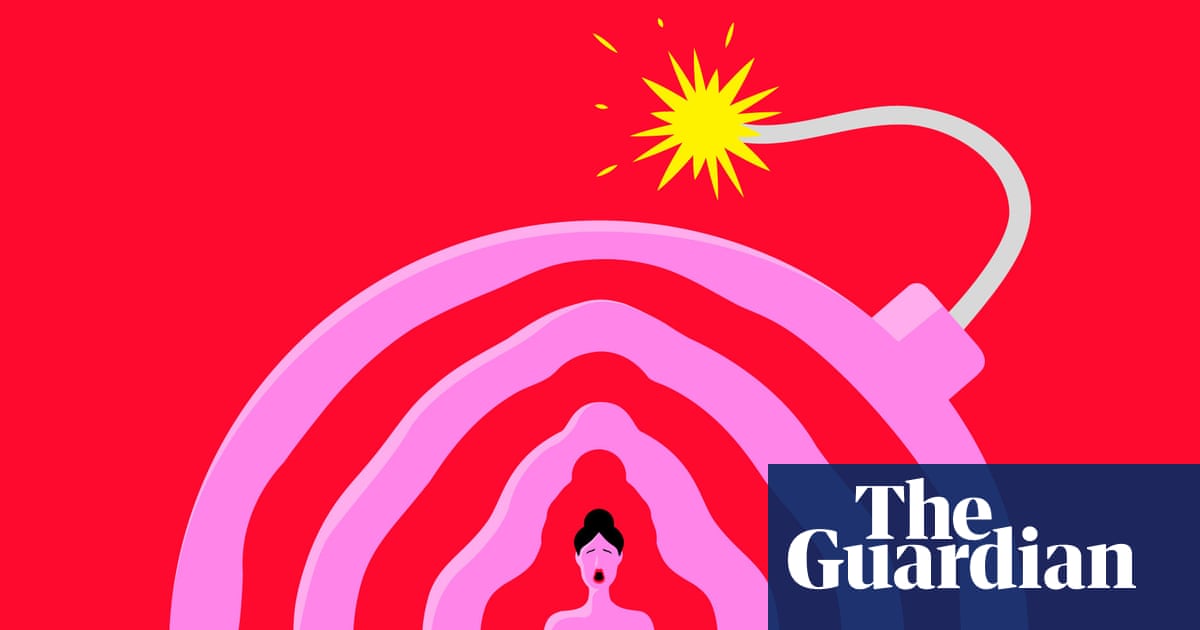
According to my Instagram feed, I am not doing enough. Not spending enough, not saying enough, not taking enough care. I feel more sure of this than anything. And it’s bringing out an irrationality I’m not proud of: one afternoon, in between screengrabs of masked men snatching civilians from their homes, videos of wellness influencers evangelising “anti-trauma” hip stretches, and carousels of political action items disguised as catchy memes, I am served a targeted ad for a “Don’t Talk to Me About AI or I’ll Kill Myself” crochet pattern; and even though I have never crocheted anything in my life, I find myself looking up the materials to get started … on Etsy to avoid supporting any big, Maga-oriented corporations.
It’s overwhelming, this general pressure, palpable not only on social media but throughout the larger culture: today’s most urgent issues, from technological end times to tight hips, can only be solved by squeezing as much into the day as humanly possible.
Balancing political engagement with mental peace is one of my generation’s biggest and most abstract challenges, but according to psychology research, the “more is more” approach may not be the most effective. And yet, studies have found that when presented with a problem – or many, all at once – the human mind naturally gravitates towards solving it by adding elements to the mix, rather than taking existing ones away. For example, to assuage burnout, most people would add an hour-long meditation class to their calendar before removing a stressful, low-priority commitment. They’d buy an expensive sleep supplement to improve their rest before deciding to cut down on after-hours computer time. To prevent food waste, they’d look up a complicated TikTok recipe for leftover produce, as opposed to resisting the impulse to overbuy perishables.
This tendency towards doing the most is called “additive bias”. Those of us living in highly consumerist societies, especially social media users who are encouraged to compare their lives to others’ online, may be even more vulnerable to this mindset, which, ironically, can weaken problem-solving skills.
According to a report by Diana Kwon for Scientific American, people generally find fault with subtractive solutions far more readily than they do with additive ones. When presented with a problem, our penchant for loading up on “more resources, more rules, more habits and responsibilities”, as opposed to evaluating the options with more balance, can stall or even worsen the very issues we’re trying to fix. Studies show that if problem solvers are under a “heightened cognitive load”, as when they have a lot on their mind (healthy dinner prep, work deadlines, global war crimes), the effect becomes even more extreme.
A collection of 2025 studies published in Communications Psychology looked at additive versus subtractive treatments for mental health struggles and found that participants consistently recommended additive solutions, like meditating and exercising, more than subtractive ones (eg quitting smoking and limiting alcohol). They also rated additive solutions as more “feasible and effective”, even when the measurably easier and more efficient fix came from the opposite approach. The researchers determined that people tend to get more additive as they age. Even ChatGPT advice is biased towards additive solutions, which it recommends quickly and confidently, even when they don’t best serve the user. Furthermore, participants were more likely to accept additive mental health advice for themselves and recommend it to strangers; the only people to whom participants naturally suggested subtractive advice were close friends.
“This bias has the potential to create a social context in which we are advising one another to always do more,” the studies’ authors concluded. “In a world where we already feel like we are time poor and doing too much, there is a sense that we must do yet more to cope with the sadnesses and anxieties of life … potentially leaving us more overwhelmed.”
One of the study’s lead authors, Dr Tom Barry from the department of psychology at the University of Bath, concluded that while people do recognise the value in removing harmful or unnecessary elements from their lives, it’s not what their instincts tell them to do. “While well-meaning, [this] can unintentionally make mental health feel like an endless list of chores,” he said. “Good advice should balance doing more with doing less.”
In a way, this sentiment can apply to political action, too. How might I have better spent the time and money I dedicated to an anti-AI crochet kit I’ll never use, if I had simply stepped back and assessed my options more deliberately? How can we use what we know about subtractive solutions to serve our values better? What advice would I give to a close friend?
While writing my book The Age of Magical Overthinking, I spoke to therapist Linda Sanderville, about how to tap into the philosophy of “radical imagination” – how to cultivate a vision for a more equitable future during the fast-paced and often pessimistic-seeming digital age. Sanderville naturally offered a subtractive approach. She told me that she makes sure to free up periodic slices of time in which she does not consume any media – no internet, no television, no news.
“It’s hard to consume and create in the same state,” she explained. “If you value any kind of creativity, and I don’t just mean art, give your brain a break from consuming, because that gives you space to process all that you’ve been [learning].” We have to afford ourselves this space consciously, said Sanderville, because, after all, our instincts guide us towards consumption, not away from it. “Ask how you can figure out a way to be grinding less so that you can be more creative, more influential,” she said. “How can you spend your energy on the things that deeply matter to you?”
Amanda Montell is author of The Age of Magical Overthinking: Notes on Modern Irrationality (Atria).
Further reading
Do Nothing: How to Break Away from Overworking, Overdoing, and Underliving by Celeste Headlee (Piatkus, £12.99)
The Anti-Burnout Book: How to Avoid Burnout and Your Recovery Toolkit If You Do by Emma Hepburn (Greenfinch, £10.99)
The Beginning Comes After the End: Notes on a World of Change by Rebecca Solnit (Granta, £14.99)
