

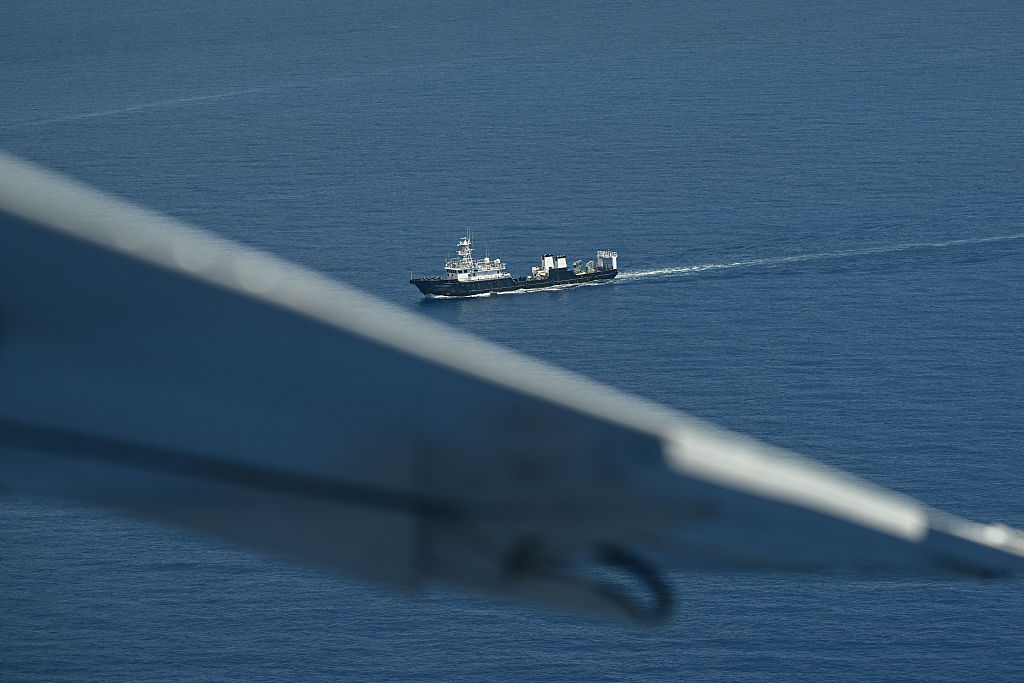
In the South China Sea, China is expanding its presence in disputed waters and adopting increasingly dangerous tactics against neighbouring states.
At the same time, it is challenging the centrality of the United Nations Convention on the Law of the Sea (UNCLOS) as the foundation of global order at sea, a decade after an arbitral tribunal rejected Beijing’s sweeping maritime claims.
And it is doing so at a time when international attention has been diverted by crises in Europe, the Middle East and the Western Hemisphere.
A recent clash between the China Coast Guard and the Philippine Navy near the Second Thomas Shoal, a reef in the South China Sea, prompted each government to summon the other’s ambassador. The incident was only one manifestation of a broader trend.
China’s activities in critical contested areas of the South China Sea have accelerated over the past year. At the annual South China Sea Conference hosted by the Center for Strategic and International Studies in Washington this month, two trends stood out.
First, the Asia Maritime Transparency Initiative reports the most significant changes in China’s activities in a decade. China has resumed major artificial island-building, including construction of one of its largest new features in years. It has faced little international pressure to halt these activities.
Alongside this construction has come an expansion of administrative measures, including increased research activity and the establishment of a new marine protected area around Scarborough Shoal. Marine conservation is a global public good, but in practice, these initiatives risk being weaponised through a form of strategic greenwashing: using environmental protection and administrative zoning to strengthen control and claims over contested maritime space. The 2016 arbitral tribunal ruling concluded that China itself had violated its UNCLOS obligations to protect the marine environment through its island-building in the South China Sea.
Second, China’s operational presence around Scarborough Shoal has increased dramatically. The Asia Maritime Transparency Initiative reports that Chinese patrols and maritime assets have doubled over the past year and more than tripled over the past two years. This means Philippine fishers are blocked from fishing in areas where they previously and legally operated. In the West Philippine Sea, the Philippines remains at the coalface of maritime grey-zone coercion, often receiving inconsistent backing from the wider international community.
Beijing’s strategy, however, is not confined to what happens on water. Rather, it increasingly appears intent on reshaping the legal and institutional framework through which maritime disputes are resolved and managed.
The China Institute for Marine Affairs acknowledged its own 30th anniversary of UNCLOS accession in its new assessment report on the convention. While positioning UNCLOS as a cornerstone of the international legal order, the report argues that the convention ‘neither covers all law-of-the-sea issues nor stands as the sole source of the law of the sea’.
For many of the smaller and middle powers across the Indo-Pacific region that played an instrumental role in negotiating UNCLOS, the convention has been regarded as a ‘constitution for the oceans’: the principal framework governing the world’s seas. China’s report instead presents UNCLOS as only one pillar of ocean governance among several possible legal arrangements.
This potentially opens the door to a more fragmented maritime order. Rather than strengthening existing institutions, Beijing may be interested in developing parallel mechanisms that could prove more accommodating to its preferences.
One example is the new International Organization for Mediation headquartered in Hong Kong. It claimed success earlier this year in resolving a maritime charter dispute between parties from China and Singapore, and at least one China scholar has proposed that the organisation could play a role in managing or resolving maritime disputes in the South China Sea. Yet UNCLOS already contains arbitration and conciliation options for resolving maritime disputes. If these mechanisms already exist, it is reasonable to ask why an alternative might be needed.
Despite these trends, international attention is fading. A decade ago, the South China Sea dominated discussions of regional security. While the United States quickly condemned the latest ‘dangerous and aggressive’ actions at Second Thomas Shoal, there is a risk that the wider international community may begin to regard these confrontations as routine. The South China Sea now seems to barely register in Washington policy debates. The Trump administration is distracted by crises elsewhere that dilute focus on Asia. Yet unsafe and unprofessional encounters between Chinese forces and foreign military vessels and aircraft continue. Australia itself has experienced several dangerous near-misses in airspace over recent years.
China is not alone in testing the resilience of global order at sea. Other states have increasingly embraced exceptionalist approaches in places such as the Strait of Hormuz, normalising discussions of blockades, maritime tolls and the use of force to restrict navigation. Conflicts in the Middle East, Europe and the Western Hemisphere have also allowed Beijing to advance a narrative that East Asia is comparatively a region of peace and stability, which sits uneasily alongside its sustained use of coercive and grey-zone tactics against neighbouring countries.
As a major trading nation, Australia’s prosperity depends on open sea lanes governed by predictable rules. Australia’s own 8-million-square-kilometre exclusive economic zone exists by virtue of the ongoing legitimacy of the international law of the sea. Any erosion of the international legal architecture that protects the interests of maritime states would undermine Australia’s security and prosperity.
